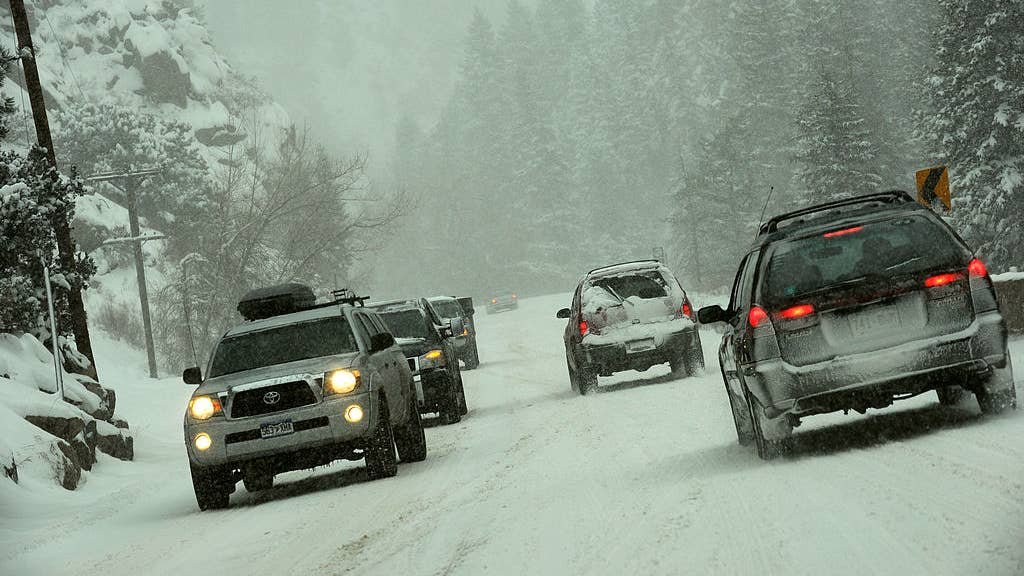
The late-season Pacific storm that hit Wyoming overnight has now expanded into Colorado. NWS Denver has issued a Winter Storm Warning for the high terrain of northern Colorado above 9,000 feet, with up to 18 inches of snow forecast for Rocky Mountain National Park and the Medicine Bow Range through 9 PM Monday. A separate Winter Weather Advisory covers the I-70 corridor and the major mountain passes south of the warning zone, where 4 to 12 inches is expected. NWS Denver explicitly notes that “the heaviest amounts occur in the mountains north of I-70.”
Where It’s Hitting in Colorado
|
Zone |
Highway / Pass |
Snow |
Through |
|
Rocky Mountain National Park, Medicine Bow Range |
Cameron Pass, Trail Ridge |
8-18″ |
9 PM Mon |
|
Mountains north of I-70: Indian Peaks, Mount Blue Sky |
Berthoud Pass, Winter Park |
4-12″ |
9 PM Mon |
|
Summit County mountains, Mosquito Range |
I-70, Eisenhower Tunnel, Breckenridge |
4-12″ |
9 PM Mon |
|
East Slopes Southern Gore, Williams Fork |
Kenosha Pass area |
4-12″ |
9 PM Mon |
Highest amounts are forecast on east-facing slopes. Valley locations in Summit County may see little if any accumulation while the mountains immediately above I-70 take the bulk.
What Drivers Need to Know Today
- I-70 westbound out of Denver is the storm’s main commuter route. Snow is expected to be heaviest late Monday morning into the afternoon, exactly when the Monday work week tries to start. NWS Denver warns the system “may impact the Monday morning and evening commutes.”
- Checkcotrip.org before leaving. CDOT activates traction laws and passenger vehicle restrictions on I-70 quickly in these conditions. Chain laws frequently follow.
- Wyoming drivers should checkwyoroad.info or dial 511. I-80 across southern Wyoming remains under high-profile vehicle restrictions in segments. WYDOT broadcasts closures on AM 1610.
- Tire choice matters more than vehicle choice above 9,000 feet. Three-Peak Mountain Snowflake (3PMSF) tires are the industry standard for high-elevation snow. Our guides on best practices for driving in snow, ice, and rain and the best cars and SUVs for snow and winter driving cover the trade-offs.
- Cold-soak tire pressure drop is real. A vehicle leaving Denver at 60°F can sit 4 to 6 PSI light at the Eisenhower Tunnel at 11,158 feet. Check pressures before you climb.
AccuWeather Expert Meteorologist Adam Douty noted earlier this weekend that this system “will focus more on the higher elevations of Colorado and will also track farther north than the storm earlier this month,” which is exactly why Rocky Mountain National Park and the Front Range mountains are now in the bullseye after Wyoming bore the brunt overnight. The storm clears the West by Wednesday.