A tech-world documentary may seem an unlikely candidate for one of those movies people claim simply must be experienced in a theater. You Can See Everything makes a strong case all the same. There are moments in Nathan Fielder and Lance Oppenheim’s beguiling profile of the disgraced Theranos CEO Elizabeth Holmes that inspire gasps, convulsive laughter, and involuntary hand gestures. One such moment was especially resonant in my theater, though. (And be warned: There are very mild spoilers ahead.)
To put it as vaguely as possible, the moment involves Fielder attempting to pin down Holmes about her history of dishonesty. (As the trailer suggests, there’s a lot of that going on throughout the entire, plus-size runtime.) In this particular instance, Holmes says something so hard to believe, it can only be taken with a Texas-sized grain of salt. Since Fielder is a master of deadpan who has made a career out of soft-spoken understatement, his naked astonishment registers as volcanic: “Liz, what?!”
It’s a very funny moment, but it’s more than that. There’s something cathartic at play, too. A decade into the post-truth era, as powerful people stand 10-toes-down on flagrantly false narratives, it’s the kind of deeply human reaction to dishonesty many Americans have been craving. In his rejection of the line he’s being asked to swallow, Fielder jars viewers out of whatever boiled-frog comfort we may have found in a timeline riddled with unreality, forcing us to see it with fresh eyes.
The post-truth era meets the AI era
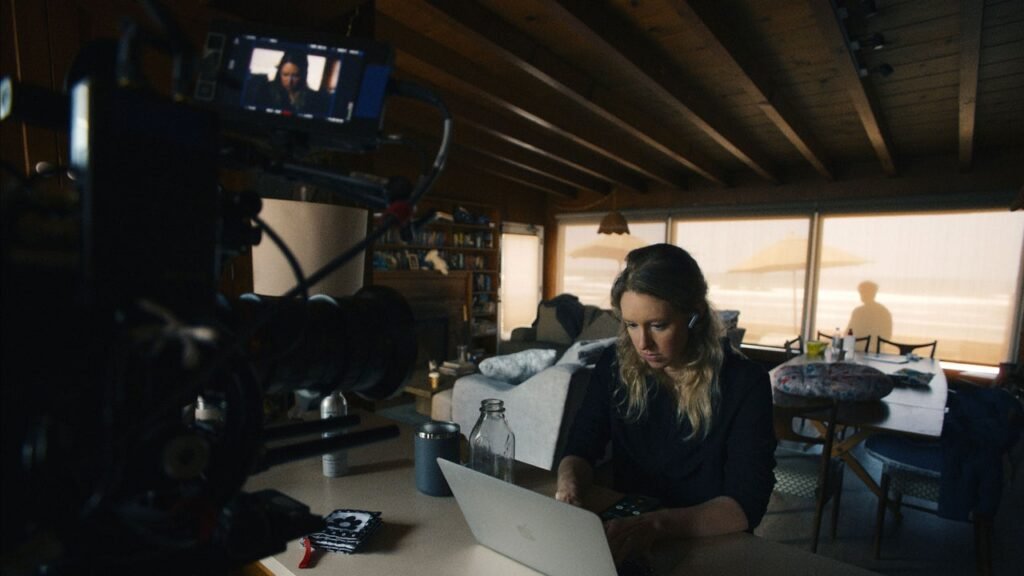
You Can See Everything finds Holmes and her husband, Billy Evans, having invited Fielder to observe and interview the Theranos founder in 2023, during the days leading up to her 11-year prison sentence for defrauding investors. Fielder is a canny but bold choice for this mission, as he is a comedian best known for making one TV show about business scams (Nathan For You) and another about his endless fascination with authenticity (The Rehearsal). It’s never explicitly stated how this arrangement came about, but theories abound online.
For his part, Fielder does not seem to view the project as an opportunity to determine whether Holmes was dishonest while leading Theranos. (We’re well past that, as anyone who’s read John Carreyrou’s explosive exposé, Bad Blood, which Fielder has, can vouch.) Instead, his movie suggests that some dishonest people are simply sociopathic, while others are less connected to reality on a neurochemical level, and others still might be somehow both, with Fielder hoping to assign a definitive category to Holmes. His dogged refusal to accept Holmes and Evans’s framing is a clarifying encapsulation of what it’s been like to read the news on any given day in recent years.
Although the rise of partisan media outlets and Twitter echo chambers had been fracturing public belief systems long before 2016, Trump’s election is what thrust us into the post-truth era. Every president lies, but the breadth and scale of Trump’s lies was previously been unheard of in American politics. By making false claims about eminently observable reality, Trump revealed that lies don’t carry consequences if enough powerful people are willing to ignore them. His emergence as the leader and mascot of the United States announced that being factually accurate was no longer as important as simply appearing supremely convinced of one’s own veracity.
This performance of total confidence—as in the “con” in “con man” or “con woman”—has now become standard in just about all forms of mass communication, from wellness influencers with a questionable grasp on nootropics to reality show contestants who definitely aren’t there to develop a personal brand. The just-trust-me shtick seems especially prevalent in today’s tech world, though, which often rewards people for confidently describing an AI future that does not yet exist.
Tech executives now increasingly make eye-roll-worthy claims in a few distinct categories. There’s the “inevitability” boast, which suggests AI is unleashing its world-changing power on the labor market whether anyone likes it or not, so everyone might as well get on board anyway. (As if stringent third-party guardrails would somehow violate the laws of nature.) There are the claims of urgency, with CEOs citing some historic threshold like the supposed arrival of Artificial General Intelligence, which their tech has conveniently just crossed. (Altman recently claimed we’re in the singularity.) Finally, there are the testimonials about the magnitude of change to come, which will apparently be so transformative that humans will require a universal basic income to live.
Unfortunately, when tech executives publicly make these outrageous assertions—which just happen to present their products in a flatteringly powerful light—they are seldom, if ever, confronted by someone with Fielder-like skepticism, tenacity, and a lack of fu*ks to give.
‘Your questions are designed to trick me’
Pop culture falsely prepared us all to expect grand and timely comeuppances. In the world of movies, obvious liars in high places are always destined to get caught on a hot mic bragging about their deceptions, only to be run out of town on a rail or thrown into a prison cell.
Holmes’s fall from grace, however, is an exceedingly rare exception to the Trumpian rule that one may impose their perception of reality on the world if enough boldface names allow it. Perhaps it’s the power that comes with so much of the U.S. economy being entangled in AI that allows the field’s leaders to make extraordinary claims with insufficient pushback.
For instance, there doesn’t seem to be nearly enough scrutiny of all the recent doomsday messaging. Anthropic’s CEO, Dario Amodei, recently said there was a 25% chance the future would go “really, really badly” due to AI, while OpenAI’s Sam Altman comparatively hedged at 10%. In both cases, the CEOs avoid getting into the weeds of how they arrived at these figures or explaining how AI Armageddon might actually unfold. We’re to take them at their word.
Pushing back on those worst-case scenarios, Nvidia’s CEO, Jensen Huang, went the opposite route. During a July interview, he called the idea that AI would destroy half of American jobs “complete nonsense.” He did not, however, provide any data-driven economic evidence that AI is unlikely to spark staggering job losses, relying instead on good old industry optimism.
And then there’s SpaceX CEO and fellow recent documentary subject Elon Musk. He presents himself as the visionary steward of a utopian future that consistently fails to materialize by any announced deadlines. Despite how often he is loudly proven wrong, though, none of his false interpretations of reality, to put it generously, ever seem to produce any satisfying consequences.
Even when Musk appeared in court back in April for his case against Sam Altman (Musk was an early cofounder of OpenAI), he refused to accept questions that exposed his previous lies. The judge had to intervene several times as Musk avoided straightforward answers and painted lines of inquiry as unfair, at one point concluding, “Your questions are designed to trick me.”
In the minds of all empirically correct masters of the universe, the truth is whatever it needs to be, and anyone unwilling to accept it as such must be the enemy. Without giving too much away, this kind of attitude can be detected in certain parts of You Can See Everything.
The utter exhaustion of being asked to believe certain things
The most effective deception doesn’t always ask people to believe a lie; sometimes, it just requires them to stop believing there’s a definitive truth that can even be known. This is the world we live in, and the one in which You Can See Everything unfolds. It’s filled with people who are apathetic, cynical, confused, and utterly exhausted.
Fielder embodies that last trait most of all, his unbelieving eyes telegraphing how tiring it is to be sold a bill of goods all the time. He’s the ideal avatar of anyone who thinks that with the right set of questions they would trick Musk into admitting, despite past denials, he was indeed aware during Trump’s inauguration that the gesture he was making strongly resembled a Nazi salute.
But you can’t compel someone to concede anything they’re determined not to admit, just because logic and the facts are on your side.
You Can See Everything doesn’t chisel a full confession out of Holmes, but it does accomplish the next best thing. Fielder’s “Liz, what?!” moment offers viewers the vicarious thrill of telling a famously dishonest person that even their performance of honesty is impossible to believe.