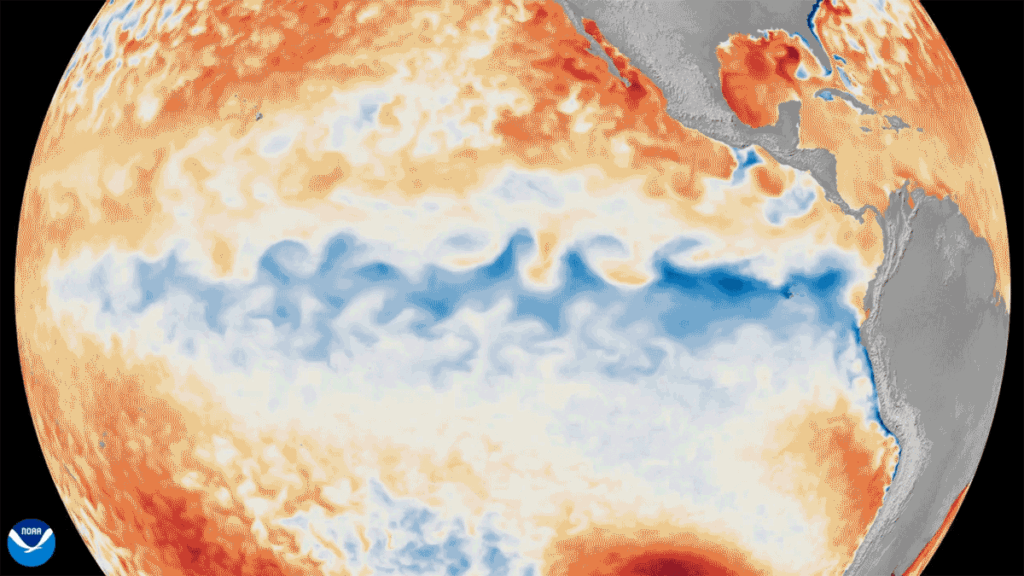
Brace for a stretch of potentially wet and wild weather: Forecasters at the National Oceanic and Atmospheric Administration’s Climate Prediction Center issued an advisory on Thursday stating that the current El Niño event could prove to be one of the strongest in recent history.
The new forecast says that the current El Niño “has strengthened over the past month,” and as a result, it is expected to “intensify through 2026,” and is likely to “continue through early 2027.”
“There is an 81% chance of a very strong El Niño during October-December that would rank among the largest El Niño events in the historical record going back to 1950,” the forecast reads. “Even the strongest El Niño events do not lead to the typical impact everywhere, but stronger events can more significantly tilt the odds in favor of expected outcomes.”
In simple terms, El Niño (and its counterpart, La Niña) are phases of ocean cooling and warming in parts of the Pacific Ocean, which can have an effect on wind and rain patterns, and seasonal weather effects in different parts of the world. Specifically, El Niño events refer to a warming of the ocean’s surface in the central and eastern Pacific, and they occur frequently—roughly once every several years.
As for what it all means? While El Niño events affect weather patterns around the world, it’s difficult to say what, exactly, they could lead to in a particular area.
But there are some predictions: Potentially, it could mean fewer hurricanes in places like Florida, as wind pattern changes have the potential to sap hurricanes from growing too strong. But it could also mean more severe and stronger weather systems during the winter months, and also relatively warm temperatures in the northern parts of the U.S. Generally, too, it could lead to more storms in parts of the South, with more precipitation in the form of both rain and snow, leading to potential flooding.
While it’s a bit of a crapshoot in terms of what exactly could happen in regard to a particularly strong El Niño—the strongest on record, going back to 1950, occurred during the early 1980s—it could end up hurting the economy. A 2023 study found that El Niño events can cost the global economy trillions—for example, the 1997-1998 event led to losses of $5.7 trillion.
Those sorts of losses have people around the world closely watching the models.
“The footprint of an El Niño travels far beyond its origins in the Pacific Ocean, impacting agriculture, energy supplies, trade, water resources, supply chains, and livelihoods across entire regions,” said Celeste Saulo, Secretary-General of the World Meteorological Organization, in a statement.