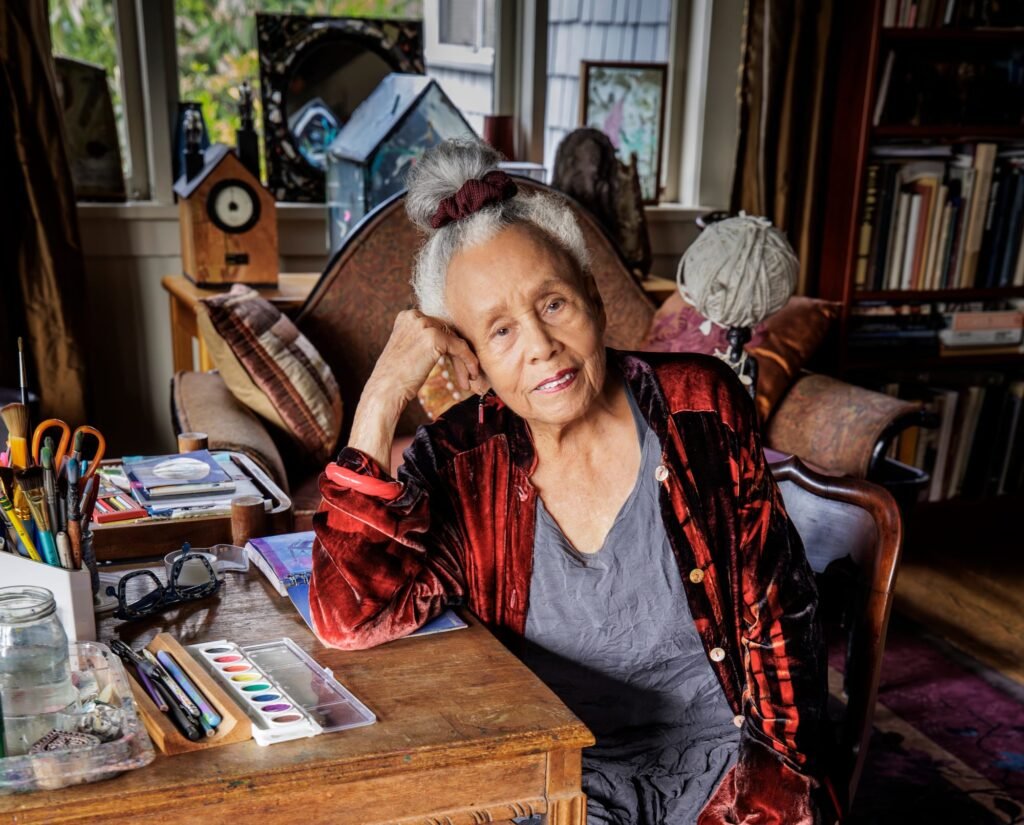
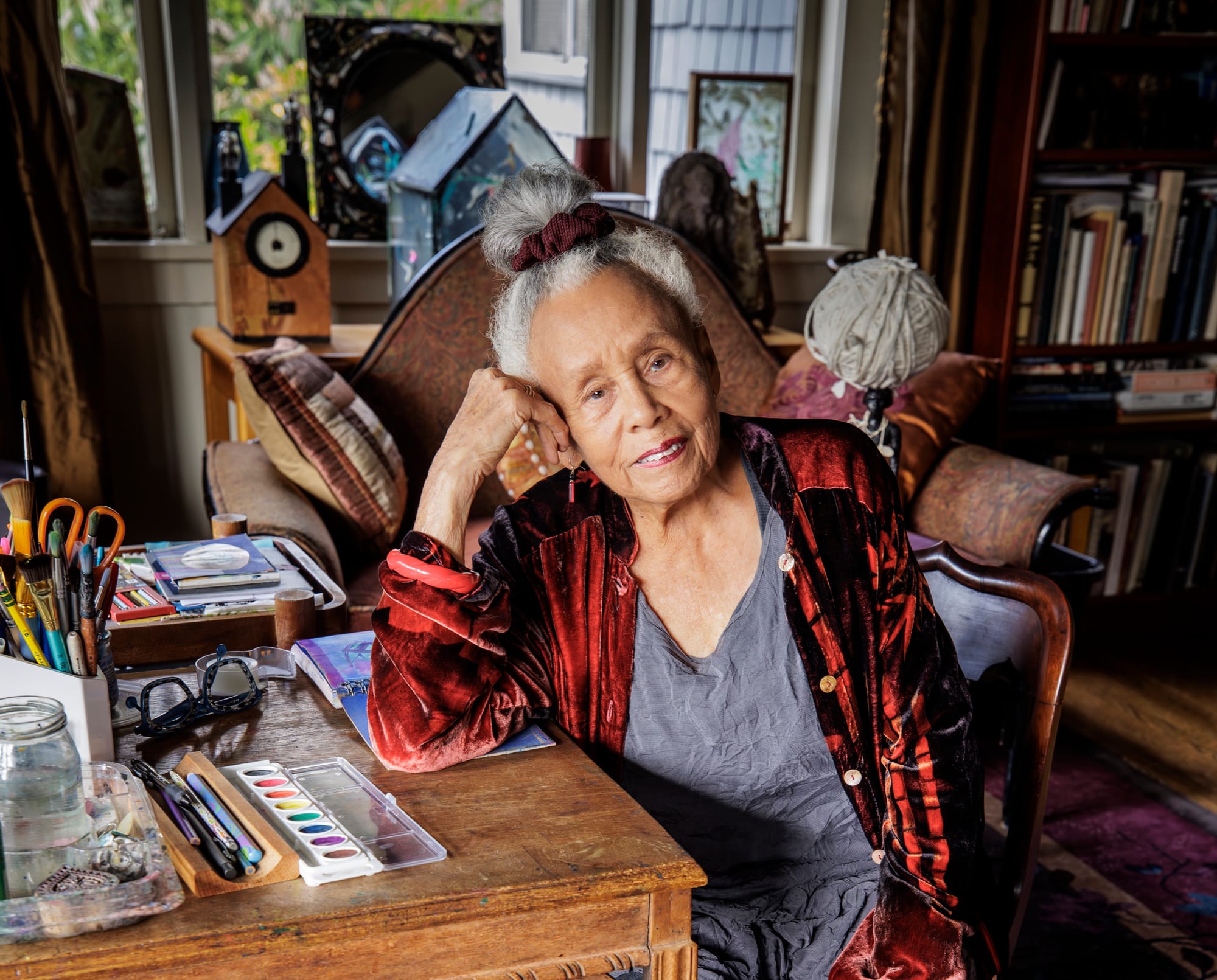
Betye Saar, who trawled the depraved archive of Americana and transmuted its most vile depictions of Blackness into conceptually freighted assemblages that are mystical, moving, and revolutionary, died at 99 in Los Angeles yesterday, July 26. Her death was confirmed by Roberts Projects, which represented her.
Over a seven-decade career, Saar hunted for and gathered objects with “an intangible energy, a previous life,” armed with an almost magical intuition she termed “mother-wit.” She incorporated these tchotchkes and treasures into prints, sculptures, and installations threaded through with her uncanny capacity to perceive and visualize the arc of history like no other.
“People would go to church after a Saturday lynching and they could never see the disconnection or connection,” she told Jasmine Weber in 2019. But Saar could. She drew upon her Black, Irish, and Native American heritage and familial history to make gripping and poignant effigies on grief. She harnessed time itself, whether via a ticking metronome, the deployment of astrological symbols, or the passage of skills and technologies learned from her mother and great-aunt to her three daughters, Tracye, Alison, and Lezley, who survive her.
Saar was born Betye Irene Brown in Los Angeles, California, in 1926 under the sign of Leo. She was a clairvoyant until the age of four, as she recalled in interviews. After her father died in 1931, she lost that ability, though her psychic sensibility remained. That year, Saar, along with her mother and two siblings, moved to the Watts neighborhood.
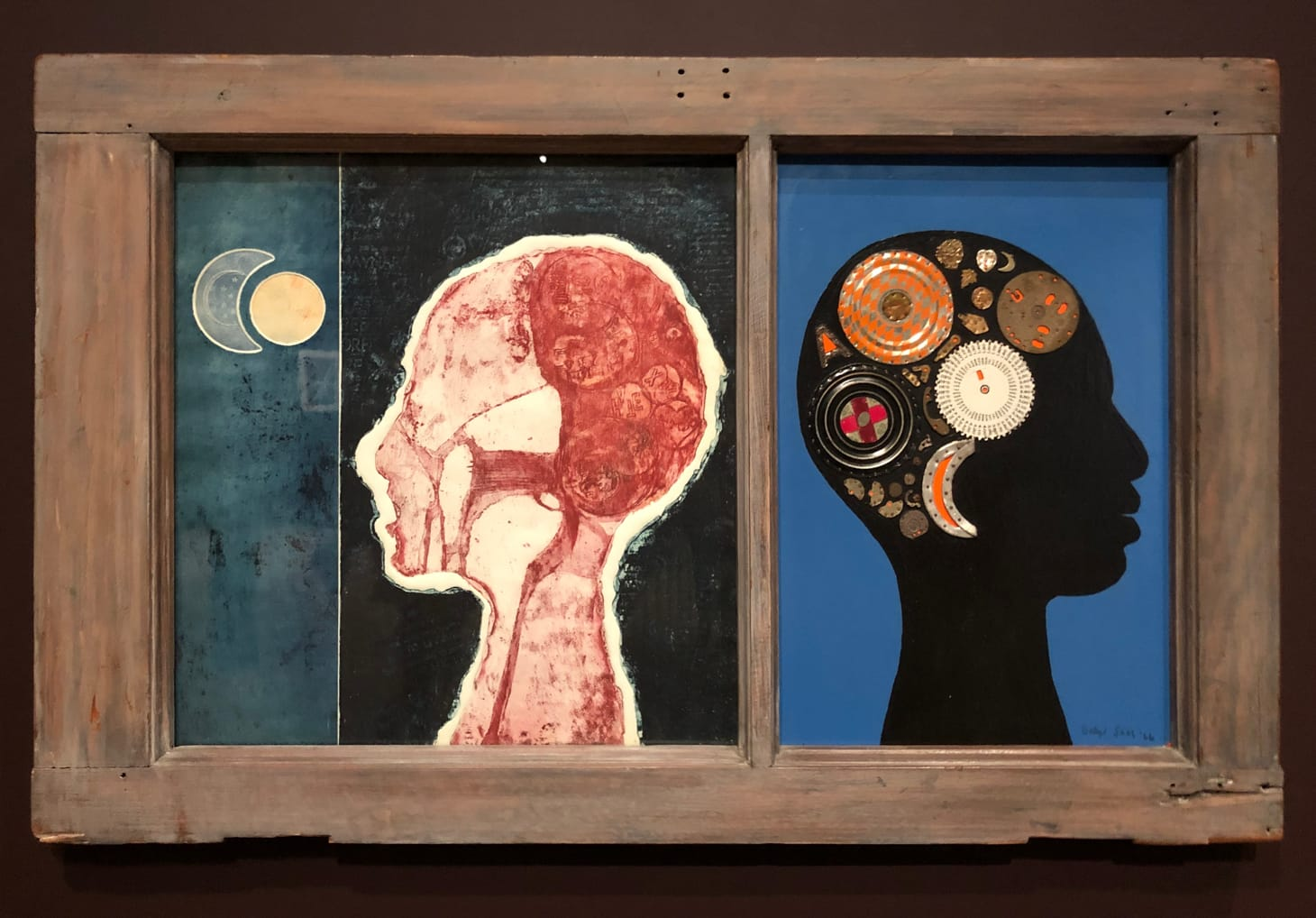
There, she would pass by artist Simon Rodia as he built the “Watts Towers” (1921–54), launching her lifelong project of collecting, repairing, and reviving found objects. “Making art out of nothing — the Watts Towers were where I learned how to be an artist,” she told Jonathan Griffin in 2016.
The women in Saar’s life were also a lasting influence. Her mother, a seamstress, was artistic in temperament and stoked that sensibility in her children. The family lived with her great-aunt Hattie Parson Keys; when she passed in 1975, Saar created works using photographs, lockets, letters, and other objects she inherited for decades afterward.
As art schools were segregated in the 1940s, Saar attended Pasadena City College and the University of California, Los Angeles, receiving her Bachelor of Arts in design from the latter in the late 1940s. She then worked as a social worker, created a greeting card line, and founded an enamel business, Brown and Tann, with designer Curtis Tann in the early 1950s, creating jewelry and accessories. She began making prints during graduate school at Cal State Long Beach, from which she graduated in 1962.
The 1960s saw a series of interlinked cataclysmic events that massively shifted the trajectory of Saar’s career. In the aftermath of the Watts Rebellion in 1965, Louis Smith and Robert Hall launched Shindana Toys to create nurturing and empowering images of Black children via dolls that looked like them, piquing Saar’s interest in collecting both positive and negative imagery of Black people and culture. Later, Dr. Martin Luther King Jr.’s assassination in 1968 catalyzed her to use those depictions in overtly political work.
In 1967, she attended an exhibition by sculptor Joseph Cornell at what was then called the Pasadena Art Museum, now the Norton Simon Museum. Stunned by his “jewel-like” works, wherein found objects are lovingly arranged into boxes, she was inspired to shift from printmaking to sculpture. “I had been working within a frame and then the frame became a window and the window became a box,” she told James Christen Steward.
Indeed, the frame became “Black Girl’s Window” (1969), perhaps her first great breakthrough. In the work, nine panels of a wooden window are filled with symbolic imagery: suns, moons, and lions; a photograph of her parents dancing; a picture of death at the center. Beneath that grid, a young girl presses her hands against the picture plane, as if yearning to break out of the frame.
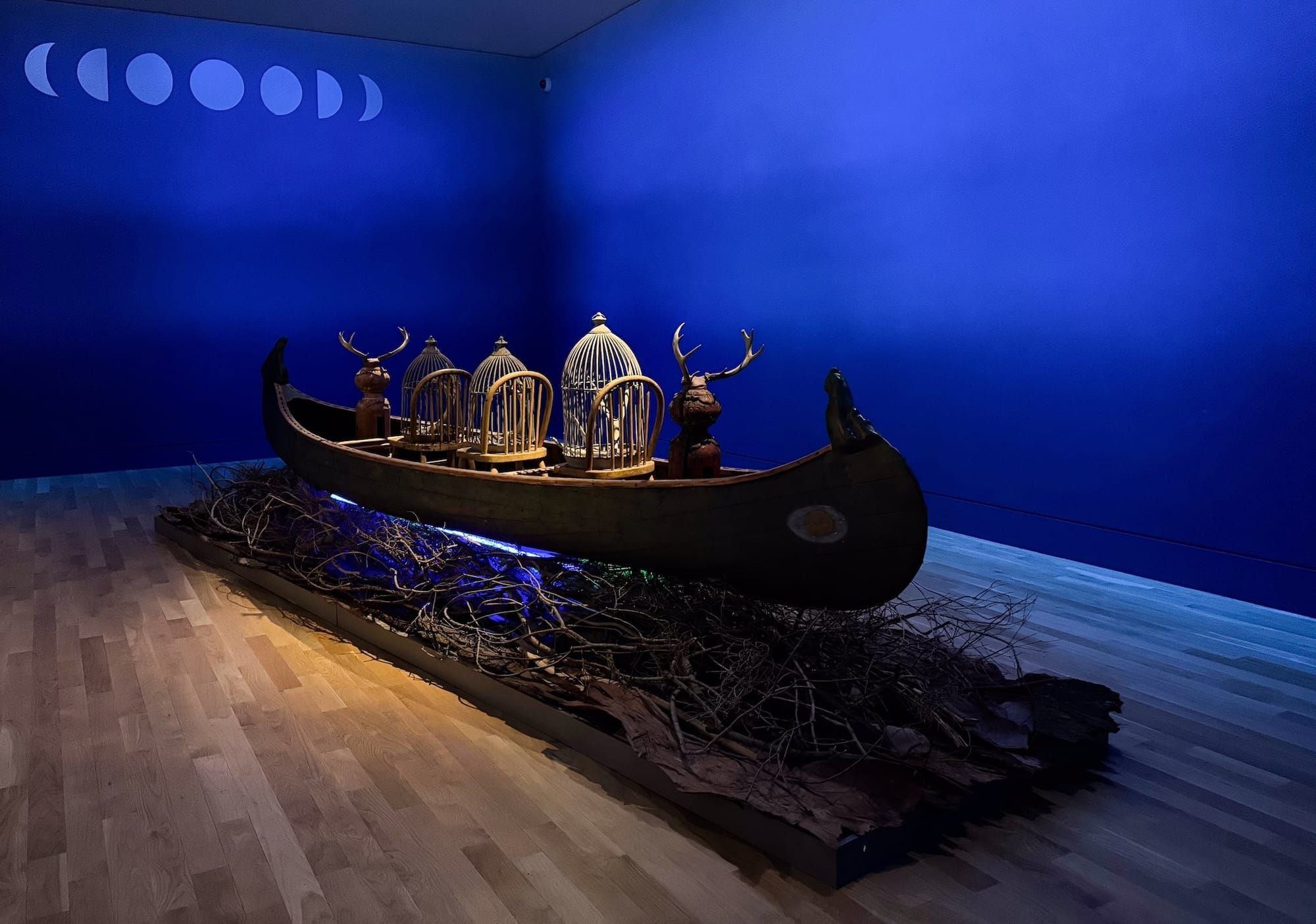
“This is an artwork that’s living,” Weber wrote of the work in 2019. “It has a soul in the most literal sense — each of Saar’s assemblages carries a bit of her. Many Black women, myself included, can see themselves in this work.”
In 1970, a visit to the Field Museum with David Hammons, specifically its collection of African and Oceanic objects, prompted Saar to begin her worldwide travels. The Vodou spiritualism of Haiti proved particularly influential. “I want to be in a place with living magic,” Saar told Carolina A. Miranda in an interview in the Los Angeles Times.
That magic came in the form of one of the most influential works of the 20th century — the work that launched the Black Women’s Movement, according to Angela Davis. Saar had, by this point, joined Judy Chicago’s feminist art collective, Womanspace, but found the predominantly White second-wave feminist movement limited, preferring to broaden her incisive vision. She debuted “The Liberation of Aunt Jemima” (1972) at Rainbow Sign community center, a Black cultural hub at the fringes of the Black Panthers’ territory in Oakland.
“It’s like they abolished slavery but they kept Black people in the kitchen as mammy jars,” Saar recalled to Miranda. She took them out of the kitchen, placing a found figurine of the racist caricature within a shadowbox and equipping her with a gun and hand grenade in an embodiment of protection and rebellion against white supremacy. “I decided to make a Black heroine,” she told Griffin.
The decades that followed saw a prolific explosion of works at-once philosophical, political, and conceptual. She referenced music, made self-portraits, silkscreens, and altars, and kept sketchbooks. During the COVID-19 lockdown, she began creating watercolors — a medium she hadn’t touched since childhood — of dolls she had begun collecting more than a half-century before. Earlier this year, the New York Historical opened an exhibition of Black dolls from her collection, a promised gift to the institution.
Time seemed less a line for Saar than a sandlot. “You could say I work with dead objects,” she told Griffin. “But my work is at the crossroads between death and rebirth. Discarded materials have been recycled, so they’re born anew, because the artist has the power to do that.”