India’s 2026 BRICS Presidency and the struggle to reshape global economic power.
What would happen if the countries that once had little say in writing the rules of the global economy began asking for a bigger role in shaping them? This is essentially the question behind BRICS-2026.
The grouping now represents 49.5% of the world’s population, around 40% of global GDP and 26% of global trade; on paper, that is enormous economic weight. Yet there is a striking contradiction, the currency at the center of global finance is still the US dollar.
India’s 2026 BRICS Presidency brings this contradiction into focus. If BRICS has an economic size, can it turn that size into actual influence? Or is building an alternative economic order easier just to discuss?
BIG ENOUGH TO MATTER, BUT NOT ENOUGH TO BE BOTHERED.
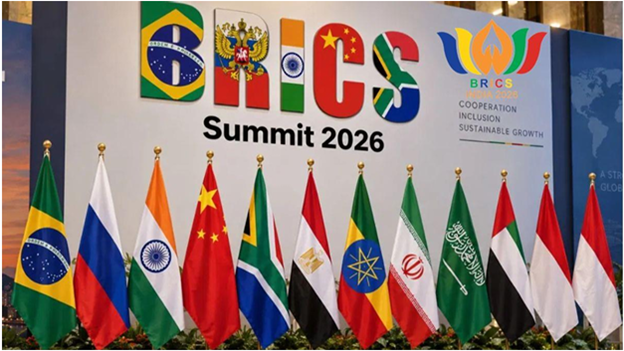
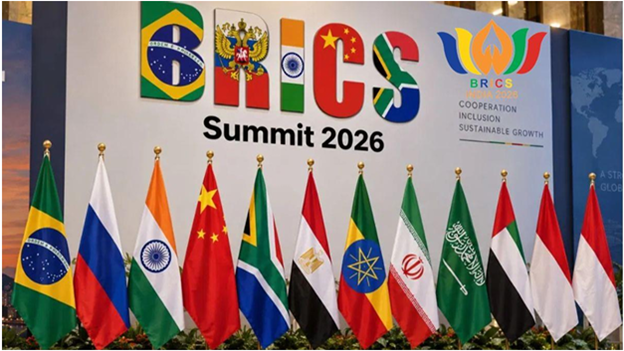
BRICS was never designed as an economic union like the European Union. It began with Brazil, Russia, India, and China, before South Africa joined in 2010. The expanded grouping now includes 11 countries, stretching from major energy exporters such as Russia, Saudi Arabia and the UAE to huge consumer markets such as India and China.
The number shows that members are already trading with each other. Intra-BRICS merchandise trade increased from $84 billion in 2003 to $ 1.17 trillion in 2024, more than a thirteen-fold increase. But more trade does not necessarily mean more balanced trade.
INDIA’S BRICS PROBLEM IS HIDDEN IN THE TRADE NUMBERS.
India’s trade with BRICS countries reached about $417.5 billion in FY-2026. But India exported only $95.7 billion while importing $321.8 billion, leaving a staggering $226.1 billion trade deficit.
Much of this imbalance reflects India’s dependence on imports, such as machinery, electronics, etc. Should India celebrate rising BRICS trade?
Not yet.
The bigger question is whether BRICS can help Indian companies sell more; particularly in service, pharmaceutical, engineering, and agriculture, rather than simply providing another channel to import. That explains India’s focus during the 2026 Presidency on MSMEs, service, trade, finance, and resilient supply chains.
THEN COMES THE DOLLAR.
This is where the BRICS debate becomes complicated. If the goal is to reduce dependence on the Western financial system, why not simply replace the dollar? Simply because the dollar is not just a currency. It is an entire financial ecosystem.
The IMF estimated that the US dollar still made up 57.13% of allocated global foreign exchange reserves in the first quarter of 2026. It is deeply embedded in international trade reserves, borrowing, investment, and financial transactions; replacing it would therefore require much more than announcing a new BRICS currency. Furthermore, BRICS itself does not appear to have a unified plan for doing that.
India has shown little appetite for a common BRICS currency. Russia, meanwhile, has also said it is not pursuing wholesale de-dollarization. So, perhaps the question is not “Can BRICS destroy the dollar?” But “Can BRICS make sure the dollar is no longer the only convenient option?”
That is much more important.
INDIA ALREADY HAS SOMETHING TO CONTRIBUTE.
We have UPI.
In August 2026 alone, India’s unified payment interface processed ?24.5 billion transactions worth nearly ?29.84lakh crore. That is not a theoretical model. It is infrastructure already operating on an extraordinary scale.
India’s advantage in the BRICS conversation may therefore not be in creating another global currency, but in demonstrating how a digital payment system can make transactions faster, cheaper, and more accessible.
If BRICS countries can connect their payment system more effectively, businesses could eventually have more ways to settle cross-border transactions without depending entirely on traditional financial channels. This does not make the dollar disappear.
It simply gives countries more routes to choose from.
ENERGY COULD BE ANOTHER BIG ADVANTAGE.
There is another reason BRICS matters to India: energy.
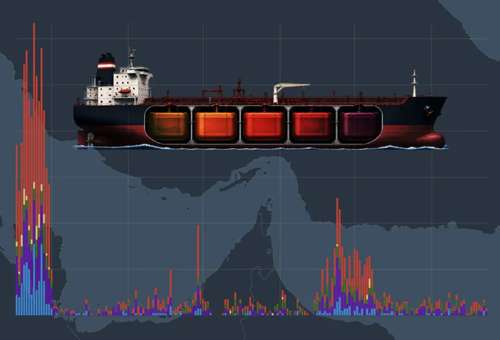
Russia, Saudi Arabia, the UAE, and Iran bring major energy resources into the group, while India and China represent two of the world’s largest consumer markets. For India, this matters because crude oil remains central to its energy security. Its crude oil import dependence is around 88%.
Greater cooperation could therefore matter for long-term energy contract infrastructure, investment, and supply security. This grouping that brings major producers and major consumers into the same economic forum has the potential to make energy relationships more predictable.
But energy also exposes BRICS’ internal contradiction. Countries can co-operate on supply while competing for markets investment and geopolitical influence.
BRICS has the resources. Turning those resources into a coordinated economic strategy is the harder part.
THE NEW DEVELOPMENT BANK, THE QUIETEST EXPERIMENT.
If BRICS is serious about changing global economic power, then the ‘New Development Bank’ may be more important than the headline about a common currency. The bank has already committed nearly $10 billion across 32 projects in India. The Indian rupees bond program is sanctioned for around 250 billion rupees over 5 years; they are also planning to project another $5 billion in sovereign lending to India over the same period.
The significance is not just in these numbers but in the attempt to give emerging economies another channel through which development projects can be financed, including through greater use of local currencies. The latest BRICS summit shows that this approach is more practical.
The New Delhi declaration backed greater use of local currencies in trade and investment and recognized work on making cross-border payment system more interoperable. BRICS is taking a slower route, making it easier for countries to use their own currencies while reducing the fiction involved in cross-border payment.
BUT THERE IS THE CHINA PROBLEM.
There is one problem India cannot overlook. What if reducing dependence on the West simply increases dependence on China? China is by far the largest economic power in BRICS and remains a major supplier of machinery, electronics, and manufactured goods to India. India’s enormous BRICS trade deficit makes this sensitive. Therefore, for India a multipolar economic system cannot mean replacing one dependency with another. It has to mean having more choices.
And that is where India’s approach to BRICS becomes important. New Delhi has continued to favour practical cooperation on digital payment and national currencies rather than pursuing a comma BRICS currency. The latest summit reflects that approach.
SO, CAN BRICS BUILD AN ALTERNATIVE ORDER?
Probably not in a sense.
A common currency is unlikely to emerge soon. BRICS does not have the monetary coordination, political cohesion or integrated financial markets needed to create a complete replacement for the existing system. But perhaps that is not the real test!
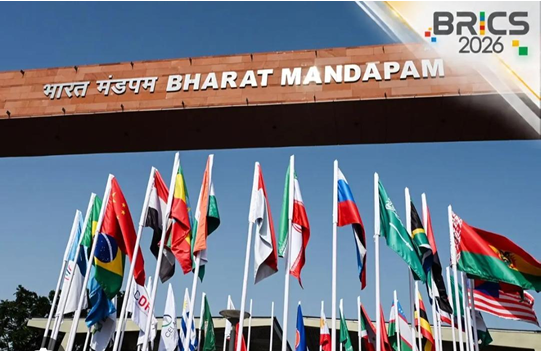
The New Delhi Summit has made the direction clearer: BRICS wants trade in local currency, a better payment system, stronger financing development, and greater representation for emerging economies in global institutions.
BRICS can therefore change the global economy without replacing it. India seems to understand this distinction. Its BRICS strategy is not about abandoning the dollar, the IMF, or Western markets. It is about having alternatives while remaining connected with them.
And that may ultimately be the most important shift.
The future may not be about one economic order replacing another; it may be about building a world where no single economic power has complete control over the routes through which everyone must trade, invest, and grow.
REFERENCES
1. UPI transactions near record level of ?29.8 lakh crore in August – The Hindu https://share.google/iybXysaf6hv3qAp7q
2. Press Release Page | Press Information Bureau https://share.google/tmqYndtLnxuIGRF9k
3. Press Note Details: Press Information Bureau https://share.google/Qzo9YgezBzmqljUyY
4. New Development Bank plans $7.5 billion funding to deepen rupee lending – The Economic Times https://share.google/3qgBidCdwGwv2LDur
5. Image from business today
6. Wion
Writer – Vidhi Mehta
Editor – Mrunmayee Patwardhan
<p>The post BEYOND THE DOLLAR: CAN BRICS BUILD AN ALTERNATIVE ECONOMIC ORDER? first appeared on The Economic Transcript.</p>