- Cadillac has released the first details about the XT5 PHEV.
- Chinese crossover sports a dual-motor plug-in hybrid system.
- Model features an advanced semi-autonomous driving system.
While Americans are patiently waiting for the second-generation XT5, Cadillac is already expanding the lineup in China. As part of this effort, they’ve introduced a new plug-in hybrid variant.
The company confirmed the model has a “dual-motor plug-in hybrid system with a 5C-capable lithium battery.” That’s vague, but China’s Ministry of Industry and Information Technology has already revealed the crossover has a 148 hp (110 kW / 150 PS) engine and two electric motors. The latter have peak outputs of 215 hp (160 kW / 218 PS) front and 148 hp (110 kW / 150 PS) rear, implying this could actually be a range-extended model.
More: America’s Aging Cadillac XT5 Watches China’s Newer One Get Lidar And A Plug
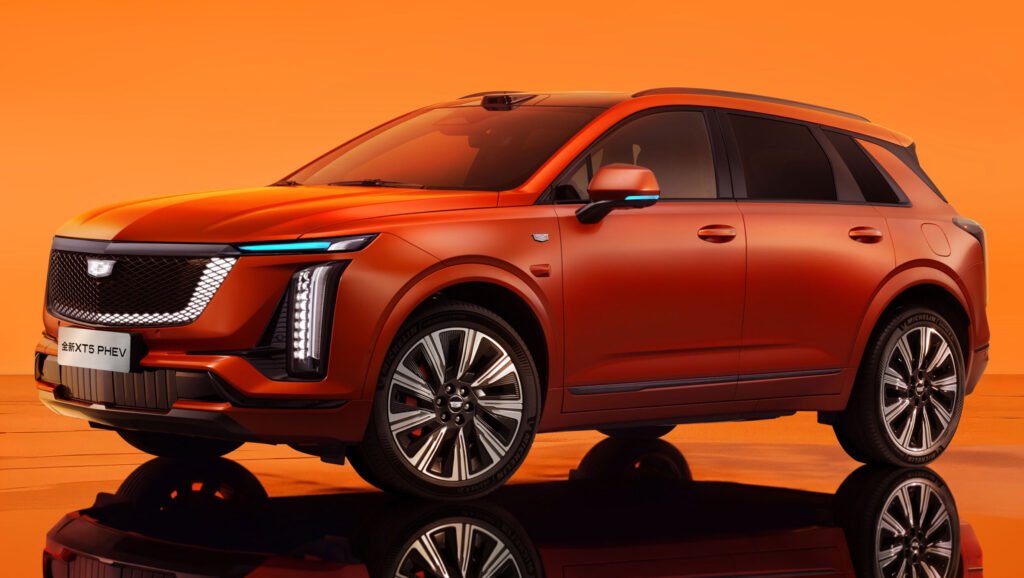
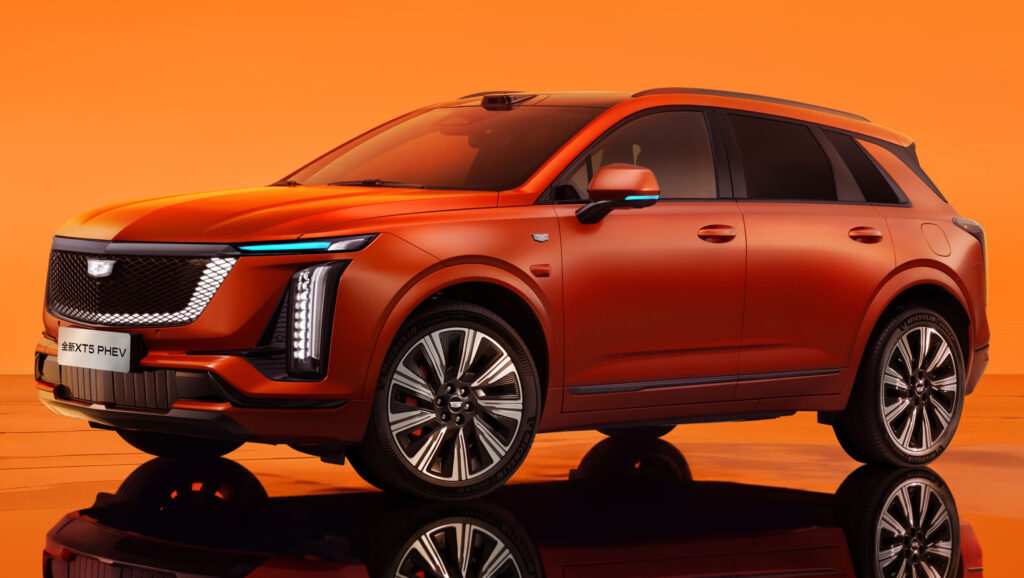
On the outside, we can see an updated front end with a revised grille sporting illuminated accents. It echoes the Optiq, Lyriq, and Vistiq, and is accompanied by an active shutter lower intake.
Elsewhere, there are aerodynamically optimized wheels that are backed by a braking system with red calipers. Government pictures have also revealed an updated rear end that lacks exhaust cut outs.
More notably, the crossover sports a roof-mounted Lidar sensor, side-mounted cameras, and turquoise lights. These changes usher in an advanced semi-autonomous driving system using the Momenta R7 World Model.
We can expect the crossover to offer the Xiao Yao Zhi Xing system that can already be found on Chinese Buicks. It’s essentially Super Duper Cruise as it allows for “seamless navigation through city roads, handling scenarios such as cut-ins, roundabouts, pedestrian crossings, and lane changes.”
For Cadillac’s part, the company said the XT5 PHEV will offer a “more confident, intuitive and reassuring assisted-driving experience tailored to China’s diverse and dynamic road conditions.” The company also claimed the system will “move beyond simply recognizing roads and obstacles with enhanced ability to understand, predict and respond more naturally across complex real-world scenarios.”
MIIT