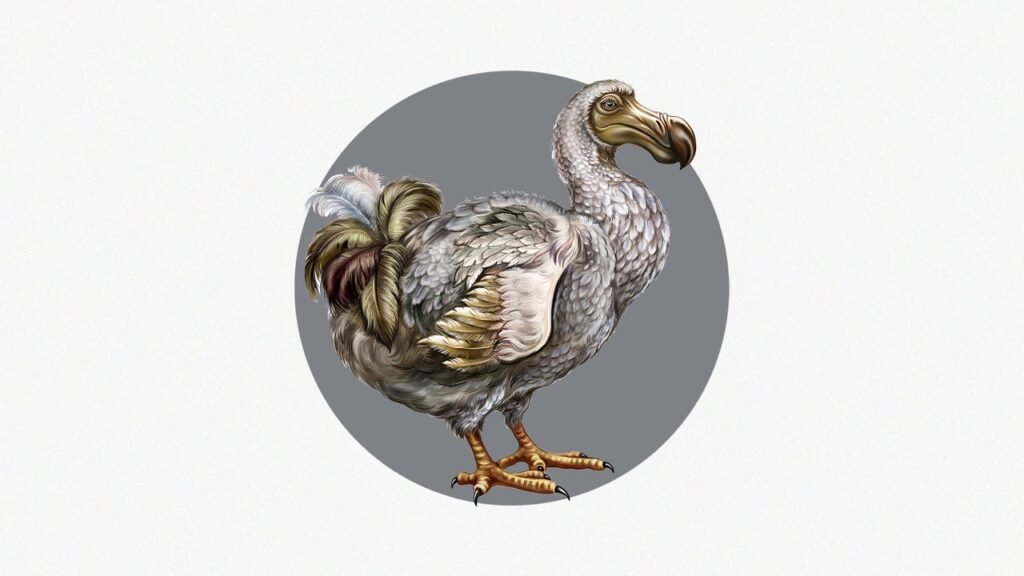
Since its founding in 2021, Colossal Biosciences has sought to bring back extinct animals, including the Dodo, the iconic flightless bird once endemic to Mauritius. The bird was documented by humans when the Portuguese first arrived on the island in the 16th century, but hasn’t been seen in hundreds of years. The bird struggled to survive the arrival of new invasive species and human hunting, and, as the saying goes, went the way of the Dodo.
For that same reason, Colossal Biosciences, the healthtech genetics company that already claims to have resurrected the dire wolf, wants to bring the Dodo back. This could be difficult: The company’s strategy relies on editing the genomes of other species, living relatives, with the extant preserved DNA from the species they’re trying to regenerate. But the Dodo is difficult: the company only has access to one Dodo genomic example, and needs to apply its technology—previously applied to dire wolves conceived via surrogate—to a species gestated in an egg.
But the company, on Wednesday, announced that it’s made progress toward that goal by using a new AI tool it built, called GenoMorph. The AI tool is trained on DNA from other species and can identify which sections of a genome are likely to be associated with different traits, like a beak or a feather. The scientists are using that technology to identify which regions of the Dodo DNA they do have are responsible for the traits that make the Dodo, well, Dodo-ish. Thus far, they’ve whittled the list down to 2,300 DNA targets (The company also says its, for the first time, used lipid nanoparticles to conduct genomic editing within an egg.)
This is all a reminder that what Colossal Biosciences is doing isn’t complete genetic replication of the original Dodo, but something more nuanced. The company’s strategy instead involves building what its leadership calls a ‘functional’ Dodo, filling in the genetic sequence of a living relative species, a type of pigeon, with selections of Dodo DNA associated with specific Dodo traits, like its iconic beak.
Whether or not you think this strategy constitutes actually bringing back the Dodo hinges on how broadly you’re willing to define a species. Some scientists have strongly objected to Colossal’s framing of its work, even as the company announces quests to bring back the mammoth, the thylacine, and the giant Moa. But Chief Science Officer Beth Shapiro counters that the distinction between different species is often fuzzier than we think. “It’s a species definition that’s based on an arbitrary threshold of sequence similarity,” she says. “But that threshold is arbitrary. It’s going to be arbitrary no matter who you are.”
Fast Company sat down with Shapiro and Colossal CEO Ben Lamm to discuss its latest Dodo updates, the definition of species, and the way their company uses AI.
This interview has been edited for clarity and length.
You’ve announced your quest to bring back the Dodo a while back. What progress have you made today?
Beth Shapiro: As a biologist who spent most of my career staring at genomes, the real hard thing is how do I know—in this 2 billion letters of DNA that make a bird, or three and a half billion if it’s a mammal, or 4 billion if it’s an elephant—what it is that I need to change if I’m going to take a Nicobar pigeon and turn it into a dodo? And for some of our projects, like the mammoth, we can start by looking at all of the 100 mammoths that we have and say, okay, where are they all the same as each other but different from elephants? That gives me a good idea where to start.
But what do we do when we only have one genome, which is the case for the dodo […] How do I look at that genome and figure out what it is that we need to edit if we’re going to take a Nicobar pigeon, which is a smaller, beautiful-colored, strongly flying pigeon with a tiny little beak, and turn it into the iconic dodo?
What we did here was combine DNA sequence data that we had for a bunch of birds [and] 3D skulls that we have for a bunch of birds. This is obviously something that’s difficult for a human to be able to mark, but an ML algorithm can very quickly figure out how to summarize that 3D shape into something that a computer can intake and output. We also considered development data, basically, how the shape of bird face forms at different stages of development.
So to collect that information, we looked at different birds through that developmental pipeline, very early development, as that beak is forming, and collected gene expression data: what genes are on, what genes are off, how on are they, or how off are they, and fed all of this information collectively into this AI tool that we built called GenoMorph. This tool can tell us, using machine learning algorithms, what genes are turned on and off, and when, and it outputs a big list, and that is our candidate list of what might be helpful for bringing back the Dodo.
It sounds like you’re looking at known birds, where we can understand their genome nad that genome expresses in real time, to understand and zoom in on what Dodo DNA might be most important for those quintessential dodo traits.
Beth Shapiro: That’s right. It’s all about this regulatory landscape, which is confusing…. Every cell has the same book in it, but which chapters should I be reading if I want to make a dodo beak versus a Nicobar pigeon beak?
When people think about AI right now, they’re thinking of LLMs that are covering a wide base of knowledge. This sounds like one of the more traditional definitions of AI, where you have a very specific training set that is very refined and for a very specific domain, and then you can kind of build out of that…. Did you use a frontier model at all to make this?
Ben Lamm: In the early days of LLMs, they weren’t doing a great job at ancestral state reconstructions or comparative genomics, so we had to go solve those. They’re highly nuanced, right? We do have good relationships with the big AI companies. Our unique data set—plus some of the kind of traffic control stops cop stuff that we’re building in this—will further refine and be able to be leveraged by the superintelligence platforms.
But we’re not currently doing that. We do have access to some of the latest and greatest on OpenAI and Anthropic with Mythos, and we are using it for certain things, but not yet this. Not just the data sets, but also how we derived the results of the thinned-down data set will be valuable and [could be] fed into a super intelligence platform.
Beth Shapiro: Some of the frontier models that are super cool that are out there are not really trained to solve this particular problem, which is how do we map a particular genotype to a phenotype… [basically] mapping a particular bit of developmental biology onto the way an organism ends up looking.
If you could map out how this would be applied to mammal species, would there be important differences? How would that work?
Ben Lamm: The fundamental tech will be applied to both. We’ve really focused it on the avian side….One thing that I was unaware of till this morning was how fast we think the core platform can be leveraged on some of the other work.
When it comes to your claims that you’re bringing back the Dodo, people are very attached to formal delineations of species. They say you’re not actually bringing back the Dodo.
Ben Lamm: I used to own a conversational intelligence platform before… We’re very thoughtful on monitoring sentiment analysis, social graph, and earned media. There is a population that is very fixated on what to call things. They would have crushed it in the Garden of Eden, right?
But that is not representative […] We believe in freedom of speech. If somebody wants to say, you know, our dodos are dodos, and our mammoths are mammoths, great. If they want to say they’re cold-tolerant Asian elephants with edited mammoth alleles from 104 mammoth genomes from 1.3 million years of genetic divergence, that’s cool too.
I do think if you say the second one, you are kind of missing the forest for the trees, right? I was recently told that one of these people said online that if it looks like a duck, if it quacks like a duck, if it walks like a duck, it serves the ecological function of a duck, it eats like a duck, that doesn’t mean it’s a duck. Tell my two and a half year old that.
Beth Shapiro: We’re focused on filling ecological niches, and if we can bring back an organism that fills an ecological niche that performs the role, then we will have successfully brought that animal back.
We will make decisions that are based on animal welfare and the capacity to live in the habitats of today. Our dire wolves are white because ancient dire wolves were white, but we didn’t use the dire wolf DNA version to edit to make them white becaus, in a gray wolf genetic background, there’s some evidence that that would have made them unhealthy. They would have made them deaf or blind. So we used a version that circulates today in gray wolves, but we still resurrected that dire wolf trait, and that’s what we’re going to do. We’re going to make decisions that focus on animal welfare and restoration of key traits, and that’s our definition of de-extinction.
Are you worried at all that you might be missing some trait, that there’s some other part of the body of the Dodo that you’re not looking at, which might be quintessential to the Dodo?
Beth Shapiro: I think our goal, which we define in collaboration with the Mauritian Dodo Advisory Committee, is to create a large ground-dwelling fruit-eating bird that can restore the dodo’s ecological niche, and if we are successful in doing that, we will have brought back the dodo.
Ben Lamm: If I just had to make a bird that looked like a dodo, my life would be easier, and I could raise way less money. My point is, if I make a unicorn tomorrow, I think fewer people will bitch because they’ll be like, ah, we can’t say they didn’t use unicorn DNA.
Beth Shapiro: It’s a species definition that’s based on an arbitrary threshold of sequence similarity. But that threshold is arbitrary. It’s going to be arbitrary no matter who you are.
Ben Lamm: So we have 104 mammoth genomes, right, over 1.3 million years. None of them [produced] living cells. We can’t clone them. You know what’s crazy about 1.3 million years of genetic divergence? They’re very different. You know what’s not different? The parts.
If…. I had all those living cells, I could just clone them and magically have 104 mammoths. Which ones are a mammoth? I will tell you, genetically, they are insanely different over 1.3 million years.