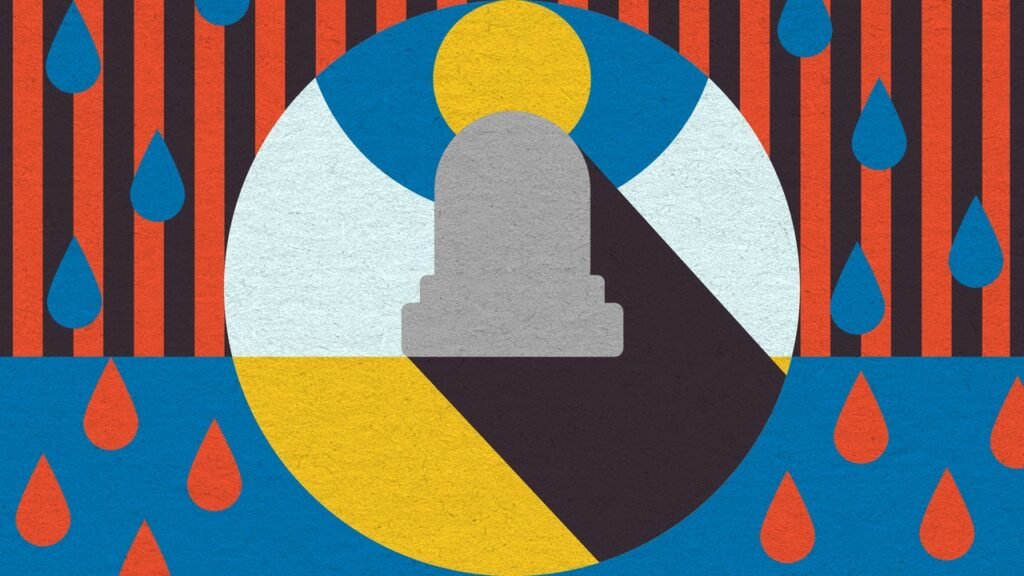
At the beginning of the summer, Figma, the popular design platform, hosted a funeral for design. “Come pay your respects,” the company posted on X, inviting visitors to a pop-up on Rivington Street in New York City. Attendees found a site adorned with funereal flower arrangements and received black hats that read “Design Is Dead.” On Instagram, the company posted, “we mourn design—killed, according to X, approximately 847 times this year alone.”
The pop-up, part of a larger advertising campaign from Figma, came (at least in part) as a response to Claude Design, Anthropic’s new tool for creating visuals from presentation slides to interface prototypes. Before the release, Mike Krieger, Anthropic’s chief product officer, resigned from Figma’s board, putting the two companies on a collision course. (Anthropic’s launch prompted a temporary 7% decrease in Figma’s market cap.)
The “Is this the end” narrative has followed Figma, now considered an incumbent in the design tooling world, since its 2025 initial public offering. Despite 48% year-over-year revenue growth, its stock is still down roughly 80% from its all-time high, underscoring the uncertainty around how designers will work—and with what tools—in the AI era.
Design has always been a strangely insecure profession, and Figma’s tongue-in-cheek response tapped directly into the uncertainty around what the future of design looks like.
The existential dread started in earnest in 2021 when OpenAI launched DALL-E, an image generator that could create realistic images from simple text prompts. DALL-E opened the floodgates and was quickly followed by other image generator products, from Midjourney to Adobe Firefly.
With each new advancement in AI, it can feel to designers like they are steadily marching toward the end of . . . something. If we’re to believe the doomsday narrative, AI seems to signal not just the end of our jobs, but the end of design itself.
Yet as I’ve spoken to leaders across design and AI over the past few months, the future of design feels less dire than our doomerist thinking leads us to believe. Besides, design has survived technological innovation many times before. Is this time really any different?
A long history of near-deaths
This feeling that design is dead, or at least dying, is a familiar one. I’ve worked across the design industry for nearly 20 years—from designer to writer to university professor—and for my entire career, death has seemingly been knocking at our door.
I have a vivid memory of a high school friend (someone far outside my design world) asking me as we graduated whether I was worried about studying graphic design because anyone could get a copy of Photoshop.
Then in the early 2010s, I remember conversations with designer friends about whether we should be worried about emerging platforms like Squarespace and Wix, which were making web design newly accessible to anyone with an internet connection, while a plethora of logo-making services were emerging, threatening the same for branding.
Last month, when the man installing my new air conditioner asked what I did, and I told him I’m a designer, his first response was to ask how I was dealing with “this AI thing.”
I’m sure we can go back even further. Before all of this, of course, there were designers who looked at the desktop computer with uncertainty. Some felt the same way about printing technology.
In a paper presented at the very first Type Directors Club conference in 1958, British designer and writer Herbert Spencer said of the role of printing: “What I am trying to stress is that we must be constantly alert to the technical changes now taking place in printing and in methods of reproduction and mass communication generally.” Spencer’s urging feels just as relevant today, though the “technical changes” are quite different 70 years on.
The progression of technological advancements of the last, say, 30 years—from desktop publishing to Claude Design—has been a slow process of democratizing design tools by putting them in the hands of more and more people. The skills needed to produce design no longer require years of study as these tools become faster, cheaper, and easier to use.
My high school friend was right to ask about what impact easy access to Photoshop would have on my education; today we should be thinking just as much about how AI tools are opening design to non-designers.
But maybe the history of design is the history of technology threatening to end it. Could AI be the final nail in the proverbial coffin?
What products like Claude Design or Figma Make, or even Midjourney, allow is for anyone to create, with a few text prompts, basic illustrations, logos, interfaces, slideshows, and posters. Moreover, within corporate design teams, product managers on one side and engineers on the other, can now do more of the design work themselves. For the designer in the middle, this can feel like a gradual squeezing on both ends until there are no more designers left.
And yet! There are more designers working today than ever before in history. The U.S. Bureau of Labor Statistics reports that in 2024, close to half a million designers were working in either graphic design or web and digital interface design. Compare this to 2004 when there were only slightly more than 200,000 graphic designers (BLS didn’t have a category for “web and digital interface design” until 2018).
Figma’s recently released 2026 AI report shows an increasing demand for designers despite the proliferation of new tools. Sure, product managers and engineers are doing more design, but designers are also able to do more product management and development. In other words, AI products are democratizing not just design skills, but all types of skills. AI is not killing, it’s blurring.
The great blurring
In his 2023 book, Digital Design: A History, art and design historian Stephen Eskilson writes that the advent of desktop publishing similarly scrambled designers’ roles. “[Digital design] brought designers back into the world of production,” he writes. “In the near pre-digital era, typesetting was an entirely separate world from graphic design . . . with the Macintosh, [designers] found that they could lay out and prepare print-ready galleys of [their] magazine themselves.”
This is the paradox of these AI tools: They simultaneously bring production closer to the designer while also separating production from the product strategy. “Every designer on my team is a builder,” Hector Ouilhet, VP of design for Amazon Web Services, tells me. “We’re designing just as much in code as we are in Figma.”
Joel Lewenstein, Anthropic’s head of design, echoes this, telling me that his team of designers, developers, and product managers now all work in the same tools (a combination of Claude Chat, Code, and Design.) “People are speaking each other’s languages more,” he says. “A project manager might make a prototype in Claude Design to talk through with a designer to get feedback, and because our designers are pushing code, they can then make a functional prototype that an engineer can work off of.”
As the Bureau of Labor Statistics reports suggest, there’s always a fuzziness around the word design and what designers do. Before 2018, for example, when the Bureau separated out Interface Design as its own category, those designers were previously grouped under engineers. As the design industry has grown, so, too, has the diversity of design jobs.
Look on any design-centric job board and you’ll find a dizzying array of titles: digital designers, product designers, motion designers, UX designers, software designers, brand strategy. Where design was once a unifying umbrella for these different roles, they’ve now simultaneously collapsed and fragmented thanks to corporate organizational structures and AI tools.
Where you once had a fairly linear design process, from idea conception to strategy to development to front-end design, those discreet steps have collapsed into a constant feedback cycle of negotiation among constituents and stakeholders.
“In our survey, we found that 56% of non-designers are doing design work: prototypes, visual exploration, brand exploration,” Andrew Hogan, Figma’s head of insights, tells me. “And yet, designers are actually busier than ever. They’re doing more tasks than they were doing before.”
Figma’s report reads, “Designing with AI is shifting from solo to collaborative” with around half of developers now designing and designers now developing. Similarly, the Designer Fund’s AI in Design 2026 report states, “AI has spread into all parts of the design process—and brought designers into areas that most didn’t touch, like coding, prototyping, and accessing business data at scale to influence decisions.”
This is why design, as an industry, has outlived decades of democratizing technologies. Its fluidity, its ability to shift roles, is its strength. It’s why I have no fear of design’s near-death.
Designing a feeling
Think of the discourse around AI and taste. OpenAI President Greg Brockman’s viral post on X last year read, “Taste is a new core skill,” and venture capitalist Paul Graham posted, also on X, “In the AI age, taste will become even more important.” Words like taste, craft, even beauty might have a monetary benefit for these corporations, as Kyle Chayka has noted in The New Yorker, but they also can’t be quantified. They are vague.
The same is true of design. The value of design is not something that can always be quantified. It’s not something that can clearly track with the data. There are an infinite number of ways you can measure the impact of design depending on where you sit. Good design isn’t simply about metrics but about emotion, experience, novelty, vibes. “What is good design?” Dutch graphic designer Piet Schreuders wrote in 1977. “There is no formula for it.”
At the end of my call with Hogan, I ask how he defines good design, a term we’d used throughout our conversation. When answering, he doesn’t refer back to data. “It’s a feeling,” he says. “You know it when it feels right.”
And in a recent episode of the Most Interesting Thing in AI podcast, writer and technologist Paul Ford said, “The designer wins when everybody realizes again that everything that Claude produces looks about the same.” He continues: “We come up with a system or framework . . . and then we humans mess it up, we want more novelty, more design, more thinking every time.”
Ouilhet calls this “humorphism,” a portmanteau of human and skeumorphism. “If the past era belonged to skeuomorphism (mimicking the physics of objects),” he writes on his Humorphism site, “The next era belongs to humorphism (mimicking the dynamics of people).” In other words, technology must adapt to people, not the other way around.
For Ouilhet, the role of the designer is increasingly about negotiating “scale.” “Scale for machines is about making more things and making those things bigger,” he tells me. “But scale for humans is about proportions.”
Think about sitting in a chair that is slightly too low or putting on a jacket with shoulders that are a bit too small: This is proportion. It doesn’t feel right. “The last 50 years of software has been big-box stores selling three jackets and you have to pick one of the three that you like the most,” Anthropic’s Lewenstein says. “But there is a world in which we are all going to make bespoke custom-fit jackets with Claude code running locally on your computer making the perfect software just in time.”
This metaphor gets to the heart of design: It is both a noun and a verb. It’s both a process and a product. As Steve Jobs famously said, “Design isn’t just how it looks, but how it works.”
In the 1400s, Italian scholar Leon Battista Alberti popularized the term disegno, from which we get the modern word design. For Alberti, disegno carried many meanings, from the drawing or planning of an object to the compositional or formal aspects of the design itself. Important in Alberti’s definition, writes Eskilson, was that design was an intellectual activity that was not necessarily tied to the production of the artifact.
AI makes this separation clearer than ever before. “I think people mistake design for the artifact. These tools make artifact creation cheaper so the role of the designer becomes much more strategic,” Hogan says. “It’s about getting yourself into a position where you can express a strong point of view.”
Where desktop publishing moved design downstream toward production, AI tools are moving design back upstream toward strategy, systems, and direction. “For many years, design was about software, about user interfaces,” Lewenstein says. “But I think service design is going to have a huge comeback. You’re not just making a product anymore.”
This is the task before designers: How do we design large systems that work at a human scale, that truly put the human in human-centered design? That’s a task that’s as messy and unquantifiable as design itself. It’s a task that can’t be automated. It’s a task less about data and production and more about feeling. At the risk of correcting Jobs, design isn’t just what it looks like or how it works anymore: Design is how it feels.