
Georg Baselitz, an influential German artist who was internationally known for his robust, often violent, Neo-Expressionist paintings, died today, April 30, at the age of 88, according to a press release from Thaddeus Ropac, his representative gallery. Baselitz’s final paintings will be on view in the exhibition Eroi d’Oro, opening at the Fondazione Giorgio Cini in Venice on May 6.
Baselitz caused controversy when, in 2013, he told the German newspaper Der Spiegel, “Women cannot paint very well. It’s a fact.” In accordance with such views, some of his most famous works center the drama of male genius. His 1960s series, Heroes, for instance, consists of monumental portraits of male soldiers (in the aforementioned Der Spiegel interview, he also referred to his own paintings as “battles”). Like contemporaries Joseph Beuys and Gerhard Richter, he confronted Germany’s culpability in World War II — sometimes ambivalently — in depictions of broken military men in tattered uniforms that embody a tragic, Wagnerian grandeur.
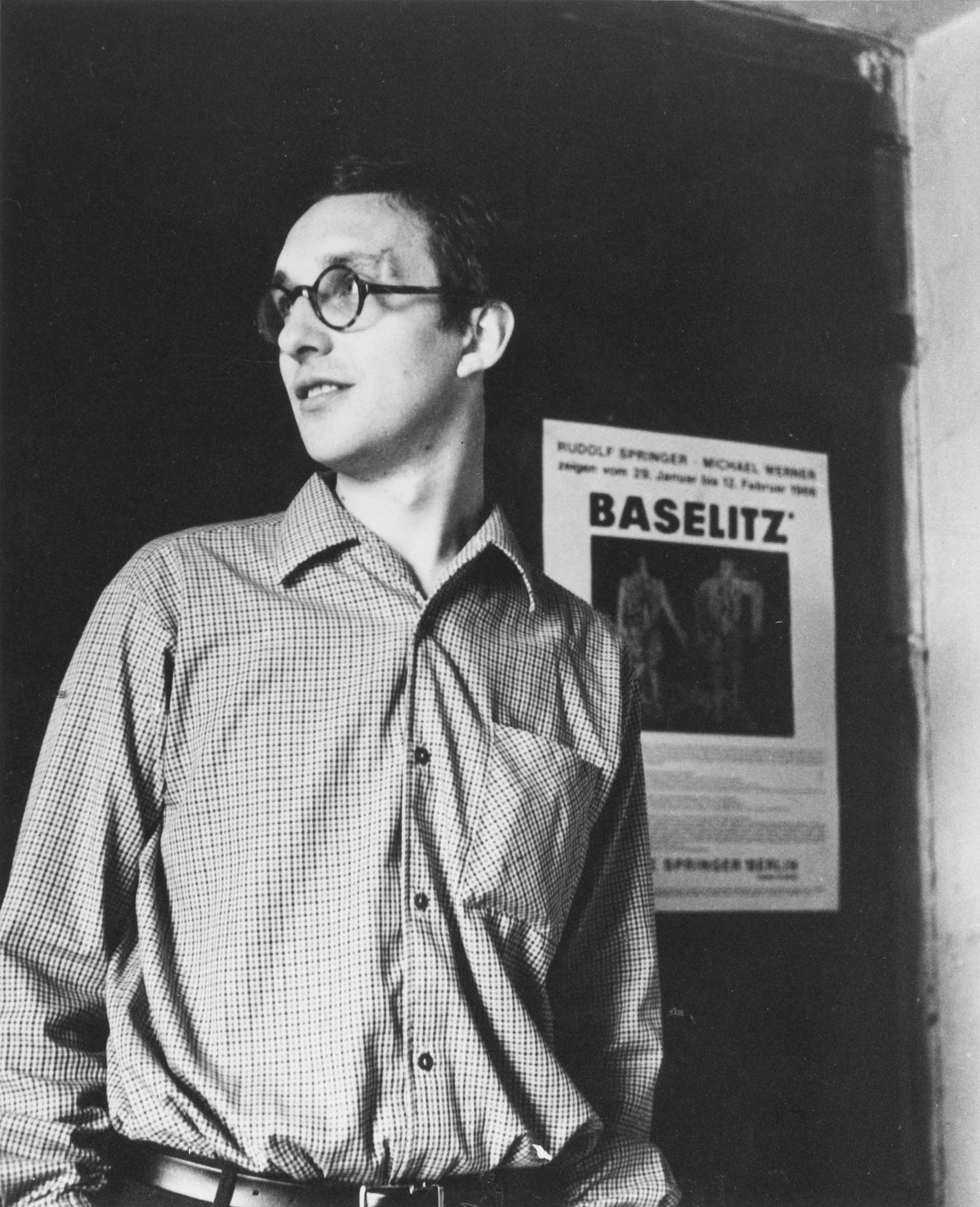
Baselitz was born in Deutschbaselitz, a village in Saxony, Eastern Germany, in 1938, a year before World War II broke out. His family home was later destroyed by the invading Soviet army, and he was a first-hand witness to the Allies’ bombardment of Dresden, a scene of violence and destruction that would inform the entire arc of his work. After the war, he studied art at the Academy of Fine and Applied Arts in East Berlin, where he trained in social realism before being thrown out for his opposition to its central tenets, and at the Academy of Arts in West Berlin (now the Universität der Künste Berlin).
He first encountered American Abstract Expressionism in 1958 at an exhibition in West Berlin. It changed the trajectory of his career, encouraging him to reject cool, geometric abstraction in favor of dynamism and expressivity. “I had never seen anything quite like it before,” he told the Guardian in 2014.
Baselitz admired artists like Jackson Pollock, yet it was the semi-figurative paintings of Willem de Kooning, with their animalistic bodies and feral ferocity, that most directly influenced his work. His style emphasized the organic human body, its functions and vulnerability, in all its crudeness. His 1962–63 oil painting, “The Big Night Down the Drain,” for instance, represented a masturbating male figure, his phallus grotesque extended. His frame suggests that of a young boy, and some have argued that the figure’s haircut also resembles Hitler’s. It was one of two paintings deemed “obscene” and seized by public prosecutors during Baselitz’s first solo show at Galerie Werner & Katz in 1963.
In the intervening decades, Baselitz continued to develop his influential aggressive, expressionistic, and sometimes grotesque style, consisting of drastic swerves and daubs. In 1969, he inaugurated his “upside down” paintings, in which figures were inverted, forcing viewers to think of the works more in terms of rhythm and painterly gestures than resemblance.
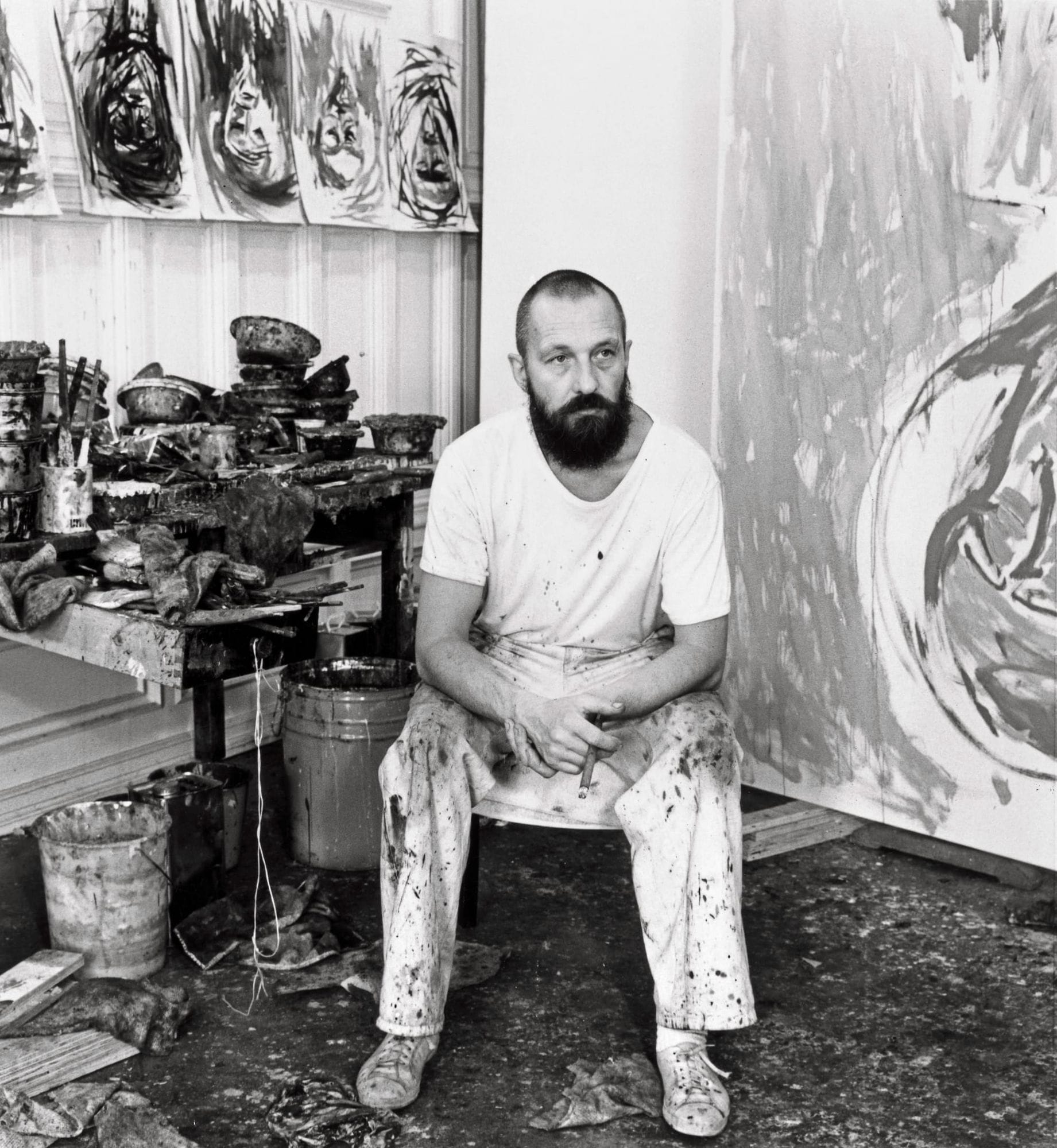
He was a key precursor to Germany’s younger generation of artists, known as Neue Wilde, whose 1980s Neo-Expressionist style embodied a radical turn from the prevailing Minimalist and Conceptual Art. In that decade, his works turned toward the monumental. He returned to his explorations of the trauma of World War II more explicitly, in paintings like “Dinner in Dresden” (1983), whose central figure recalls Edvard Munch’s “Scream” (1893) and whose sickly pink hues bring to mind the color palette of Philip Guston.
In 1995, the Guggenheim Museum mounted a survey of Baselitz’s works. There, his enormous canvases dominated the museum’s rotunda, inducing the sense that one could not back up far enough against its ramp to properly take in their vehement, angry forms.
Starting in 2005, he consciously began reworking themes from his early works across series like Remix. These works are typified by looser, more rapid brushstrokes, bordering on caricature — his 2006 reworking of “The Big Night Down the Drain,” for instance, made the central figure more mummy-like and uncanny.
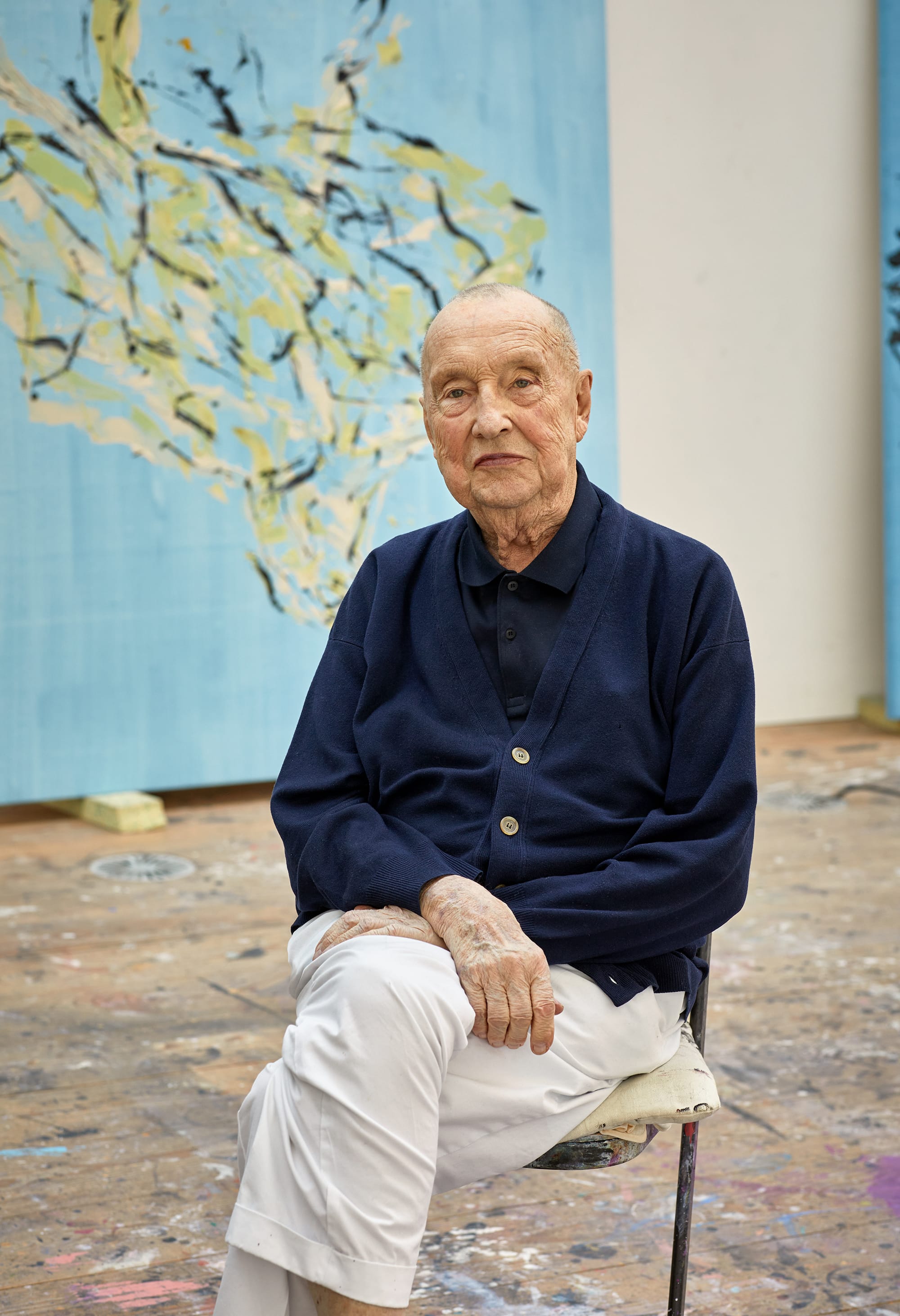
In his very late works, such as “Surdororeal” (2019), he began exploring the desolation of old age, with layers of caked, cracking paint against a golden varnish resembling wrinkled skin. And his final works seemed to touch upon death itself — in the stark 2025 oil painting “What is, is was not,” for instance, emaciated figures, upside down, plunge into the depths of darkness.