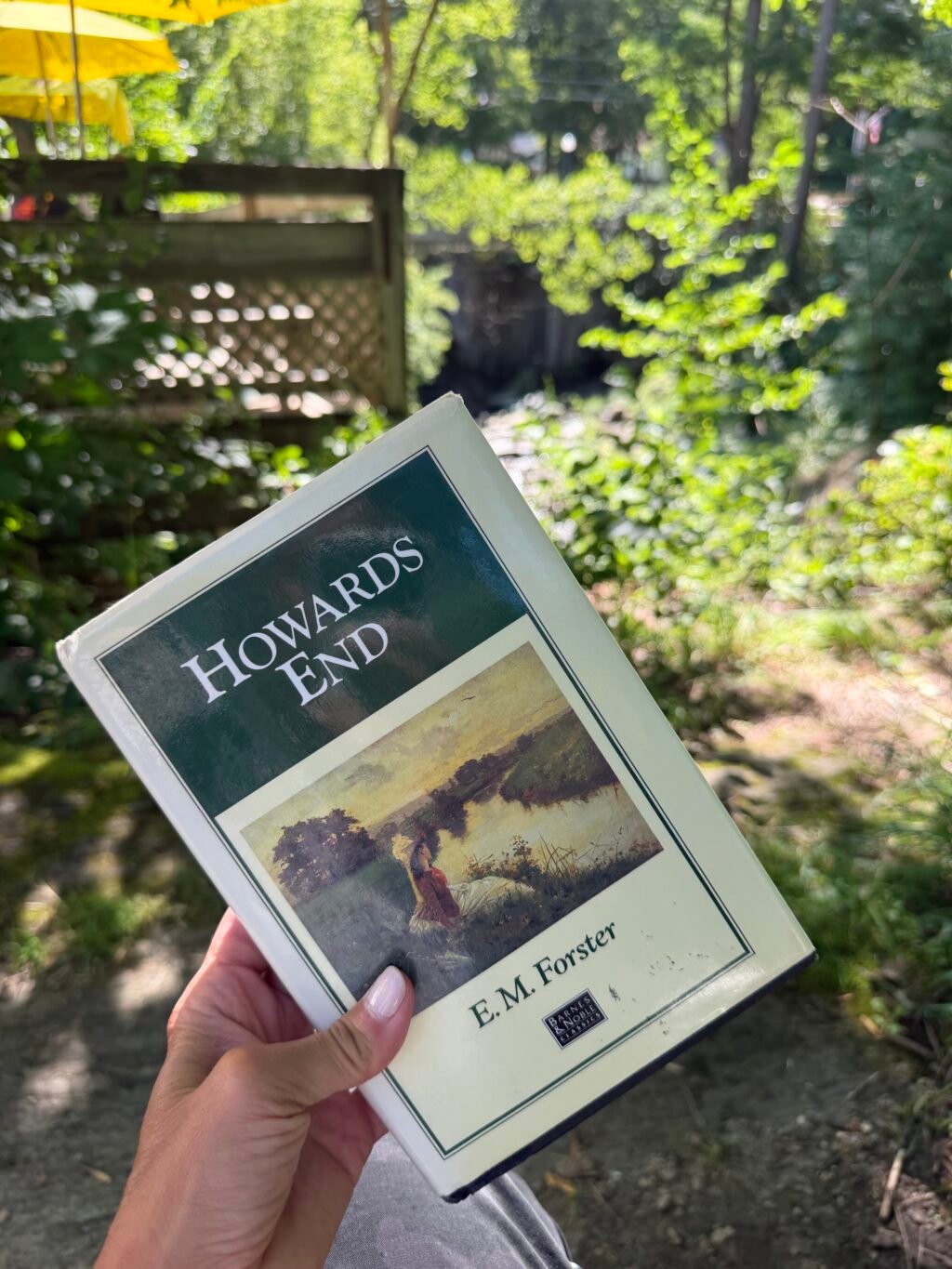
I just finished Howards End by E. M. Forster for what must be the third time. I read A Passage to India (1924) in college and then picked up Howards End for pleasure reading that summer in the mid-nineties. I reread it in my late thirties and now again in my fifties. With Howards End, my admiration continues to grow as I get older.

The Plot Thickens
With many British novels of manners—think Austen and Brontë—there’s a criticism that not much happens. Well, that’s not the case here. Yes, there are the expected weddings and old people passing away, but in addition, there is scandal, violence, infidelity and financial misdeeds. Maybe that’s why the 1992 movie was such a hit. Watch it—the cast is amazing!
Back to the book. There are too many characters to mention here, but this is the gist: It’s a story about the Schlegel sisters, Helen and Margaret, and one particular family they cross paths with and become deeply intertwined with—the Wilcox family.
The Wilcox men seem to be drawn to these women and the life force that surrounds them.
Orphaned in early adulthood, the sisters are responsible for themselves and their younger brother, Tibby. With no one wiser to guide them, they lead a whimsical and rather charmed life full of lively dinners, intellectual discussions and travel.
Curiosity gets the best of the sisters. Because they put themselves out into the world of men, the plot starts to thicken. Then the proposals start rolling in.
The men make the money, lose the money, act with passion and jealousy, and drive the story forward.
It’s All About Men
The men make the money, lose the money, act with passion and jealousy, and drive the story forward. I decided to reread this book because my reading list of late has been woefully light on strong male leads. In Howards End, yes, the women are the central characters, but the men are the ones driving the plot.
Through them, Forster examines what it means to be a capitalist and an industrialist. The deals, land grabs and proposals are all based upon the desire to conquer. And it’s not just wealthy men we encounter. Through the rather pathetic and confused character of Leonard Bast, we’re shown a man who wants a life full of beauty and art, but because of his class and his miserable marriage, it remains beyond his grasp.
“He has worked very hard all his life, and noticed nothing. Those are the people who collapse when they do notice a thing.”
But It’s Really About the House
When the Schlegel sisters expose Leonard to art and beauty, it becomes his downfall. Cities are painted as horrific centers of ill repute, but they are also the centers of art and thought. Only a country retreat can provide the solace and life force needed to bring the sisters back together. That’s where Howards End (a house) is glue that binds and the balm that heels.
While Forster adores Meg’s pluck and Helen’s honor, let’s be honest: His favorite character in the book is the eponymous house. Howards End is where one can take root and live with dignity and purpose.
“The feudal ownership of land did bring dignity, whereas the modern ownership of movables is reducing us again to a nomadic horde. We are reverting to the civilisation of luggage, and historians of the future will note how the middle classes accreted possessions without taking root in the earth, and may find in this the secret of their imaginative poverty.”
Only when the sisters are ensconced in Howards End can they find true happiness and safety. Forster writes, “The Age of Property holds bitter moments even for a proprietor.” But in the end, property—more specifically, LAND—is the ultimate savior.
Dirty Money and Clean Hands
Forster knows things. He’s not like the Transcendentalists who dreamed of casting off material concerns and heading out into nature. One could read this book as a counterpoint to the American Transcendentalists, who were most active from the 1830s through the 1850s, especially in New England. Think Emerson’s Nature (1836) or Henry David Thoreau’s Walden (1854). Men who told us to cast everything off and head to the pond.
Forster is more realistic, especially when it comes to women.
“Money pads the edges of things,” said Miss Schlegel. “God help those who have none.”
And then:
“New for me; sensible people have acknowledged it for years. You and I and the Wilcoxes stand upon money as upon islands. It is so firm beneath our feet that we forget its very existence.”
These lines resonated with me because they are true. As today’s billionaires hoard more wealth and grab all the headlines, economic disparity grows. It’s easy for those at the top to forget the slippery sands beneath the working class. The Leonard Basts among us deserve beauty and opportunity too.
Unlike Emerson and Thoreau, Forster grasps the complexity of extending the healing power of nature to people of all classes. He holds farmers and countrymen in high esteem.
“Their hours were ruled, not by a London office, but by the movements of the crops and the sun. That they were men of the finest type only the sentimentalists can declare. But they kept to the life of daylight. They are England’s hope. Clumsily they carry forward the torch of the sun, until such time as the nation sees fit to take it up.”
What It’s About
It’s a story about class, the healing power of nature, striving and, most of all, the power of sisterhood.
That last part seemed to sit more deeply with me than ever before. Now the mom of two daughters, I was intensely invested in the relationship between Helen and Meg. One is practical and poised; the other is pretty and impulsive. What they share is compassion, a love of art and a penchant for intellectualism. I love the mystical powers afoot in this novel. The power of beauty and feminine charm feels almost sorcerous, and it is beautifully written. And I admit, the ending is one of the most satisfying around. No spoilers here, even though this book is more than a century old.
There are too many beautiful sentences to quote. His writing inspires me to do two things: get out into nature and carefully craft my words. This is an author who simply sticks with me.
I urge you to revisit your favorites as you age. Some will hold up. Others will surprise you because they no longer command the respect you once afforded them.
Howards End holds up. In fact, I love it more dearly every time I return. Do yourself a favor and buy this one in hard cover.

Final Thoughts
Howards End is a beautifully written novel about class, money, nature, property and the life-giving power of human connection. But on this reading, it was the bond between Margaret and Helen that moved me most. Now the mother of two daughters, I felt the power of their sisterhood more deeply than ever. This is a book that has grown alongside me—and one I love more dearly every time I return to it.
One-line takeaway: Howards End asks whether beauty, nature and human connection can survive in a world driven by money and acquisition.
For fans of: British classics, novels of manners, complicated sisters, questions of class and privilege, beautiful prose, houses that feel like characters, and books that reveal something new with every reading.
Where I read it: First in my twenties, again in my late thirties, and now in my fifties—three readings at three very different stages of my life.
Momtrends Rating: ★★★★★ (5/5)
Book Club Score: ⭐⭐⭐⭐⭐ (Outstanding discussion potential)
Would I Recommend It? Without hesitation—especially for readers who love beautifully crafted classics and books that become richer as you age.
The post Howards End Book Review: Why E.M. Forster’s Classic Gets Better With Age appeared first on Mom Trends.