
Andrés Cantor is unlike most public figures. He may walk down the street or dine at a restaurant without being immediately recognized. It’s not until he opens his mouth and speaks that his identity is revealed: He is the man who yells “goooooal!” during soccer matches.
Cantor is Telemundo’s lead soccer play-by-play announcer, covering major tournaments like the World Cup, the Copa America, and even the Olympics.
But with 10 World Cups under his belt, Cantor is more than just the narrator of a match. He has become a staple for the Spanish-speaking soccer community.
“Sometimes they’ll turn around and say, ‘Wait, I heard your voice. You are Andrés Cantor—you’re Mr. Goal’,” Cantor tells Fast Company, 30 minutes before Spain and France were set to play in the semifinals.
Although Cantor was not set to go on air for that game, he was still resting his voice as he readied for the Argentina versus England game the next day.
“It’s very flattering when they tell you that I’ve been the soundtrack of their lives because they’ve been watching soccer for so many years with my broadcasts,” he added.
So far, Cantor has called 15 matches for the 2026 World Cup, traveling over 20,000 miles from city to city to attend the games scattered around North America.
For many fans, part of the World Cup experience is to hear Cantor’s play-by-play, so much so that the Spanish-speaking network has seen an influx in popularity this year.
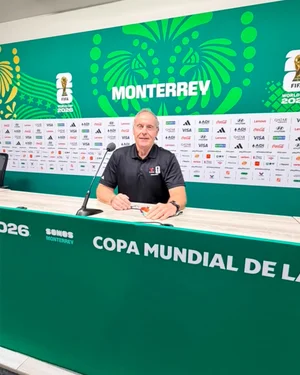
According to Miguel Lorenzo, a senior vice president at Telemundo Deportes, who spoke with NPR, this year’s tournament has been the most watched in the Spanish language in the country.
“Half of the country of the United States is watching the World Cup in Spanish on Telemundo,” Lorenzo told NPR. “We’re seeing audiences that are bilingual, that are Spanish dominant, that speak English enjoying World Cup coverage.”
And for many watchers, turning to Spanish is not just about the language, but the emotion in the play-by-play.
“The English commentators literally sound like they’re narrating a nature documentary about grass growing,” a user said on X. Another added, “the South American commentators and their ‘gooooooooooooool’ are unmatched.”
Landing the job
Cantor’s dream was to succeed behind a byline, not a screen. Born in Buenos Aires, he moved to California during his teenage years, eventually attending the University of Southern California to study journalism.
“I finished my journalism curriculum without taking one TV or radio class, because I wanted to write,” he explains.
And indeed, his first big break has writing for an Argentine newspaper, El Gráfico, serving as a correspondent for events like the Oscars and Formula 1.
But he eventually landed on broadcast by chance, when a producer at the Spanish International Network (what would become Univision) invited him to audition to be a sports commentator in 1987.
“The very first time I auditioned, I yelled in my first play-by-play game—I never meant to yell,” Cantor says. “It came out naturally because that’s the way I grew up listening to soccer, both on television and radio. So I didn’t know any better.”
His call was unlike many others that were on broadcast at the time, but felt like home to many raised around a TV playing futbol—instead of a simple “goal,” the call became a prolonged “goaaaaaaaaaaal,” emotive enough to get any credible soccer fan up on their feet.
“And then suddenly, without having set foot in a TV studio in my life,” he added. “I became the lone play-by-play announcer for Univision for the next 14 years.”
The voice that became a brand
It is rare for specific phrases to escape their ecosystem and become a part of popular culture in a way that makes a single soundbite a character in itself.
Take “stand clear of the closing doors, please” announcement for the New York City subway system, voiced by radio news anchor Charlie Pellett, or AOL’s “You’ve got mail!” greeting, voiced by Elwood Edwards.

With decades on the air, Cantor has escaped the stadiums, with his voice trickling down into pop culture, establishing his personality as more than just a play-by-play announcer, but a recognizable feature of soccer culture.
He guest-starred as himself on The Simpsons, voiced a Spanish commentator for Phineas and Ferb, appeared on David Letterman’s talk show, and cameoed in the Muppets Most Wanted movie.
You could argue that taking a single phrase and turning it into a brand is not a game of luck, but one of perseverance and curation.
For Cantor, voicing soccer matches comes with painstaking preparation, from preparing notes on the teams and players, to exercising his voice.
For instance, Cantor—who has a voice coach—uses a metal straw and blows into a glass of water to help open his throat, as well as massages his throat and stretch his face muscles before a match.
Beyond the daily rituals that prepare him for the job, Cantor has relied on his agent to decide what opportunities outside of the stadium make sense with the Mr. Goal brand—which Cantor defines as one that is respectful and organic.
This year’s endorsements include Coors—where he is featured in an ad calling “Cooooors,” a play on his famous line—Lowe’s, and Visa.
“I did five campaigns in this World Cup, but I think I was approached by probably another five or six brands, but we didn’t find that their campaigns suited my persona and who I am,” he added. “I don’t have as many as David Beckham but, for just being a play-by-play announcer, it’s very good.”