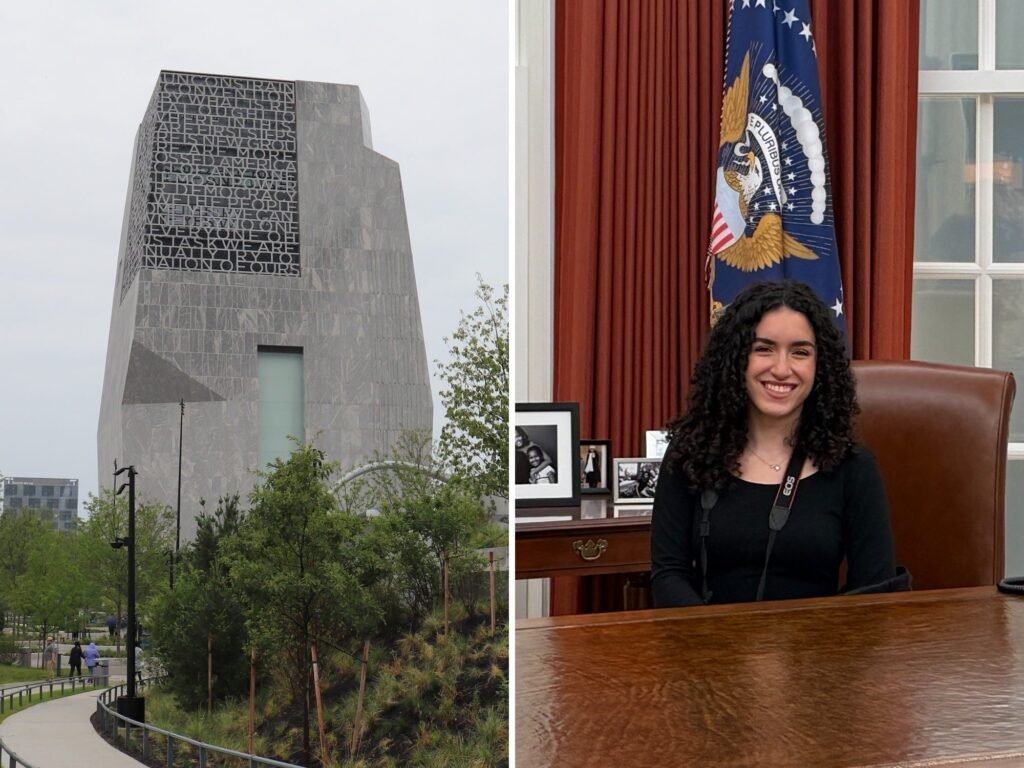
I visited the Obama Presidential Center, the most expensive presidential library in US history. Here are 15 things that surprised me most.
Kristine Villarroel/Business Insider

- The Obama Presidential Center opened in Chicago’s South Side this summer.
- The $850 million center features a roughly 19-acre public campus and an immersive museum.
- Former US President Barack Obama has the first-ever fully digital presidential library.
For over a decade, headlines have been written about the development of former US President Barack Obama‘s $850 million presidential center in Chicago — from how it would impact the surrounding community to its visually striking design.
Now, it’s open. Located on the city’s South Side, the sprawling 19.3-acre campus opened to the public on June 19.
I visited the Obama Presidential Center during its opening week, expecting an experience akin to those at other traditional US presidential libraries.
Instead, the Center challenged my assumptions through an immersive experience featuring massive art installations, interactive exhibits, and panoramic views of Chicago.
Here are some of the most surprising things I saw at the Obama Presidential Center.
Kristine Villarroel/Business Insider

Your typical Chicago travel brochure might include sights from The Loop, the Chicago River, or the historic Grant Park, but the Obama Presidential Center isn’t located near typical tourist attractions like The Bean, the Chicago Theatre, or the Art Institute of Chicago.
Instead, the Presidential Center is located eight miles south of the city’s downtown, in the historic Jackson Park in the Woodlawn community. The over 551-acre park was the site of the 1893 World’s Columbian Exposition and is home to the Griffin Museum of Science and Industry.
While the center isn’t in the city’s downtown, it is only a three-minute walk from a train station that connects to the city in an under-20-minute ride.
Kristine Villarroel/Business Insider

The center has the breathing room to house its 19.3-acre campus. The surrounding parkland, residential streets, schools, and community institutions give the grounds a spacious, neighborhood-scale feel.
While I unfortunately visited during a gray, rainy week, I was amazed by how present the outdoors felt throughout the campus.
With almost 552 acres of surrounding parkland softening the landscape, I found that the center’s brutalist, 225-foot, granite-clad tower felt far less sterile than it does in pictures.
I especially enjoyed strolling along the surrounding paths and the Wetland Walk, which connects the campus with the larger park.
Kristine Villarroel/Business Insider

Beyond the eight-story museum building, the campus is also home to two restaurants, a community garden, an auditorium, a public library, multiuse spaces, a media suite, conference rooms, a kids’ playground, and a 60,000-square-foot athletic center with a basketball court.
While I wouldn’t expect a basketball court to be part of a presidential library, the Home Court gives the campus a holistic feel.
It’s more like a community space rather than a tourist attraction.
Kristine Villarroel/Business Insider
The Barack Obama Presidential Library is the first all-digital presidential library administered by the National Archives and Records Administration.
The federal agency has legal and physical custody of the official presidential records and artifacts, which are kept at the agency’s College Park, Maryland, facility.
The Obama Presidential Center, which is privately operated through the Obama Foundation, serves as a physical, immersive interpretation of the presidency and displays selected NARA materials through a loan partnership.
The National Archives website says that the “vast majority” of the presidential records transferred to the federal agency from the Obama administration were “born digital,” including 300 million emails, which equals over a billion paper pages, as well as more than 3 million digital photographs, and 600 cubic feet of audiovisual material.
Kristine Villarroel/Business Insider
When I entered the museum’s 225-foot tower, I was surprised to find a larger-than-life video display spanning all four museum exhibition levels. The installation features historic speeches, images, videos, songs, and poetry, guiding visitors through America’s civic history.
Visitors on the lower level can look up from the atrium, and those on the higher floors see the installation from balconies. Its scale means the image changes with the viewer’s position.
The display feels immersive and gigantic in its own dynamic way.
Kristine Villarroel/Business Insider
It’s not just about the Obamas, like I previously thought. Surprisingly, the museum begins with a broader account of American history before introducing the Obama presidency. The first exhibition level traces the country’s democratic experiment and the movements that shaped the years leading to the 2008 election.
Through standout displays, the museum walks visitors through pivotal points in history, including emancipation, women’s suffrage, organized labor, and the rise of the Civil Rights Movement.
Before even mentioning the Obamas, the museum lays the groundwork of establishing the context of the America they were born into and all its historic nuances.
Kristine Villarroel/Business Insider
Two displays walk visitors through the family histories of Barack and Michelle Obama, detailing their closest relatives, earliest memories, and the communities in which they were raised.
I felt moved by personal objects on display, like Barack Obama’s elementary-school handprint art project and Michelle Obama’s family Bible, on which the former president took the oath of office in 2013.
As the museum moves into the beginnings of their joint family life, including videos in which Barack Obama discusses his wife’s role in his career, I took special notice of the couple’s wedding invitations on display, which felt especially intimate and personal to the Obamas.
Kristine Villarroel/Business Insider
One of the most expansive and educational exhibits at the Obama Presidential Center is “Yes We Can,” a detailed look at the 2008 campaign and Obama’s road to the White House.
The exhibit features various displays that trace his rise in local and national politics, using media headlines, insights, pictures, data, signs, and video to reconstruct the months leading up to the Democratic primaries.
I was particularly struck by the exhibit’s immersive experience and its detailed chronological panels showing how states voted and how Obama accumulated the delegates needed to secure the Democratic presidential nomination over Hillary Clinton.
Kristine Villarroel/Business Insider
More than 28 commissioned installations appear across the grounds, from outdoor sculptures to massive murals — and most are in spaces that are free to visit.
One of the most imposing works is Mark Bradford’s “City of the Big Shoulders,” a 38-foot-tall piece depicting the city of Chicago, which rises through the atrium near the museum exit and the lower-level café area.
Another one that grabbed my attention was Njideka Akunyili Crosby’s joint portrait of the former president and first lady located near the museum exit, which loosely reminded me of the former president’s iconic portrait at the Smithsonian’s National Portrait Gallery.
Kristine Villarroel/Business Insider
I was amused by the museum’s many interactive displays and activities, which are spread throughout the galleries and allow visitors to engage more deeply with the content and themes.
The “Democracy 101” exhibit, located on the third level, particularly made me wish I were a child playing with all the interactive and moving parts.
Designed to give visitors a basic educational foundation in how the US government and democratic system work, the exhibit features interactive screens, objects, and even a light-up poll that asks visitors to assess American democracy. During my visit, a clear majority selected the response indicating that the system could be improved.
Kristine Villarroel/Business Insider
Throughout the exhibits covering the eight years of the Obama presidency, several significant artifacts were on display, like the marriage certificate belonging to Jim Obergefell and John Arthur, the physical copy of the Affordable Care Act signed into law by the president, and an American flag signed by the military personnel who took part in the operation that killed Osama bin Laden.
Other personal items on display included Obama’s Nobel Peace Prize medal, a notepad on which the newly elected president handwrote priorities for his domestic agenda, and a selection of Michelle Obama’s most iconic dresses. The mix of policy documents and personal possessions gave the exhibit a human scale.
A personal favorite of mine — and of other visitors I spoke with — was the display of good-luck charms and small trinkets that Obama carried in his pockets during his presidency, including items like a small acorn and a bracelet given to the former president by a soldier deployed in Iraq. It felt more personal and intimate than I expected to see at the presidential center.
Kristine Villarroel/Business Insider
The last installation in the museum journey is the Nelson Mandela Sky Room, a viewing lounge at the top of the Center’s tower with panoramic views of Chicago’s South Side, Jackson Park, Lake Michigan, the Griffin Museum of Science and Industry, and the University of Chicago campus.
Visitors can access the Sky Room only via an express elevator that takes them from the fifth floor to the top floor. The elevator skips two levels, which a museum guide mentioned house administrative and utility facilities, as well as the offices of the former President and first lady.
The sudden transition from the mostly windowless galleries to the bright, panoramic room made the arrival feel almost cinematic.
The ceiling installation, Idris Khan’s “Sky of Hope,” displays thousands of hand-stamped words drawn from Obama’s 2015 “You Are America” speech, marking a reflective and inspiring end to the museum journey. The transition from the galleries to the sun-filled room felt like moving from the past toward the future. I saw many visitors sit down, take in the views, and appreciate the space.
Kristine Villarroel/Business Insider
The Center’s café had a sort of school-cafeteria feel, but the ample seating and a variety of food options made for a great break between exploring different sides of the campus.
I was impressed by the affordable prices of the fresh food. I ordered the $6 summer vegetable chicken soup and a $3 pasta salad. The costliest item in my lunch was the $7 juice from a local Chicago producer.
The campus also houses Tafari’s Kitchen, a full-service restaurant that serves lunch and dinner.
Kristine Villarroel/Business Insider
With a local community garden, a public library branch, and a children’s playground — which is a first on presidential library grounds — I thought that, beyond providing an enriching experience for visitors, the center aimed to become a centerpiece of the local community.
Kristine Villarroel/Business Insider
I had never visited a former US president’s presidential library, so I walked onto the Obama Presidential Center campus with no idea of what to expect.
Looking at pictures of some of the most recently built presidential libraries, like the George W. Bush Presidential Library and Museum in Dallas, which opened in 2013, I expected the towering structure to house the millions of records from the Obama presidency in a traditional library fashion and to include a research room where researchers can access open records.
Instead, the campus was far more dynamic than I expected, and used more than just records to tell the story of Obama’s presidency. Exhibits, art, films, landscapes, recreation, and public programming all contribute to its account of Obama’s presidency and make for an experience that combines a museum, a civic campus, and a living archive of the former president’s legacy.
Â