Alphonzo Terrell was the global head of social and editorial at Twitter, until Elon Musk’s $44 billion acquisition that led to roughly 80% of the company’s workforce being laid off—Terrell included.
But he wasted no time in creating his own social media platform, Spill, with a very clear perspective.
After years of seeing firsthand how harmful and exploitative social media can be to Black and queer folks in particular, Terrell wanted to design a space to serve, safeguard, and give equity to those communities.
The app includes features such as Spades (a popular card game within the Black community) and subcommunities for users to find their specific tribes, e.g. Foodie Spill, Art Spill, Book Spill, etc. Operating in the background of all that is an AI moderation tool the company says has a 90% success rate. And the company held a community investment round last year that allowed users to become shareholders.
It’s no wonder why just three years in, Spill is on pace to more than double signups and revenue year over year, having crossed into positive cash flow earlier this summer due in large part to brand partnerships including Netflix, Paramount+, and Gilead.
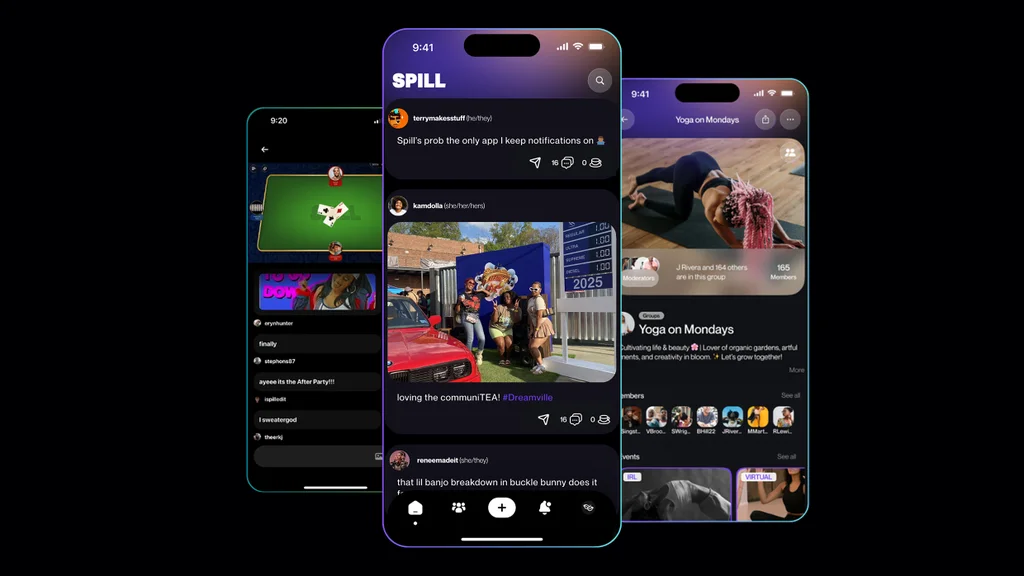
Terrell pushes back against Spill being labeled as a standalone app for Black Twitter. “I think it minimizes the power of our communities,” said Terrell in an episode of Fast Company‘s podcast Creative Control. “We didn’t own Black Twitter. We didn’t actually have agency. And it was sort of this sadomasochistic relationship of like, here’s this platform that’s constantly harming you, but yet I have to keep using it because it’s the only way I can have a microphone.”
Terrell will join a main stage panel at Fast Company‘s 12th annual Innovation Festival September 14-17 in New York City to discuss what it means to put communities at the core of your business.
But in the meantime, check highlights of Terrell’s episode of Creative Control below and be sure to listen to the episode in full on the audio platform of your choice.
On defining what Spill really is . . .
“We’ve evolved and clarified our value prop today that’s actually fundamentally different [than being Black Twitter]. We really see Spill as an operating system for fandom—and more importantly, culture-forward fandom.
When you find a place where you can be around other people that love the same thing that you love, it’s an immediate belonging. And many of us are not honest about how weird we are. And so these platforms and these tools became an incredible way to find people that were into superspecific niche things.”
On driving revenue through community . . .
“We have a really robust intelligence engine where we can tell you basically what our communities think about pretty much any topic under the sun, from Black maternal health to a new campaign about a new sauce. And that’s been really helpful for the brands. . . . A lot of these brands don’t want to make mistakes that can be costly or end up in situations where they’re getting boycotted and probably could have avoided that if they came and talked to platforms like us. We’re not a market research firm per se, but we have first party data and intelligence that nobody else has. And we want to use it so that people can make better decisions that benefit our communities.”
On maintaining trust while working brands . . .
“Anything that would hurt or harm the communities that we are built to serve and that we are every day working our asses off to build and maintain trust with is antithetical to our business model. It’s not even personal at that point or moral. It’s just, this would be bad for business.
[It’s] really about calculating short-term gain versus long-term gain. If you want to take a deal from something questionable now, maybe. But then think about six months, 12 months down the line, 24 months—if that trust breaks, your business breaks. And was that worth the cost of one deal? Most often that’s actually not that hard of a calculus to make.”
Join thousands of business leaders, makers, and innovators at Fast Company’s 12th annual Innovation Festival in New York City this September 14-17. Purchase your festival pass today and save. Standard rates end Friday, August 21.