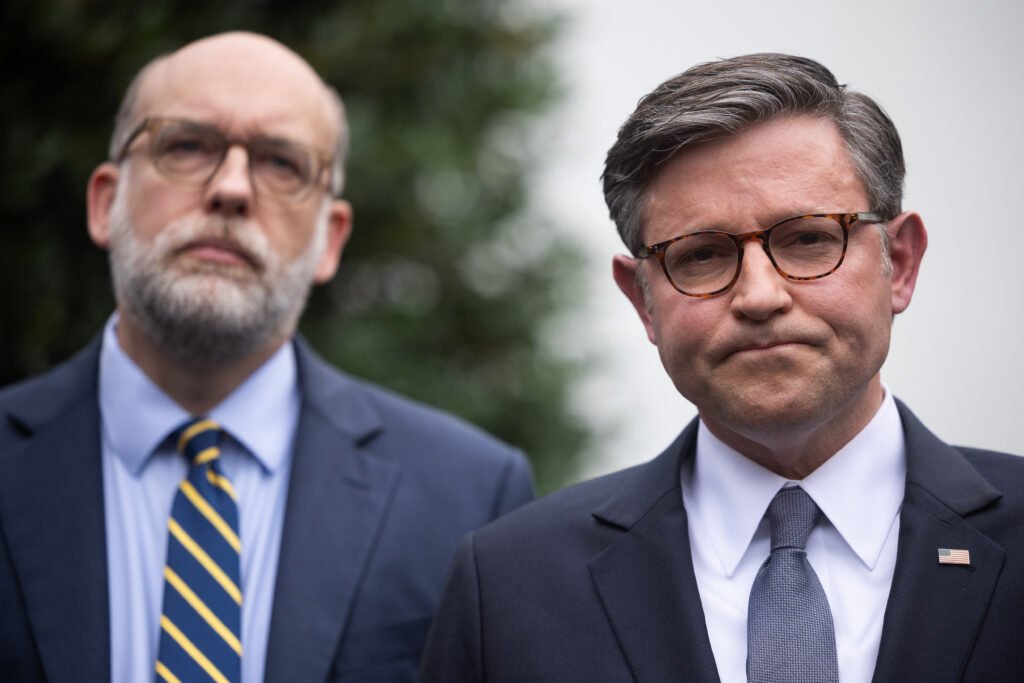
Speaker Mike Johnson and White House budget chief Russ Vought tried to rally House Republicans on Tuesday morning around passing a party-line package containing the administration’s $95 billion supplemental funding request for the Iran war and farm aid — by promising members they’d get another chance to pass a more sweeping partisan policy bill after the midterms.
A group of GOP holdouts, however, has yet to fully fall in line ahead of a critical vote Wednesday on a budget resolution that would pave the way for a filibuster-skirting reconciliation bill containing the war and agriculture funding plus components of the so-called SAVE America Act.
Rep. Tim Burchett (R-Tenn.) said the pitch “wasn’t that compelling.”
Johnson and Vought told House Republicans at the closed-door conference meeting Tuesday morning that the vote on the budget resolution Wednesday was simply a first step, according to four people inside the room.
Vought also argued the political realities in the Senate shaped the package the White House and House GOP leaders are currently pushing.
Johnson cannot lose more than a tiny handful of Republicans on the budget resolution, and he’s already lost at least one: Rep. Warren Davidson (R-Ohio) said in an interview Monday he planned to oppose the resolution and was not at all moved by the argument for a fourth reconciliation bill.
There’s also a procedural rule vote Tuesday afternoon paving the way for floor consideration not just on the budget blueprint but a stopgap government funding package, the annual defense policy bill and legislation to crack down on congressional stock trading. Republicans could vote down the rule to prevent any one of these measures from advancing.
House Judiciary Chair Jim Jordan (R-Ohio) said he thought Vought’s pitch could have some resonance given the stakes of the ongoing conflict in the Middle East.
“I thought Russ did a good job laying out why this approach makes sense,” Jordan said in an interview. When you’ve got a military operation, you’ve got to replenish the bullets. And I don’t think the Democrats are going to vote for that, so I don’t know how else to do it.”
He also said he thought most fiscal hawks did understand and appreciate the argument that approving supplemental funding through reconciliation — even without offsets — will cost less than negotiating a supplemental with Democrats.
“We’re going to know here in a few hours — we’ve got a rule vote coming up,” Jordan added.