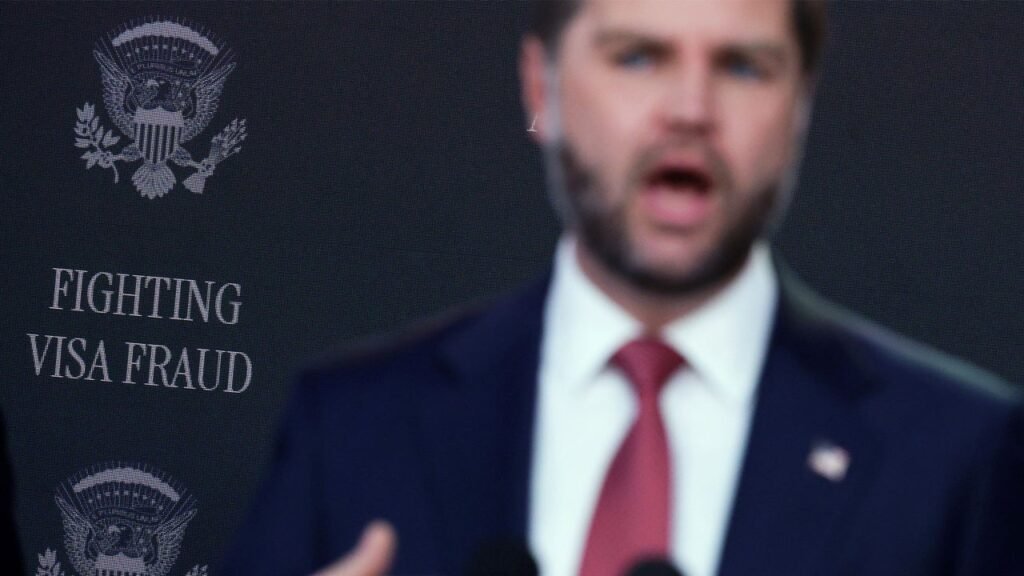
Microsoft and Adobe have been suspended from the H-1B visa program, Vice President JD Vance announced Thursday, amid accusations that they and other companies have extensively abused the system to hire cheaper labor.
“This is a great day for American workers, because we are taking some very concrete actions to cut down on some of the H-1B and J-1 visa fraud that we’ve been tracking over the past several months,” Vance said at a Thursday morning press conference.
Microsoft and Adobe did not immediately respond to requests for comment.
The J-1 visa is for foreign students, teachers, researchers and a few other visitor categories. The H-1B program allows companies to hire nonimmigrant foreign workers for roles that require specialized knowledge when they can’t be filled by the U.S. workforce.
Vance said the latter program has become “rife with fraud over the last several years—probably the last several decades.”
Rather than use H-1B visas for their intended purpose, he said, companies and outsourcing firms are using it to replace American workers “with what is effectively foreign indentured servants,” who are “being mistreated by their employers and being used to undercut the wages of American workers.”
Broader Trump crackdown
The announcements follow an executive order in September that announced a review of the program’s application data, alleging “large-scale, systematic abuse” by companies.
The order—which comes from an administration whose attacks on science and research have been documented extensively—also characterized the abuse as a national security threat for discouraging Americans from “pursuing careers in science and technology.”
The Trump administration has taken other actions to rein in H-1B visas, including last year’s announcement of a $100,000 fee for new applications, causing backlash and legal challenges.
Roughly 400,000 H-1B visas were approved in 2024, according to Pew Research, more than double the number approved in 2000.
Tech companies singled out
Vance said that no company has abused the program more than Microsoft, which he said laid off 6,000 American workers last year while benefiting from “6,300 H-1B visas and almost 3,000 green cards.”
The secretary of Labor, Keith Sonderling, also announced that the program would no longer take applications from several major outsourcing firms, which supply companies with foreign candidates.
The U.S. tech industry relies heavily on H-1B workers, who earn on average 16% less than their American counterparts, according to a National Bureau of Economic Research paper.
In the 2024 fiscal year, 64% of H-1B visa recipients worked in computer-related occupations, according to federal data.
The H-1B program “is now the major pathway for employment-based immigrants to enter and stay in the United States,” according to a study published in International Migration Review this year, creating a power imbalance between employers and migrant workers.
Criticism across party lines
Criticism of the H-1B program has previously caused infighting among Trump’s associates, and crossed party lines.
Bernie Sanders said last year that he disagrees with claims by Elon Musk and other tech titans that the program is vital due to a scarcity of highly-skilled American workers.
The independent senator from Vermont said that corporations will lay off American workers while hiring new H-1B workers, even though U.S. Census data indicates that millions of Americans with advanced STEM degrees are not employed in their field.
“The cheaper the labor they hire, the more money the billionaires make,” Sanders said.
At the press conference, Vance said the government also sees “a lot of J-1 visa fraud,” naming nine universities “that we believe merit an investigation,” claiming they employ J-1 visa students to work on federally funded grants at a rate much higher than the national average.
“We cannot allow visa programs that were designed to ensure that American corporations had access to the best and the brightest to use them to undercut the wages of American workers,” Vance said.
“Now, it’s one thing if you want to bring in a person like Elon Musk,” he added. “Obviously, if that person wants to come in and build something great in the United States of America, we support that.”
Musk, who immigrated from South Africa, has previously defended the H-1B program, vowing that “I will go to war on this issue.”
He has held both J-1 and H-1B visas, and has been accused of violating the terms of the former, which he has denied. His company, Tesla, is also facing a class action lawsuit that alleges it of having a “systematic preference” for hiring H-1B visa holders and disproportionately firing U.S. citizens.
Shares of Microsoft Corporation (Nasdaq: MSFT) fell after the announcement on Thursday, closing 1.35% lower. But the stock was up about 1% in premarket trading on Friday as of this writing.
Adobe Inc (Nasdaq: ADBE) stock was up 3.56% on Thursday despite the announcement.