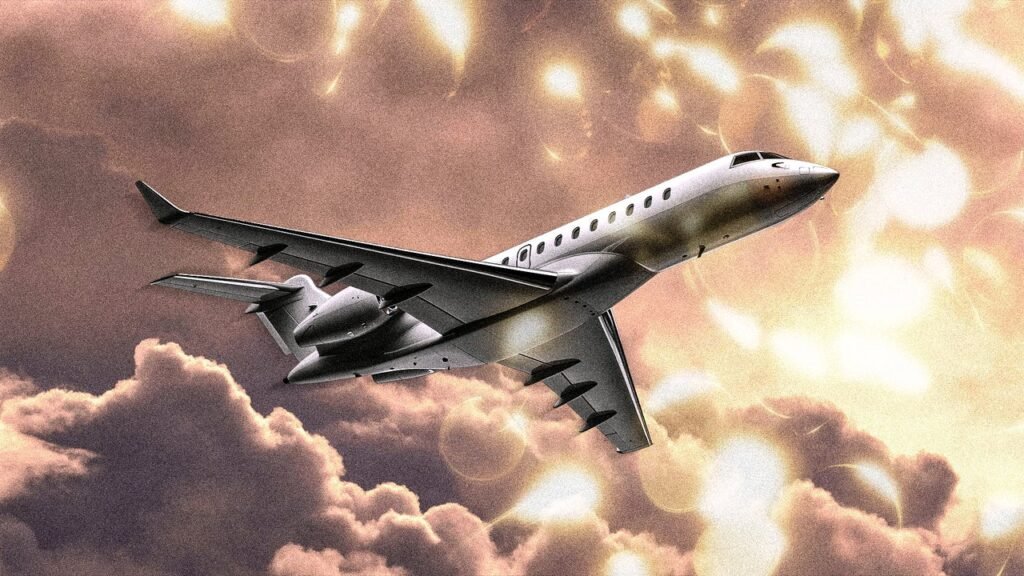
Just a tiny portion of the population flies on private jets, but those jets make an outsized impact on the planet.
And though most Americans don’t fly private, they’re helping subsidize those flights through their taxes.
That’s according to a new report by the Institute for Policy Studies (IPS), which lays out these impacts of the private jet industry and what it calls the “high cost of private jet excess.”
When it comes to the climate impacts, private jets are particularly polluting. A passenger on a private jet is responsible for up to 14 times the emissions as someone on a commercial flight.
And because private jets fly at higher altitudes, the exhaust from those planes creates contrails that are especially good at trapping heat, which warms the planet. This climate effect can be two to four times greater than the impact of CO2 emissions alone.
Land of the free, home of the jets
Though the U.S. is home to just 4% of the world’s population, the report notes, it’s the site of more than two-thirds of the world’s registered private jets. Sixty-five percent of all private jet operations take place in U.S. airports.
This means U.S. private jet flights contribute more than half (55%) of all the greenhouse gas emissions produced by private jets.
These jet owners don’t pay their fair share of taxes, IPS argues. Noncommercial private jets account for 7% of the country’s airspace activity. Yet they contribute less than 0.6% of the taxes that go into the Airport and Airway Trust Fund, which helps finance the Federal Aviation Administration (FAA).
Private jet owners also get the benefit of public infrastructure funding.
More than a third of all Airport Infrastructure Grants—part of a program created by the Biden administration’s Bipartisan Infrastructure Law—awarded through 2026 went to airport projects that may primarily benefit private jets. That comes to more than $1.13 billion in grant funds.
Private jet owners may get an even bigger pass on taxes soon. The ALERT Act, which passed in the House in April, is focused on aviation safety. Included in the bill, though, is a provision that would make it easier for private jet owners to avoid paying state and local taxes on those aircrafts. (That bill has not yet passed in the Senate.)
The unequal skies
IPS often highlights wealth inequality across the country. And the problem of private jets is tied to that inequality, the report highlights.
About 256,000 people, or 0.003% of the global population, fly on private jets. The combined net worth of that group, per the report, is $31 trillion, with average wealth of $123 million.
That figure includes those who are fractional private jet owners, a system in which people buy shares of a jet so they get a certain amount of guaranteed flight hours without having to purchase an entire aircraft.
Fractional private jet ownership is a booming business: Between 2019 and 2025, this kind of ownership increased 65%. In the first six months of 2026 alone, NetJets, a fractional jet service by Berkshire Hathaway, reported a 15.5% year-over-year revenue increase.
“The rest of us should not have to pay for the luxury excess of the private jet billionaire class,” report co-author Chuck Collins said in a statement. “Our hard-earned tax dollars shouldn’t subsidize their reckless air travel habits that further harm our warming planet.”
Alongside the report, IPS launched a Private Jet Emissions Tracker, which measures the emissions of specific private flights out of specific locations, and at certain times, like tied to the Super Bowl or Kentucky Derby.
That tracker was piloted for the 2026 World Cup. It found a total of 92,000 private flights to and from World Cup host cities, which contributed almost 150 kilotons of CO2, the same as more than 34,000 gas cars driving for a year.