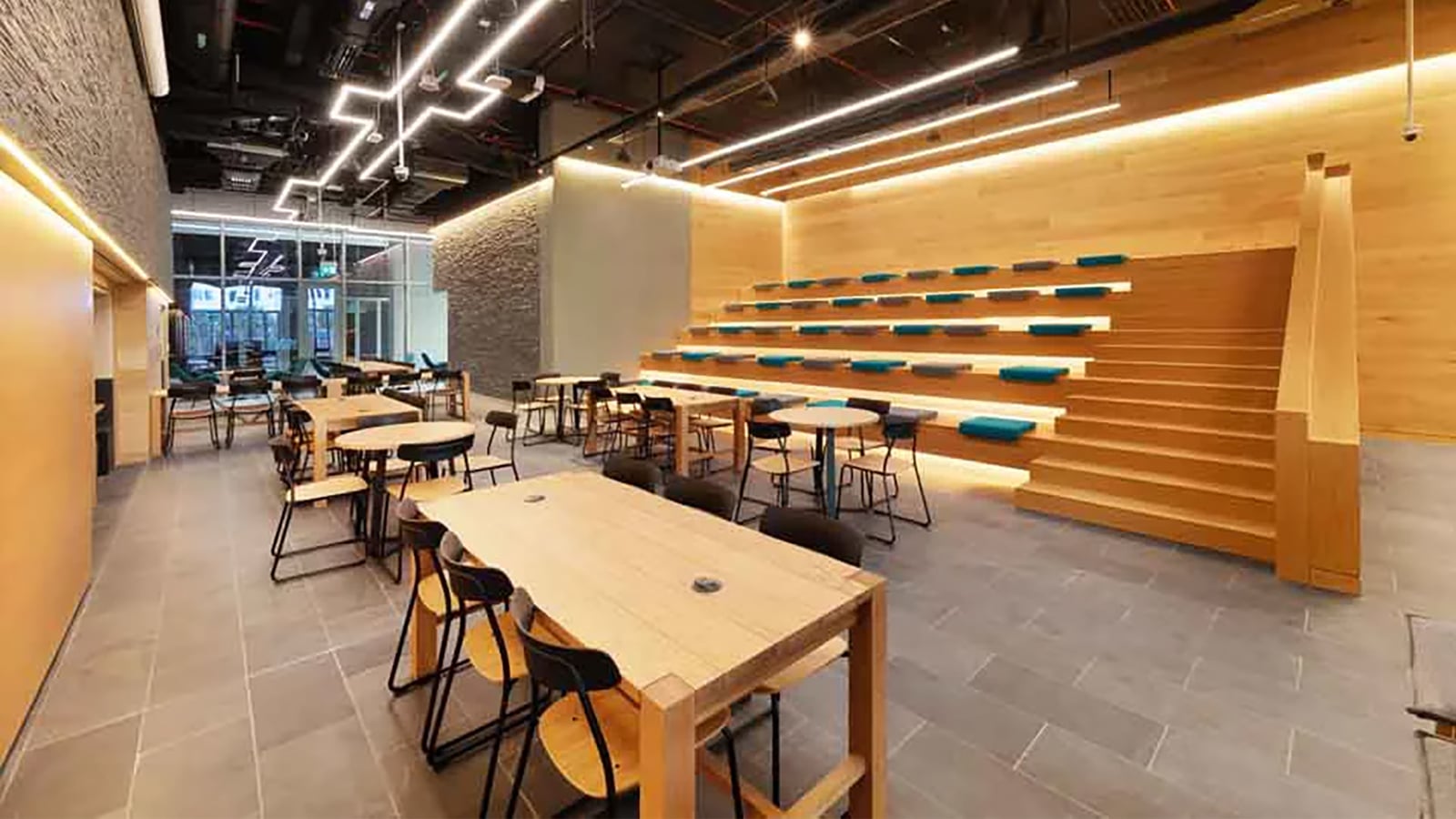
Photo Credit: Heriot-Watt University, Dubai, courtesy of JLL
Anyone who’s attended a high-level educational institution, such as a college or university, knows about lecture halls. Built like amphitheaters, complete with fixed seating and on-display professors, these massive spaces have been a part of advanced teaching for millennia.
But according to a JLL article, those lecture halls of yesteryear are dinosaurs and have no place in today’s educational process.
Universities are “recognizing that fixed-tier seating, lecture-heavy content and rigid presentation formats fail to support modern learning styles,” the article said. This requires converting thousands of square feet of campus space from static halls into a multipurpose environment.
According to the article, the modern workplace could be a good guide to such a shift.
From Cubes to Adaptation
“Cube farms” were once a popular workplace feature. Not so much these days.
“Offices have been designed on the basis that people work best when they are empowered to choose from a variety of spaces, be it individual work areas, collaborative team set-ups or presentation environments,” Sally Edelsten, director, design and asset experience, PDS Advisory, JLL, said in the article.
Edelsten also suggested that universities that swap out lecture halls for multi-functional spaces will see a dramatic change in how students engage with their campuses, as “these are the spaces that get constantly used consistently through the day, not just during scheduled hours.”
Just as space choices seem to improve workplace performance, JLL said the same could help improve students’ performance.
How Students Learn
JLL said that converting lecture halls into “active learning commons, where students naturally converge between formal sessions” can help support different pedagogical methods and various learning types.
For example, a 2020 study showed that 15% to 20% of the global population was neurodivergent, which includes diagnoses such as autism spectrum conditions, attention-deficit disorders, dyslexia and dyspraxia.
Universities incorporating multi-zone areas, such as spaces that support quiet focus and reduced sensory stimulation, could help support neurodivergent students who might not accomplish as much in the standard lecture hall.
“Rather than abandoning large group learning, neuro-inclusive design creates spaces flexible enough to support traditional lectures when needed, while enabling reconfiguration for seminars, group work or individual study,” the article said.
Considerations for Transformation
The article suggested five principles for incorporating workplace designs into campus interiors:
- Offer choice and variety, such as focus areas, presentation environments and collaborative zones
- Design active transition zones by turning hallways into areas where interaction and social learning take place between more formal sessions
- Focus on neurodiversity principles, which might include adjustable lighting, various acoustics, clear wayfinding and different seating options
- Incorporate flexible reconfiguration by integrating technology, flexible walls and more that shifts traditional lecture spaces to seminars and independent study locations
- Balance autonomy with connection by offering space that accounts for individual work preferences as well as collaborative skills
The post Not Your Parents’ Lecture Hall appeared first on Connect CRE.