Shortly after Frank Telles arrived at Northern Arizona University to start his Ph.D., researchers announced that they had just radiocarbon-dated a set of fossilized human footprints found within the gypsum dunes of New Mexico’s White Sands National Park. Sandwiched between two layers of ancient grass seeds, the fossils revealed that people were living in the region as long as 23,000 years ago.
For Telles, an Earth scientist whose own Chihene Nde Nation considers White Sands part of their ancestral territory, this peripatetic time stamp provides a fundamentally human benchmark for his research. It also means his most recent findings—on the impact of Spanish colonization on dust regimes of the American Southwest—literally just scratch the surface.
“They’re lakes, but I call them dust catchers. My lake has been capturing dust for at least 3,400 years.”
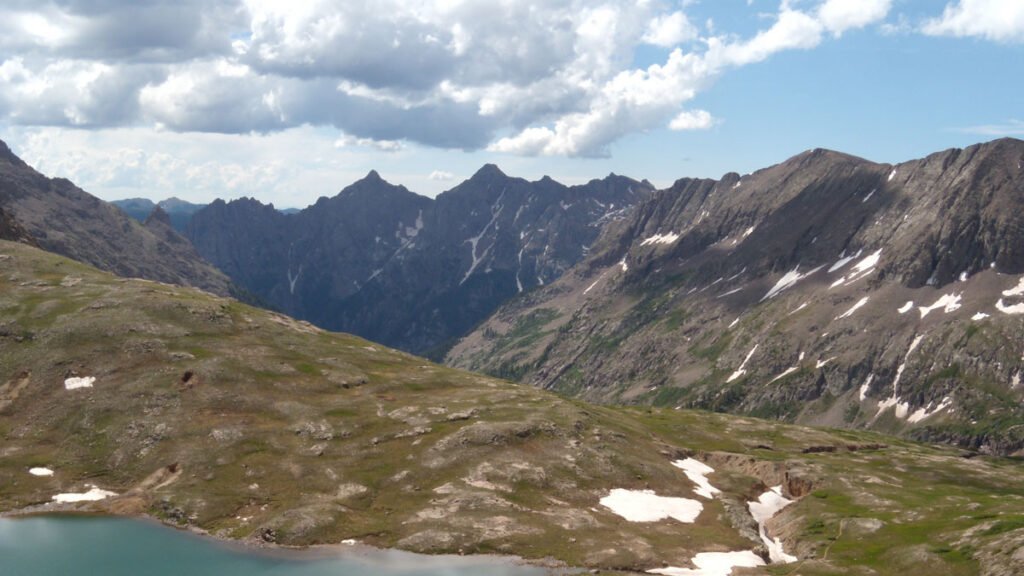
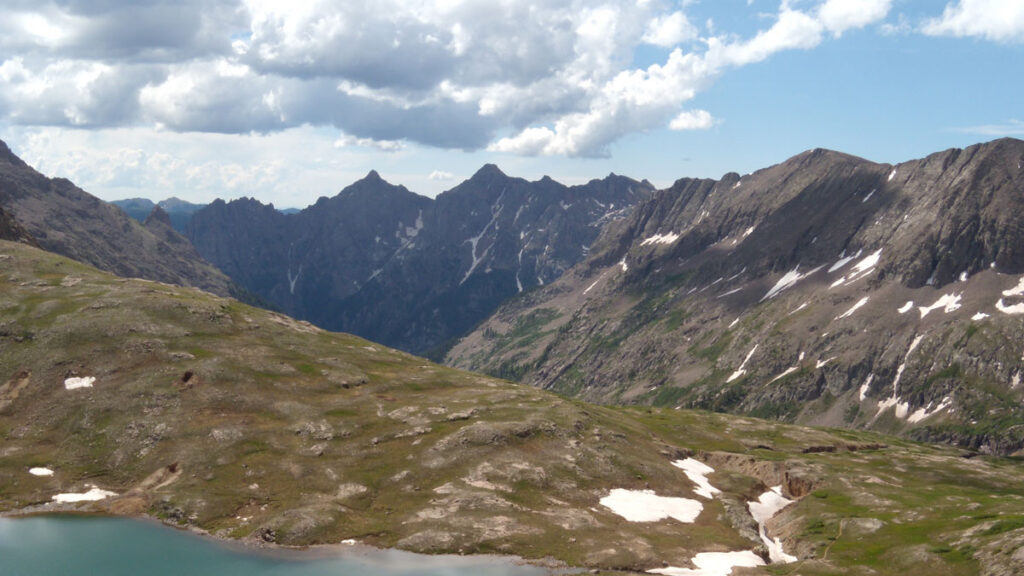
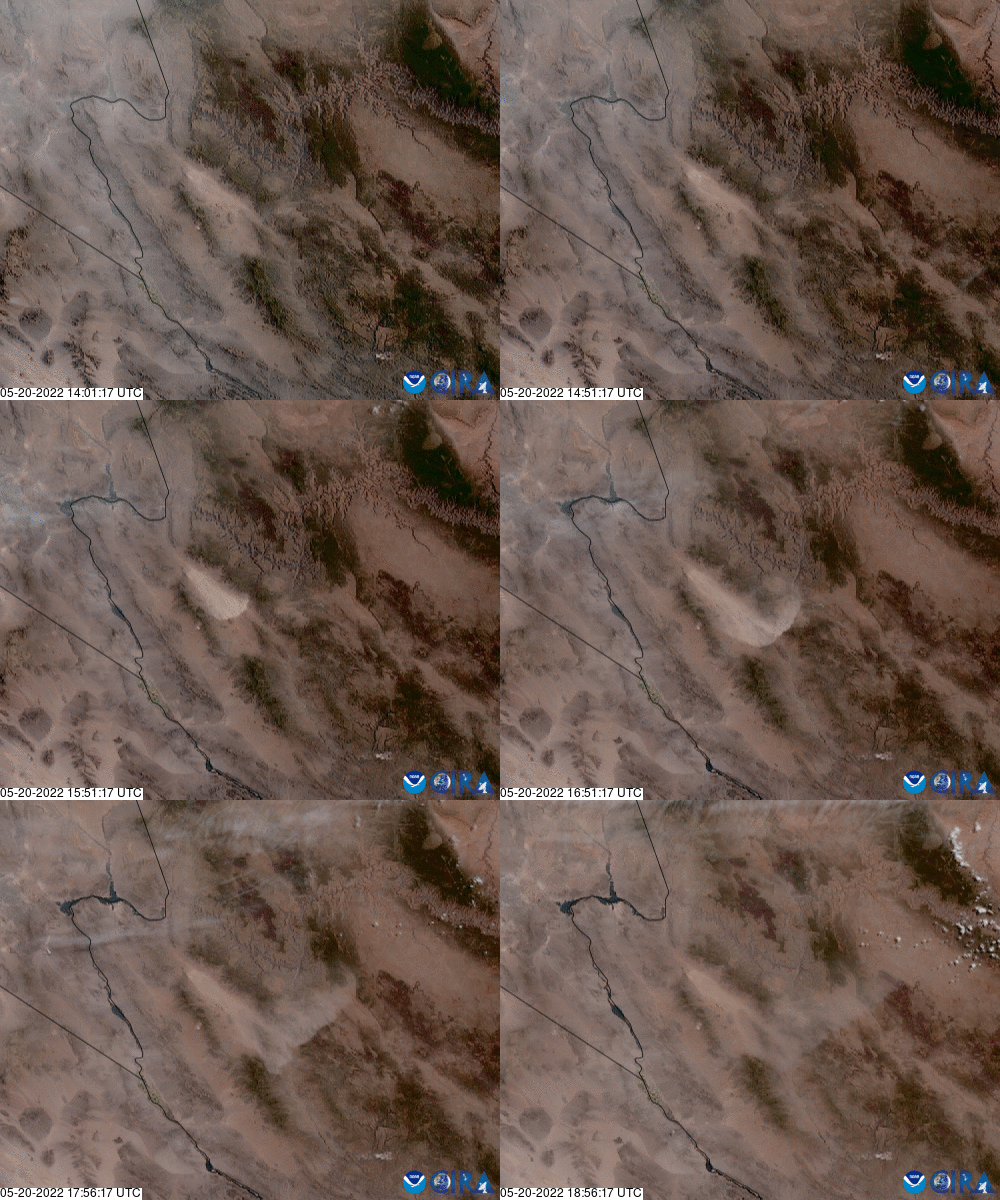
Previous research on the American Southwest has suggested a link between a rise in dust mass accumulation rates (DMAR) and westward settler expansion in the 19th century. But in a new paper published in Anthropocene, Telles and his colleagues concluded that a substantial increase in dust levels in the Southwest occurred about 200 years earlier, too. The findings stem from a 4-foot sediment core gathered from the bed of Columbine Lake, an alpine lake nestled in the San Juan Mountains of Colorado.
“They’re lakes, but I call them dust catchers,” Telles explained. “My lake has been capturing dust for at least 3,400 years.”
Catching Dust
Collected by Telles’s coauthor, Stephanie Arcusa, the delicate sediment core is made up of thousands of annually resolved layers that document millennia of dust carried north and east from thousands of square kilometers of arid deserts, mesas, and shrubland.
Accurately demarcating thousands of years’ worth of mud contained within a thin plastic tube is no small feat. Layers often bleed into one another, making precise delineations difficult. Arcusa’s 2022 methods paper, however, combined counts from multiple observers with radiometric benchmarks (such as cesium fallout from 20th century nuclear testing and preserved crustacean eggs dating back more than 2,000 years) to peg the sample decade by decade.
This granularity enabled Telles and his colleagues to pinpoint changes in dust circulation within the context of human land use practices. Beginning around 800 CE, after a period of significant drought, DMAR began to decline, eventually reaching a low around 1350. This period corresponds to the advent of intensive but sustainable land use practices by Ancestral Puebloans, who experienced immense population growth around what is now the Four Corners region of the United States (encompassing sites in Colorado, Utah, New Mexico, and Arizona). Around the 12th and 13th centuries, however, a series of megadroughts likely contributed to mass migrations of Ancestral Puebloans to the south and east.
“But then something happened in 1540. What happened in 1540?” Telles asked rhetorically. “First contact!”
Left in the Dust
Early Spanish conquistadors arrived in the Americas in the 16th century. In 1598, the viceroy Juan de Oñate ventured north from Zacatecas, central Mexico, to colonize Spain’s newly acquired territory in what is now New Mexico.
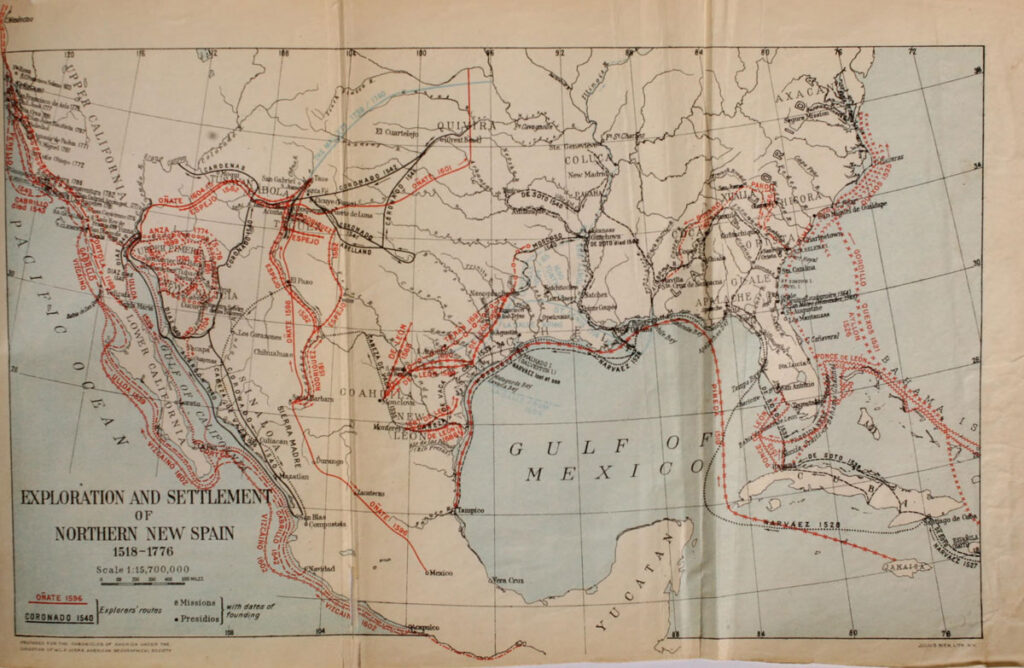
Oñate brought with him more than 400 colonists, 1,600 cattle, 3,400 sheep, 60 pigs, and 1,300 horses. The colonists introduced practices of extractive, monocultural agriculture, including the displacement of native maize (corn) by water-craving wheat. Spanish taxes, meanwhile, could be paid in sheep’s wool.
“[These animals] destroy the native vegetation,” Telles explained. “And that destroyed the blanket that sequestered dust in the ground. So the geomorphic response is, when the spring winds came through—those southwesterly winds that create huge dust storms—that dust made it downwind into the Colorado Rockies.”
“Oftentimes science is quite abstracted from the human realm. But once we’re asking these more anthropogenic questions, it’s inherently combined, right? It needs to be transdisciplinary.”
Cam Chavez Reed, a 13th-generation New Mexican and a geomorphology doctoral student at the University of New Mexico studying the science of landscapes, commended Telles’s approach, which integrates cultural history into geoscience.
“Oftentimes science is quite abstracted from the human realm,” Reed said. “But once we’re asking these more anthropogenic questions, it’s inherently combined, right? It needs to be transdisciplinary.”
This transdisciplinary approach includes drawing not only from the intersections of history and geography but also from within different branches of Earth science, Telles said. “The rock record, the superposition of sediments, the atmospheric dynamics, the geomorphology: That’s how we think, as Indigenous people. So we’re bringing that into the sciences.”
When the Dust Settles
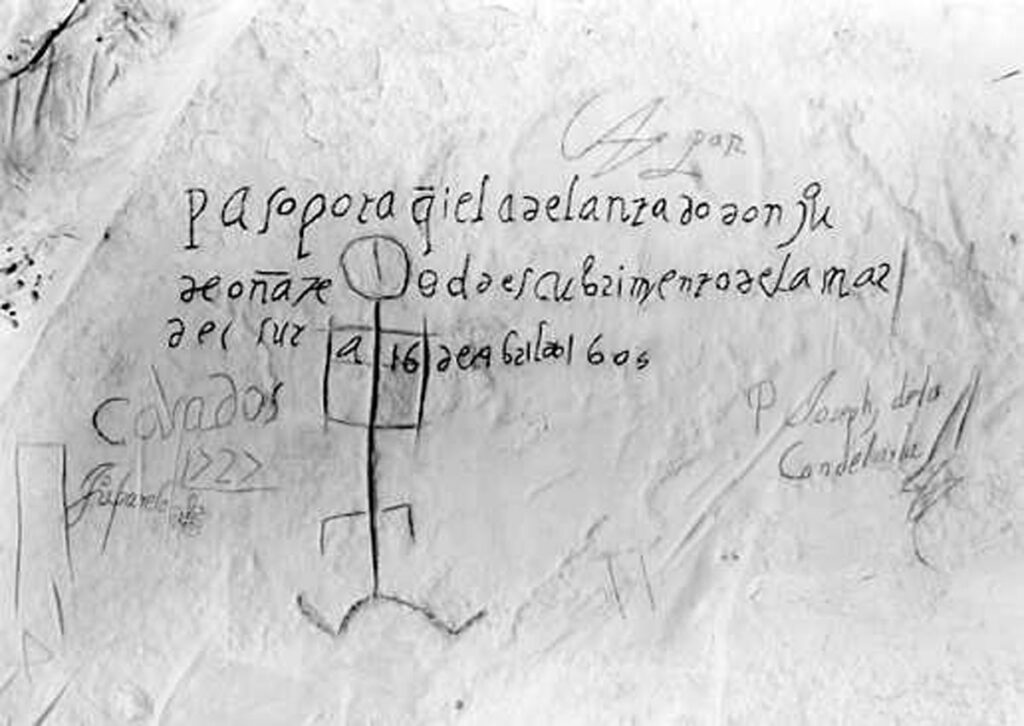
Both Reed and Telles advocate for seeking ways that human history is written into the stones, sometimes quite literally. New Mexico’s El Morro National Monument, for example, contains more than 2,000 signatures carved into its face, from Ancestral Puebloans to American pioneers and even Juan de Oñate himself.
“This is inherently place-based research, rooted in the Southwest,” Reed said. “It is really targeting anthropogenic change, interrogating the colonization of landscapes. It’s not just a natural regime shift on a cyclical, millennial scale: These are human-induced, a lot of it caused by colonial projects, that are not single events. It’s an ongoing project that still moves on today.”
Telles, who spent years teaching high school science in New York City before embarking upon his doctoral studies, also stressed the importance of integrating Indigenous values and knowledges into education and scientific practice, citing programs like the National Science Foundation’s Center for Braiding Indigenous Knowledges and Science.
“My objective in life,” Telles said, “would be to get community members to partake in the science.”
—Jonathan Feakins, Science Writer
Citation: Feakins, J. (2026), Pay dirt: How colonialism left its mark on the soil of the American Southwest, Eos, 107, https://doi.org/10.1029/2026EO260208. Published on 29 June 2026.
Text © 2026. The authors. CC BY-NC-ND 3.0
Except where otherwise noted, images are subject to copyright. Any reuse without express permission from the copyright owner is prohibited.