Editor’s Note: This story was produced with the support of the Round Earth Media Program of the International Women Media Foundation.
Rawya El Chab showed up to an interview in Brooklyn in February after teaching her performance class for children in Sunset Park. Many of her students have parents who are immigrants. In recent months, some have been uncharacteristically silent. When El Chab asked, they said they were afraid of ICE taking their family members.
It reminded her of living in Beirut under Syrian and later Israeli occupation in the 1980s. “We could feel the presence of a force that was censoring our speech,” she said.
That sense of being surveilled is all too familiar. It has become a throughline in much of the work the 45-year-old artist has produced in the last two decades. It brought her from interactive theater forums in Palestinian refugee camps and rural villages in Lebanon to explorations of clowning and death with older adults in nursing homes.
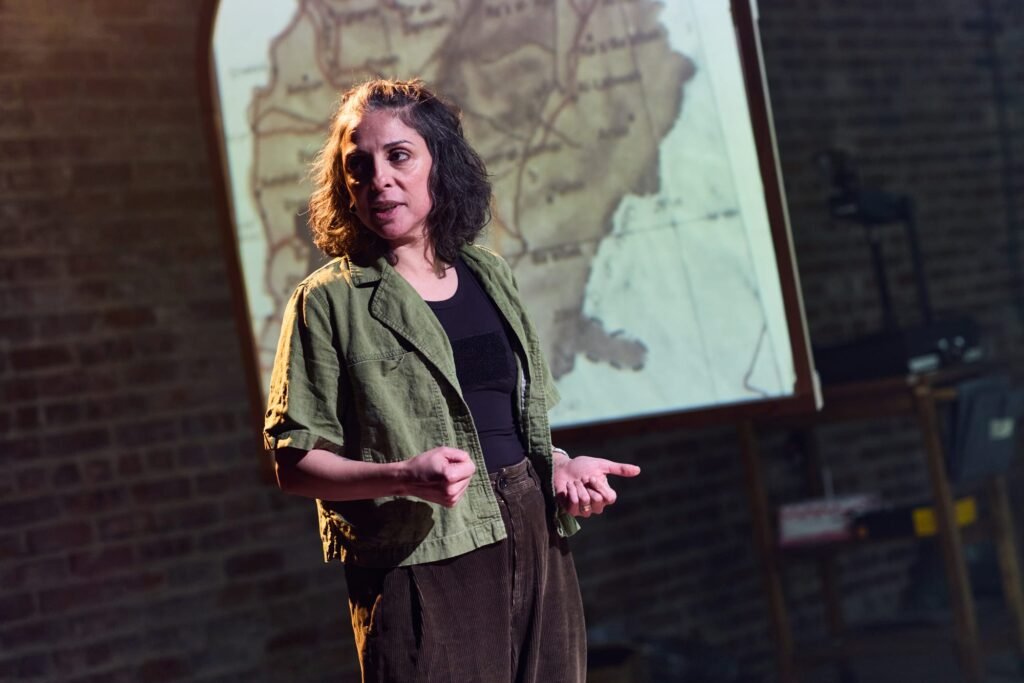
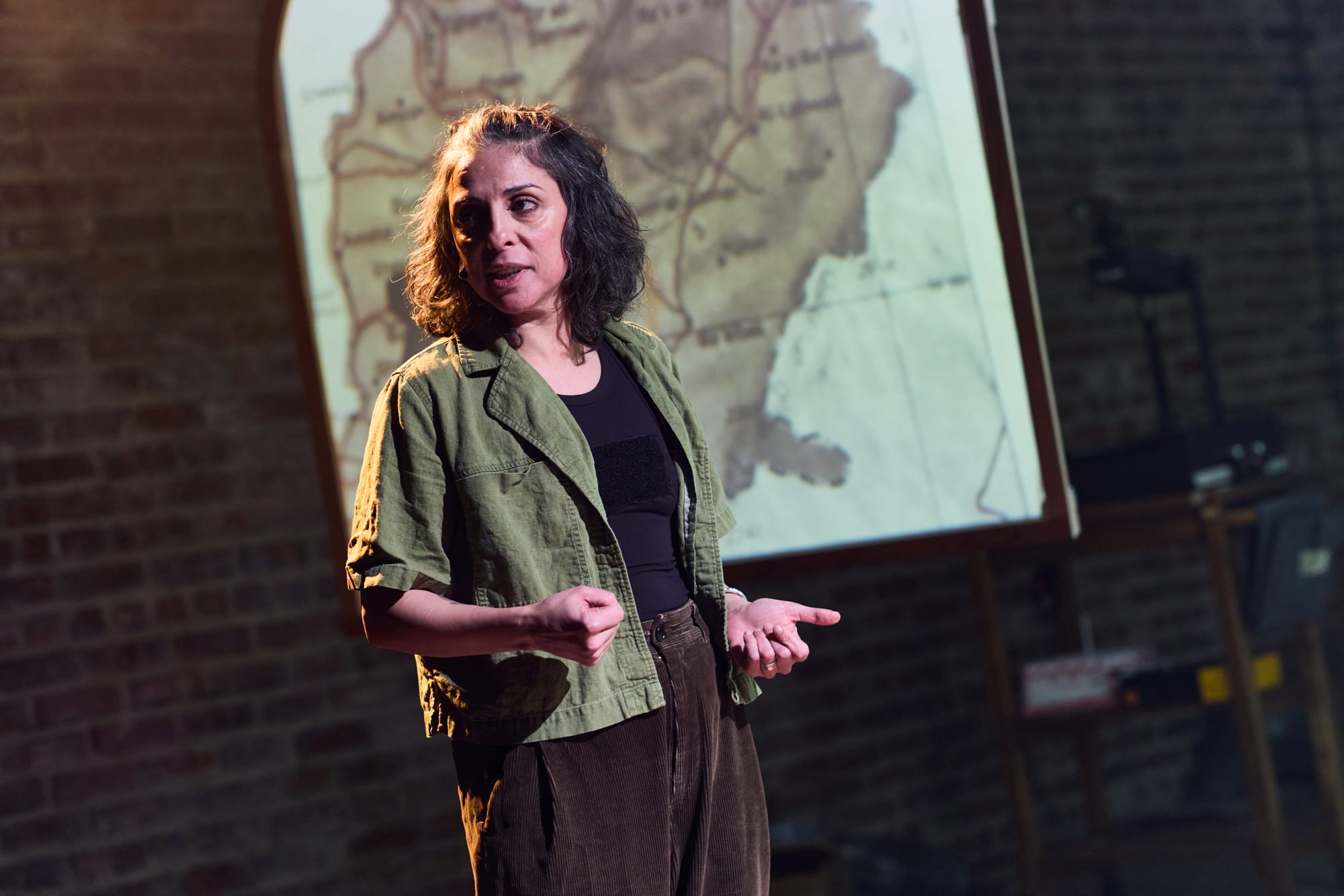
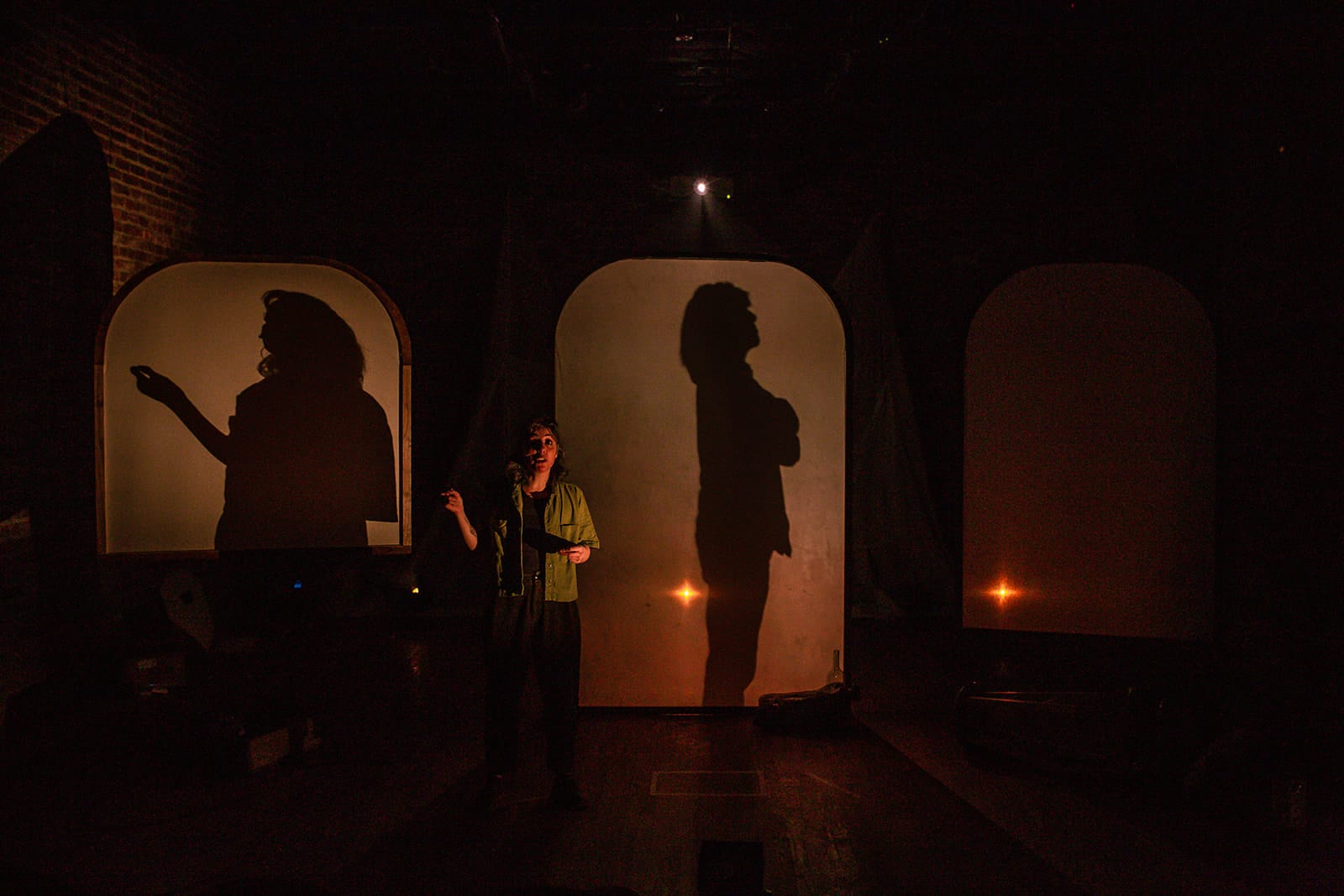
The stories that are told about others rework themselves constantly through her work. In an early scene of Crossing the Water (2025), El Chab’s performance at The Brick in Brooklyn last winter, she rows her way across the River Styx. “Don’t worry,” she comforts the audience as a deep rumbling echoes around her. “It’s not the first time I die.”
For El Chab, mythology and storytelling hold particular meaning. “Storytellers like to travel, and like to carry their stories, and like to hear other people’s stories,” she said.
This performance, the second in a three-part series that unfolds around the rise and fall of the Lebanese Left in the 1980s amidst the Civil War, the establishment of Palestinian resistance movements, and the Israeli invasion and occupation of Lebanon, finished its run in December. As war continues to rage in southern Lebanon, where El Chab’s family is from, she finds a particular need to counter the distorted portrayals of her home country.
“While these people are being erased,” she said. “I want to anchor this reality by telling these stories.”
For El Chab, this history is deeply personal. When Israel invaded Lebanon in 1982, her father, who had written for newspapers in Lebanon and feared retaliation under the new government, fled to Abidjan in the Ivory Coast, following other Lebanese fleeing the Civil War. She and her mother followed him a year later.
The idea of the series started during a discussion with a friend about the legacy of her cousin, Loula Abboud. A Communist fighter who died in what was described as a suicide bombing during the Civil War, Abboud was subsequently mythologized as “the Pearl of the Bekaa.” El Chab first engaged with her legacy in a 2024 performance that wove together science fiction and dystopian elements, marking the opening chapter of her trilogy.
In Crossing the Water, El Chab tells the history of the Israeli invasion and occupation of Beirut in 1982, and her and her mother’s flight from the city the following year. El Chab – whose memories of the time come mostly from what she later heard – tells this history by slipping between roles: embodying her neighbors in Beirut, who grow suspicious of Israeli infiltration; satirizing politicians through puppet-like caricatures; and appearing as herself — a child, passing through checkpoints as she and her mother flee Beirut to join her father in 1983.
Much of El Chab’s work centers on the transitions and losses of emigration — trying to insert the humanity of her experiences, of those who lived something similar to hers, as they deal with the realities of living in this part of the world.
At first, El Chab envisioned this series for New Yorkers unfamiliar with Lebanese history. But through her performances, she realized that her work resonated more broadly. “It felt like, ‘oh, this is a story about us,’” she said. Lebanese, Palestinian, and Syrian audience members would come up to her after the show. “All these Arabs who want to see their stories being told from their own point of view, and from their own experience.”
“I have people who come from different places who come to me: ‘Oh, you know what? My father who survived Pinochet tells me about this;’ ‘my aunt who was in Russia when Stalin died had a birthday under the table’,” she said. “And all these stories that are emerging because people get to listen to these specific stories.”
“We need to dehumanize people to kill them,” she added. “What I’m trying to do with my stories is to bring the complexities, which is the humanity of the people I lived with, and share it with others to try to make space for this reality too.”
That’s the approach she chose in Crossing the Water. “I wanted to tell the story from the point of view of my heroes, who are my parents and their generation, these men and women who participated in the struggle and who never really had their point of view told on stages in New York,” El Chab said.
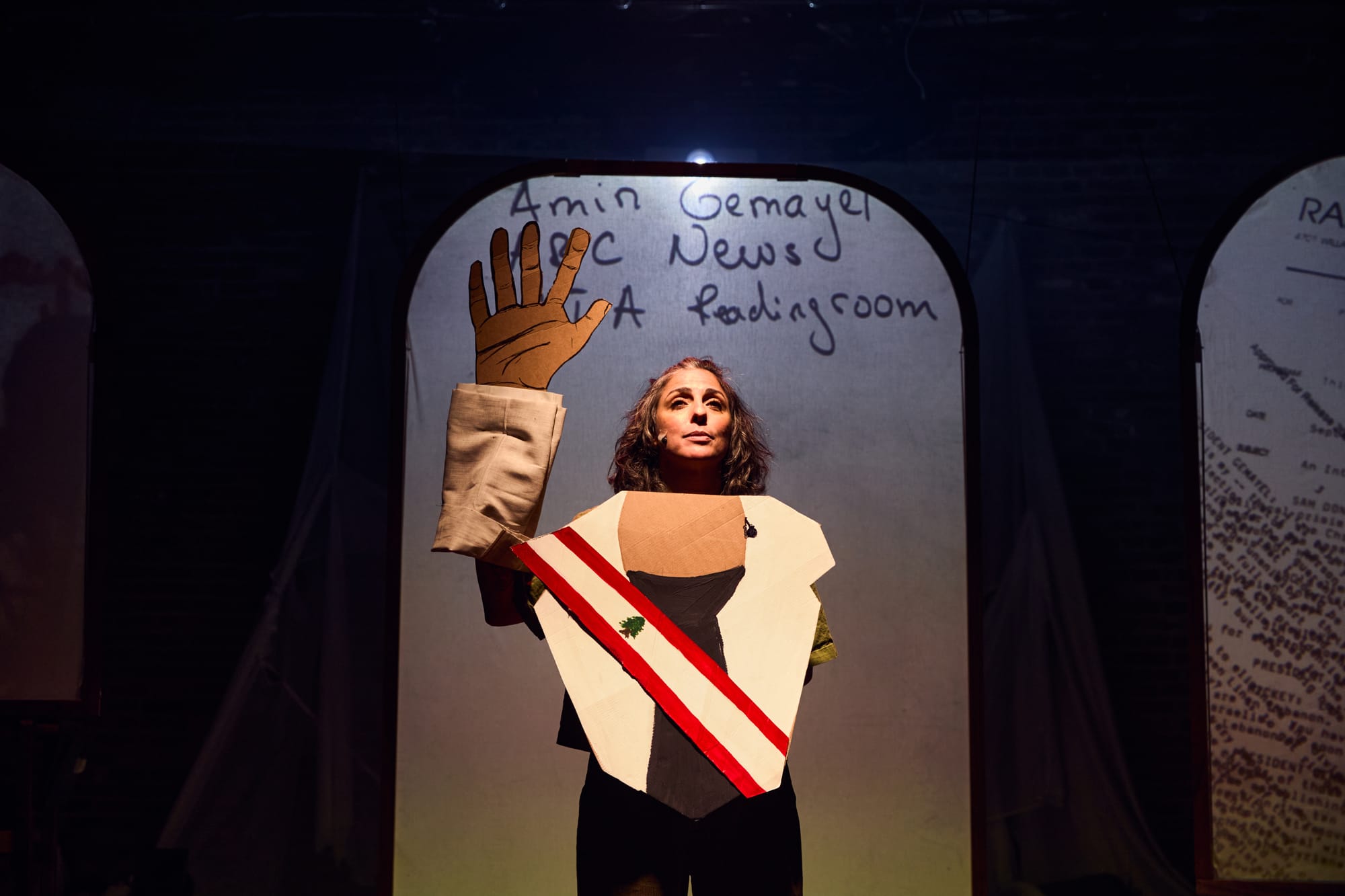
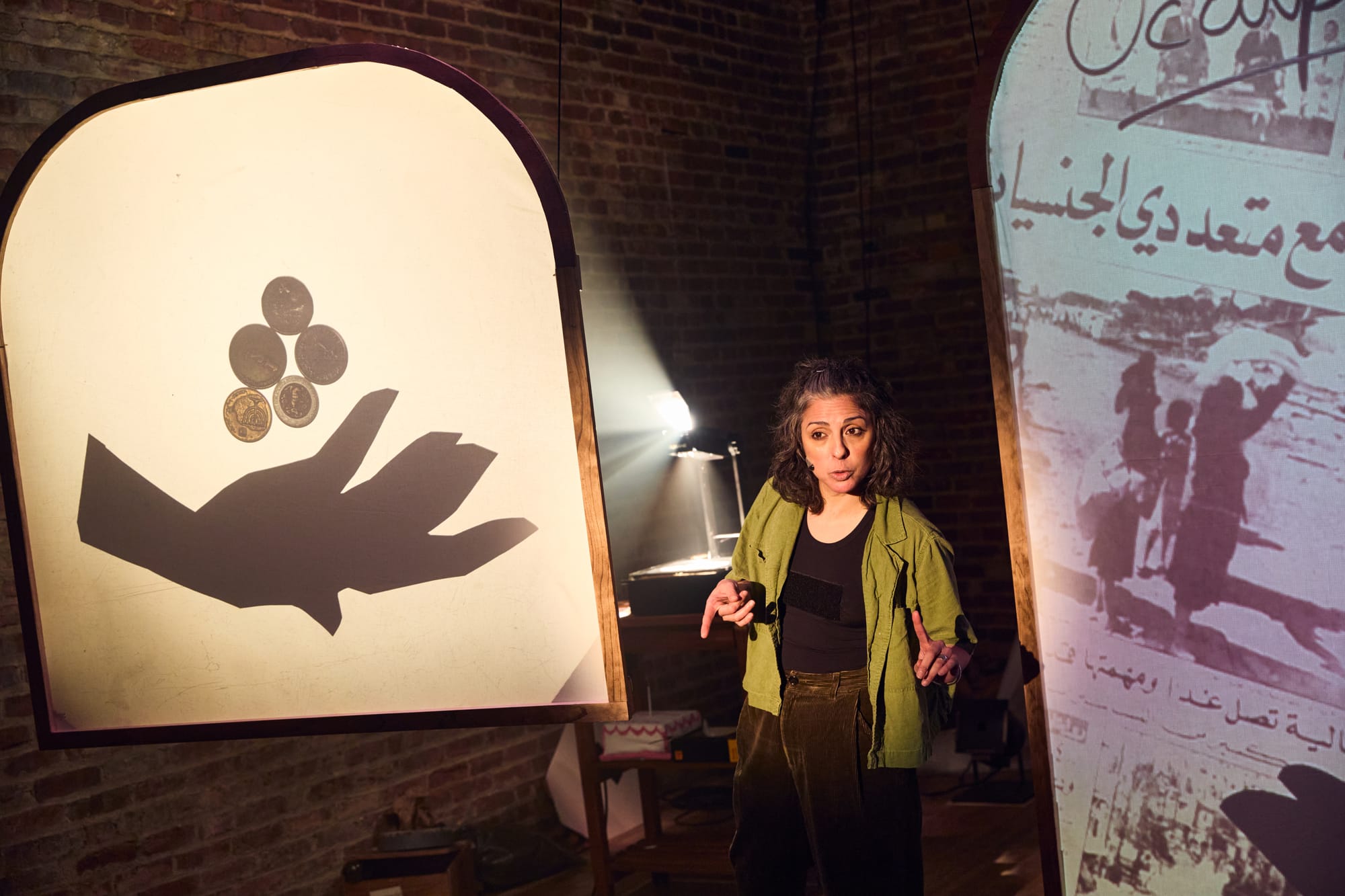
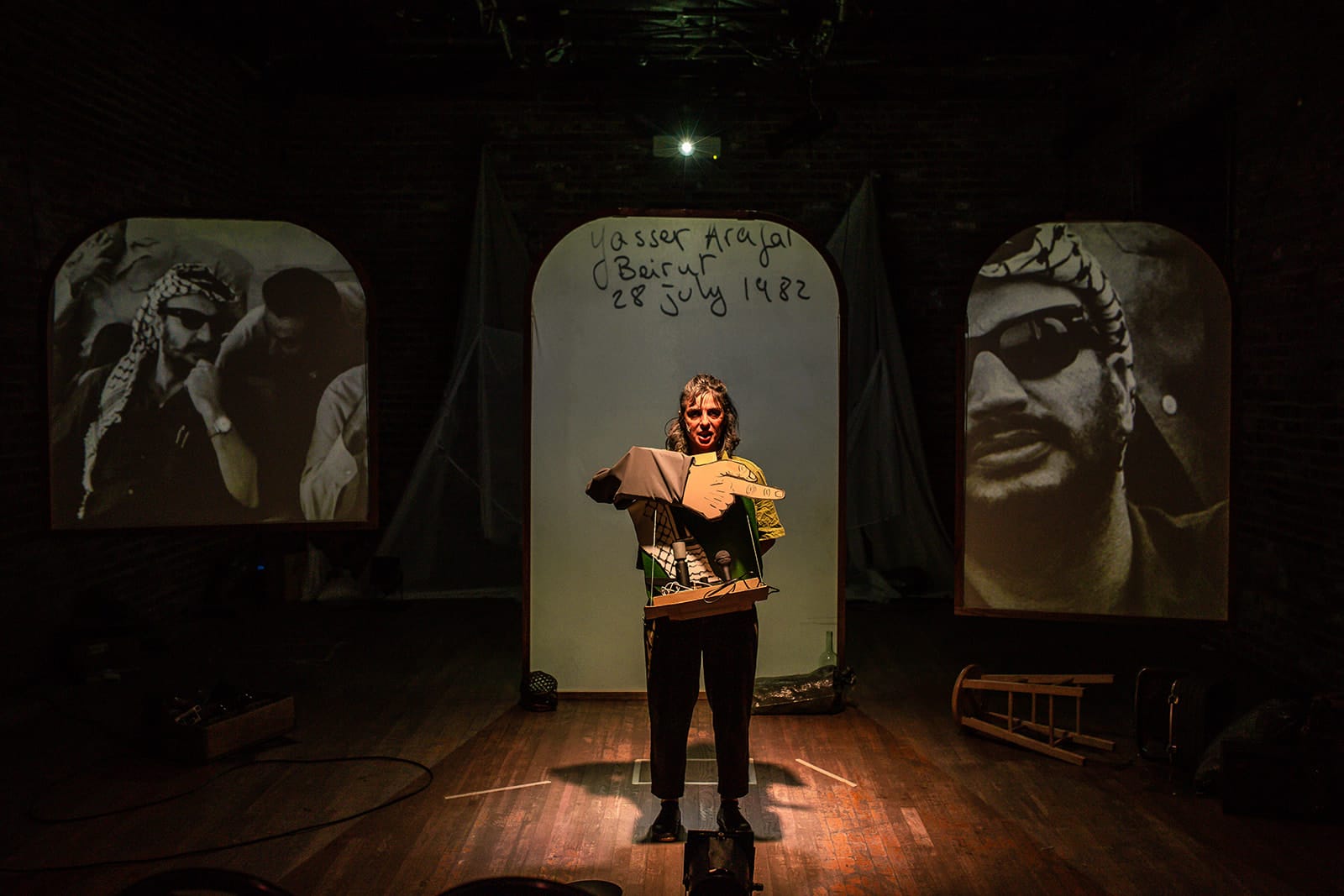
El Chab often incorporates props in her work. Paper cutouts of tanks, boats, and human figures explain the history of colonialism in Lebanon. An enormous hand puppet, its outstretched arm absurdly pointing in the air, relays the threats of former Israeli Prime Minister Menachem Begin and the rallying speeches of Amine Gemayel, then-president of Lebanon.
Puppets help her decipher the truth of politicians’ words. “It helps me get to the soul of it. Like, this is what this person is doing by saying all these words, by using all this jargon, by using all these terms,” she said, mimicking the exaggerated hand gestures that her puppets use.
El Chab herself turns into a shadow puppet, narrating in Arabic her family’s response to the Israeli invasion. “I wanted to give them something that has to do with a rhythm, an energy that I could not have given with a translated sentence,” she said of her decision not to translate into English.
Humor infuses her work. El Chab frequently assumes the character of a clown, as a way to engage her audiences in complex, often difficult topics.
“The clown is a playful way to discover the world,” said Jesse Freedman, her longtime collaborator and the director of Crossing the Water. “That kind of mischievous curiosity that a clown has, to fully explore something to the point of absurdity, is, I think, how both of us similarly make work.”
The Lebanese Civil War, which lasted roughly from 1975 to 1990, began as clashes between sectarian militias on the political right — the Phalange, funded and trained by Israeli and US forces – and the Left, a coalition of pan-Arab, leftist organizations supportive of the Palestinian Liberation Organization (PLO), led by Yasser Arafat. The conflict, which escalated to widespread violence and several Israeli invasions, resulted in the deaths of 150,000 people, the displacement of a quarter of Lebanon’s population, and the repeated devastation of wide swathes of Beirut.
The war is often portrayed in Western media along sectarian lines, between pro-government Lebanese Christians on one side and Muslims allied with the Palestinian cause on the other. But for El Chab, whose father is Shia Muslim and mother is Christian Orthodox, these religious lines oversimplify the political roots of the conflict.
“This is the culmination of identity politics: civil war,” she said. “It’s easy to come here and say, ‘But these Muslims, they want to kill all the Christians.’ But a lot of Christians weren’t okay with what was happening. Most of the resistance started in Christian villages.”
In the early days of the civil war, coalitions formed that crossed religious divides, said Jeremy Randall, a historian and associate director of the Middle East and Middle Eastern American Center at CUNY.
But over time, under the pressures of invasion, alliances began to splinter – “So the sectarian identity became more important,” he said. “The end of the Civil War in many ways reaffirmed the sectarian state and, if anything, ossified it.”
As El Chab imagines alternative paths for the Lebanese Left, he said, it offers some hope for a post-sectarian future. “What would happen if that path got changed slightly? And what kind of alternatives could arise from that?”
El Chab has moved around quite a bit: to and from Beirut, Abidjan, Paris, Conakry in Guinea, and, finally, New York. Her family, mostly from Southern Lebanon, had long involvement in Leftist politics, with several cousins fighting against the Israeli invasion and the right-wing, nationalist Phalangist party, which collaborated with Israel and fought Palestinian forces in the South.
In 1983, as El Chab and her mother fled Beirut, Israeli soldiers occupied the city, and living conditions became unbearable. Neighbors grew paranoid that familiar presences were informing on them.
El Chab remembers the image of a man wearing a balaclava, standing on a tank on the side of the road out of Beirut. Alongside the tank was a row of bodies. Her mother held her tight as they drove past the corpses.
In what would become a deeply traumatic memory, El Chab and her mother feared that her mother’s brother was among the bodies. He was not, but the wound would never completely heal.
And so she incorporated that scene in Crossing the Waters, reconstructing memory with the help of stories from interviews with several relatives.
After some years in the Ivory Coast, the family returned to Lebanon, in 1985. In 1988, they moved to France – then to Conakry, then finally back to Lebanon, where El Chab stayed until 2018.
Even in Conakry, when El Chab was eight or nine years old, she was drawn to theater. “I started doing theater and art in school because I had a hard time sitting down,” El Chab said. “When there is a story being told I can listen.”
Back in Lebanon, she would visit villages around the South with her family, and remembers attending performances in a small living room. Women played men; others wept over bodies as if they were real. “You had to purge,” she said. “You cry for yourself, but you also cry for that big loss which was even bigger than yours.”
With her French teacher, El Chab created a theater group in school. From there, she worked in independent productions in Beirut. In 2018, she moved to New York to bring her work to a new audience, among other reasons.
In her next project, El Chab plans to explore the history of a Leftist coalition, the Al-Jarmak Battalion, that formed within the PLO in the 1980s. “It’s a very interesting experience that gathered people that had different ideologies, but who came under the same umbrella of, ‘we want to liberate our lands,’” she said. El Chab views that movement as a necessary contrast to today’s social movements. “Today, everyone goes with their own communities and people like, what’s my identity? What’s my religion? What’s my sect? What’s my sexual identity? And we’re creating these divisive little groups that make it impossible for all of us to have universal healthcare.”
Now, as war rages and almost a quarter of Lebanon’s population is again displaced, El Chab sees a renewed urgency in her work. Western viewers, she says, are not shown images of Lebanon beyond widespread destruction.
“These villages and towns are thousands of years old. This is what they are destroying. They’re destroying towns where some people believe Jesus was walking, and they’re erasing them,” she said. “There are trees that are older than all of us that have been uprooted. There are animals that we don’t know of that are being erased over there.”
El Chab sees her work as a rebuilding of memory in the face of its destruction. “I want to compete with that reality that is trying to make people believe something else.”
Emigration also brings loss. The December performance of Crossing the Water ended as it began. It’s the spring of 1982 and again, El Chab rows, laboriously, through the murky waves projected around her. They’re waters that she and her mother first crossed over, in a plane, to reach the Ivory Coast on the way to meet her father.
“Today I am not the same person I was seven years ago,” she said. “And telling the story to my new family, to my new friends, to my new people and community is healing. It’s a way for me to enter this community and open my book and my heart to them.”