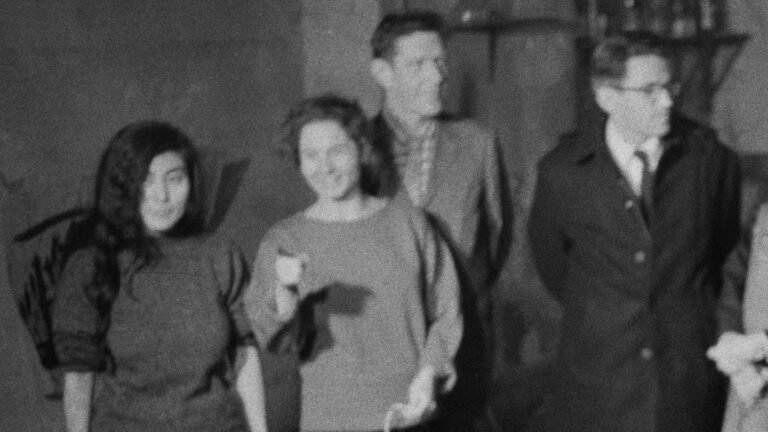
At 93 years old, Yoko Ono has witnessed multiple generations take up the questions at the heart of her practice, which at its core is about our humanity and responsibility to one another. Los Angeles Times music critic Mark Swed’s dispatch from recent performances of Ono’s works — including “Cut Piece” — traces her oeuvre as a living organism in itself, bringing new lessons with each iteration:
“Cut Piece” has a central place in Ono’s work as do film clips of her performing it in the Broad exhibition. Ono sits without a trace of emotion as she is stripped bare. Attention is directed away from her to the cutters. But the action is nullified by the fact that Ono assumes the stoic posture of the Buddhist monks seen in the news at the time setting themselves aflame in protest of the Vietnam War.
War had, indeed, inspired Ono in her shocking, exhibitionist (however ego-denying) disciplined action. Its fulfillment of an obligation to others is, like so much in Ono, a two-edged sword forcing us — be we active cutters or passive observers — into contemplation of violence.
Two of my favorite writers come together in this piece in Burnaway by Kristina Kay Robinson, a visual artist herself. She uses poems by the peerless Natasha Trethewey to structure her hybrid essay-screenplay-sojourn on the history of Black people and cameras. Citing seminal films and texts from the Black American canon, Robinson writes:
In her essay “Toward a Radical Cinematic Horizon: The unrealized works of Toni Cade Bambara and Gloria Naylor,” the scholar Randi Gill-Sadler brings readers into the intimate world of the Bambara’s and Naylor’s cinematic dreams. Gill-Sadler posits the novelists’ works and their designs, realized and not, as antithetical to what Bambara refers to as “Hollyweird.” Bambara had coined the term in her 1987 essay “Why Black Cinema?,” honing in on Hollywood’s ultimate product, for which movies are but a proxy. Paraphrasing Bambara, Gill-Sadler reveals that Hollywood is selling the viewer the idea that things never change. No matter how far the narrative may go to titillate you to change’s very borders, it is ultimately the status quo’s victory. Funnily, I love movies but often battle anxiety about movie theaters. I worry about the monsters that lay waiting outside the bubble of fantasy, making me uneasy; the vulnerability of sitting in the dark with strangers. At a friend’s invitation, I opted for another feeling about them and went to the movies to see the feature film IS GOD IS (2026).
Across mediums, witches bear the brunt of so many societal anxieties, which horror writer and film critic Gretchen Felker-Martin well knows. She gives an overview of the most common archetypes of witches in various kinds of art in Darker Times, challenging feminist readings that may unintentionally gloss over the violence of the 16th- and 17th-century witch trials:
In defining the witch as she exists within the context of horror media, a few constants hold largely true: She is old, she is unkempt, and she is a danger to children. Consider the titular sorceress of director Robert Eggers’ debut feature, The Witch, as portrayed by actress Bathsheba Garnett. Toothless, wrinkled, nude, and with flyaway gray hair hanging to her waist, she might have come straight to Eggers’ set from Häxan, Viy, or any number of classic films about black magic. Near the opening of the film she kills a stolen baby and processes its body into a liniment to rub on the handle of her broom. Later, in a youthful guise (Sarah Stephens), she seduces young Caleb (Harvey Scrimshaw) and causes his death. The protagonist’s nameless mother (Claudia Martini) in Lukas Feigelfeld’s Hagazussa, accused of witchcraft by her neighbors, becomes increasingly disheveled and sexually assaults her pubescent daughter, Albrun (Celina Peter), while suffering from Bubonic Plague.
I’m not sure what’s worse: that authors are passing off AI writing as human writing, or that readers increasingly can’t tell the difference. You can pry em dashes from my cold, dead hands, but the idea of a “literary counterculture” aimed at distinguishing our idiosyncratic, imperfect voices from the trite, sycophantic writing generated by chatbots feels like a small but meaningful rebellion. Emma Madden reports on the phenomenon for Wired:
Across magazines and digital publications, this anti-AI counterstyle is reshaping in-house style and editorial practice too. Richard Fisher, an honorary professor at University College London and editor at online culture magazine Aeon, says AI has prompted him to encourage writers “to be more human” and write more conversationally. “We don’t want to sand out the rough edges, because AI cannot write prose as spiky or idiosyncratic as humans. Writers might not want to change their practice, but some might be forced into it.”
Butterfly collection has long been a controversial vocation, but Emil Leth Beiter’s investigation into its uncertain future reveals there’s more to the story. What is the role of a disappearing practice that aids environmental efforts on the one hand, while requiring its specimens to die on the other? Visiting the butterfly garden of Steve Collins in Nairobi, Beiter writes in the Los Angeles Review of Books:
This is all part of a significant paradox in our relationship to nature. As we’ve become aware of our impact on the environment, we’ve also become more and more estranged from it. Laws against collecting reflect a belief that the right thing to do, the tasteful thing to do, is to stay away from nature, lest we destroy what we love. This environmental awareness has come at a cost—what one might call our sensibility for nature. How many environmentalists, who can speak at length on greenhouse gas emissions, agriculture reform, and sustainable energy sources, would also be able to identify the birds outside their window?
“Well, they’ve got the right idea,” Collins says as we look out on the rain, “and I understand why you want to have this type of legislation to protect nature, especially in the temperate world where the natural world is better described, but it’s often misplaced and ends up being counterintuitive.”
Another crucial question in the age of climate catastrophe is how journalists should cover wildfires, already more common now than they were a decade ago. For Emergency Mode for News, art journalist Karen K. Ho has practical tips for reporters:
Kendra Pierre-Louis recommended journalists read Timothy Egan’s The Big Burn about the largest wildfire in the US for context on why wildfire policies became focused on suppression. “That’s a problem because many ecosystems need to burn. Smaller, more moderate fires removes all of the underbrush, so you don’t get these massive, intense wild fires.”
It’s no secret that beauty trends have swung back to favor women who are impossibly thin, but the online discourse around Ariana Grande’s concerning weight loss raises other ethical questions. Ignoring it feels like normalizing an unhealthy standard, but commenting on it gets you accused of body-shaming. Enter Slate writer and cultural critic Scaachi Koul with a rare nuanced take on this subject — her piece discusses eating disorders, so please take care in reading:
To witness Grande at work and say nothing—about her remarkable thinness, about the speed of it—is to assist in an ominous performance of normalcy. Grande is thin in a way that merits concern, though concern is not really the place of her audience. The only people who can intervene in a meaningful way are her family, her friends, and her team. All the rest of us can try to do is stay free in our own bodies, in our unnecessary fears of weight gain, while the rest of the world reminds us how available it is to shrink. The hope is that her managers are corralling her offstage to provide her more-focused attention. The hope is that she returns.
Whether it’s due to a renewed love of pseudo-medieval pop culture or bardcore (if you know you know), I’m so here for the harp-assance. Laura Pitcher writes in Dazed about the revival of the 5,000-year-old instrument in mainstream media, and what its popularity means for longtime practitioners: Everyone wants to play the harp now
In many ways, young people’s current interest in traditional instruments is aesthetic, part of the current social cachet you can gain online by associating yourself with high-brow culture or ancient crafts like pottery and blacksmithing. In today’s digital age, there’s a growing anxiety around our shrinking attention span, which is backed up by research – notably, a 2023 study indicated that as our attention spans diminish, our perceived stress levels and heart rates rise. Playing an instrument can offer a kind of pure absorption that’s difficult to find elsewhere, with all the health benefits that carries. But there’s also a draw in being able to share the beautiful mahogany and strings online. In the same way that posting classical literature or a Letterboxd review of a three-hour-long film has become a status symbol, playing an instrument signals to the world that your attention span is longer than most.
James the museum enthusiast is truly out here doing god’s work:
@jamesvisitsmuseums Map of Weird and Niche Museums Across the World https://tinyurl.com/weirdmuseummap Let me know if I’ve missed anything #museum #museumtok #weird #trending #map ♬ original sound – James Visits Museums
Speaking of which … mentally I am here:
@alienfieldnotes 📍 The Mouse Mansion – Shop & Studio Het Muizenhuis – Winkel & Museum in Amsterdam, Netherlands. Definitely one of the best things i saw in Amsterdam ❤️ #amsterdam #netherlands #museum #museumtok #fyp ♬ Heart of the Forest – Ghibli Melodic & Muses Records
@saturdayam.plus Historians are baffled. #millennial #2000smusic #nostalgia #itsgonnabemay #popmusic ♬ original sound – SaturdayAM+
Required Reading is published every Thursday afternoon and comprises a short list of art-related links to long-form articles, videos, blog posts, or photo essays worth a second look.