Research & Developments is a blog for brief updates that provide context for the flurry of news that impacts science and scientists today.
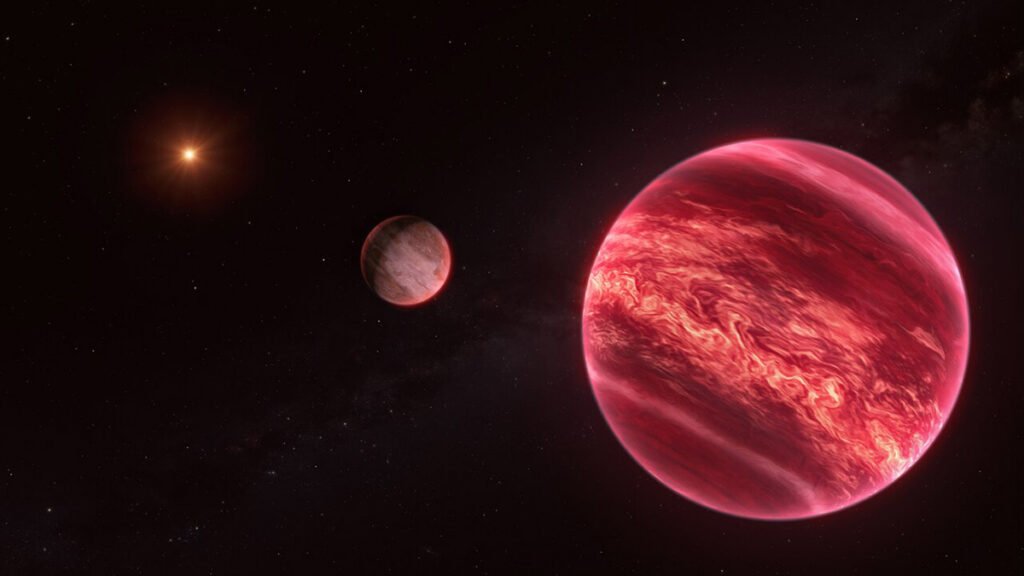
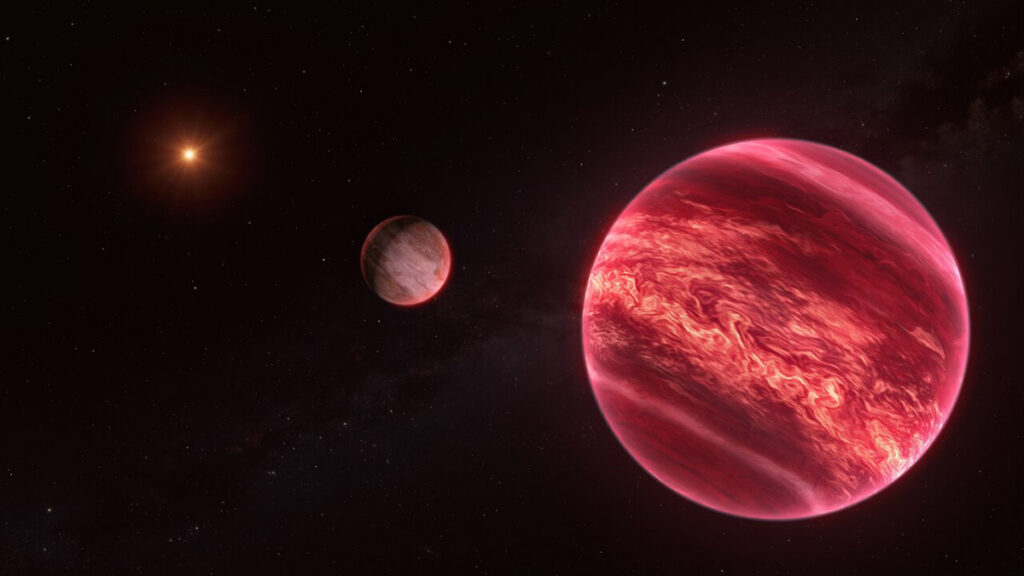
What exactly is a moon? It’s an existential question lunar researchers found themselves pondering when they discovered an exosatellite at least 90% the size of Jupiter, orbiting a brown dwarf in a system about 73 light-years away from Earth.
Depending on how exactly one defines “moon,” the object could be the first moon definitively discovered outside our solar system.
If a moon is a body orbiting another body that is orbiting a star, then yes, we’ve got a moon on our hands. But this exosatellite is orbiting a brown dwarf, a body far larger than most planets but too small to sustain hydrogen fusion as stars do, instead of a planet. And it’s enormous in a way our local moons aren’t.
The whole system is really weird, explained lead author Kevin Hoy in an email to Eos. Hoy is a European Southern Observatory astrophysics Ph.D. student who is also affiliated with the Instituto de Estudios Astrofísicos at the Universidad Diego Portales in Chile and its Millennium Nucleus of Young Exoplanets and their Moons research center.
“The host star is much smaller than the Sun, the brown dwarf is much heavier than our most massive planet, and the satellite is much heavier than any of the moons in our system,” Hoy said. “No part of this system has an obvious comparison to any object in the Solar System.”
The researchers published their findings today in Nature.
When Words Fail
The scientists detected the maybe-moon in the CD-35 2722 system using the radial velocity method, which is often used to detect exoplanets. The brown dwarf moves slightly in response to the exosatellite’s orbit, as the exosatellite exerts a slight gravitational pull. These movements can be seen from Earth as small changes in the brown dwarf’s light spectrum. Scientists observed 26 of these changes from the European Southern Observatory’s Very Large Telescope (VLT) in Chile between October 2023 and February 2026.
The scientists ran several models to see what could explain the periodic changes, including a model in which the brown dwarf actually had two exosatellites. The best explanation to fit the data, they found, was one satellite at least 90% as massive as Jupiter orbiting the brown dwarf approximately every 170 days. (The brown dwarf itself is about 37 times as massive as Jupiter, meaning that although the proposed exomoon is huge, it could be proportionally much less massive compared to its primary than the Moon is to Earth.)
The combination of techniques the researchers used were first proposed for detecting exomoons in 2018, in a paper coauthored by Andrew Vanderburg, now an astronomer at Harvard University.
“I never would have imagined that this technique would reveal such an unusual object!” Vandenburg said in an email to Eos. He added that he wondered what exactly the exosatellite was, how it formed, and how big it was. “Regardless, it’s an amazing discovery and I’m super excited to see what else we can find by observing planets like this!”
Researchers have discovered more than 6,200 confirmed exoplanets so far, but only a few candidates for exomoons have been detected, and none have been confirmed. Such a discovery could help us learn more about how various parts of the universe were formed, and how they function today, the paper suggests.
Though it’s possible some unknown variable in the brown dwarf itself could be responsible for the periodic changes in radial velocity the team observed, “we can’t think of any physical mechanism that could reproduce the signal we see,” said Hoy, the lead author of the study. “That’s why we think a satellite is the most likely explanation.”
In this case, the scientists are confident about what they’ve found. They’re just not sure exactly what to call it.
“Perhaps we are approaching the limit of language invented to describe the Solar System, which is entirely unlike CD-35 2722,” the paper reads.
—Emily Gardner, Deputy Editor (@emfurd.bsky.social)
These updates are made possible through information from the scientific community. Do you have a story about science or scientists? Send us a tip at eos@agu.org.

Text © 2026. AGU. CC BY-NC-ND 3.0
Except where otherwise noted, images are subject to copyright. Any reuse without express permission from the copyright owner is prohibited.