Editors’ Vox is a blog from AGU’s Publications Department.
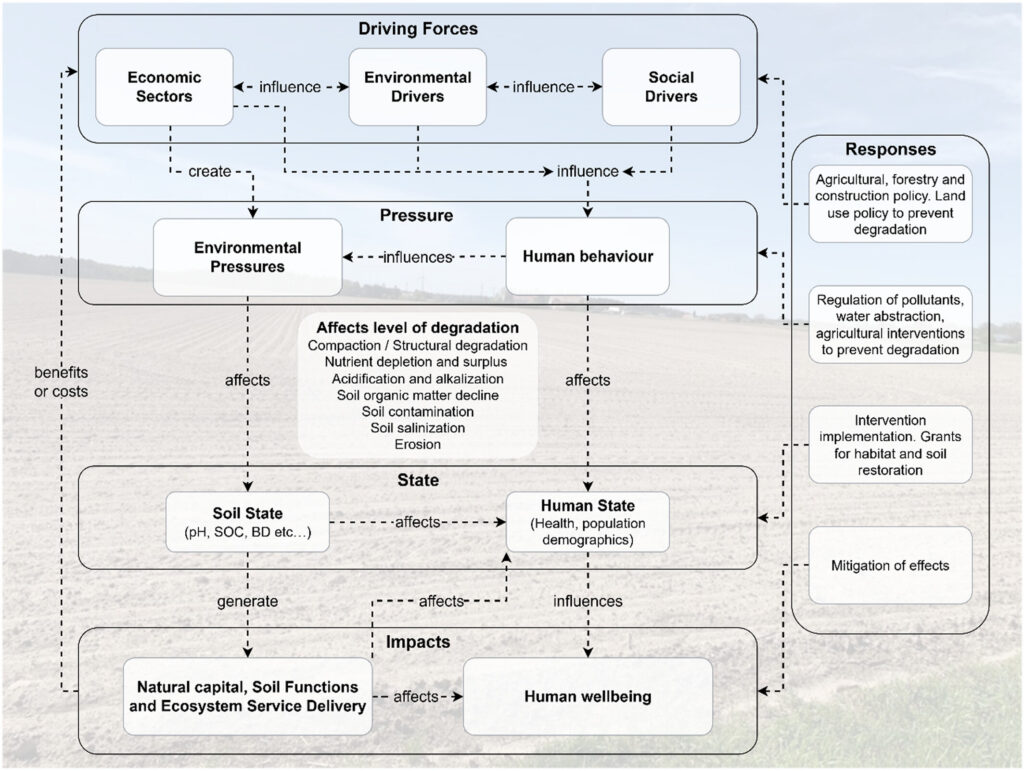
Protecting soil health is essential to achieving the United Nations Sustainable Development Goals (SDGs) since it has direct impacts on food and water security, ecosystem health, and socio-economic activities. However, human-induced drivers and pressures heighten the susceptibility of soils to degradation.
A new article in Reviews of Geophysics explores the drivers, impacts, and efforts to combat soil degradation. Here, we asked the authors to give an overview of soil degradation, practices being implemented to combat it, and what questions remain.
What is soil degradation and why is it important to study?
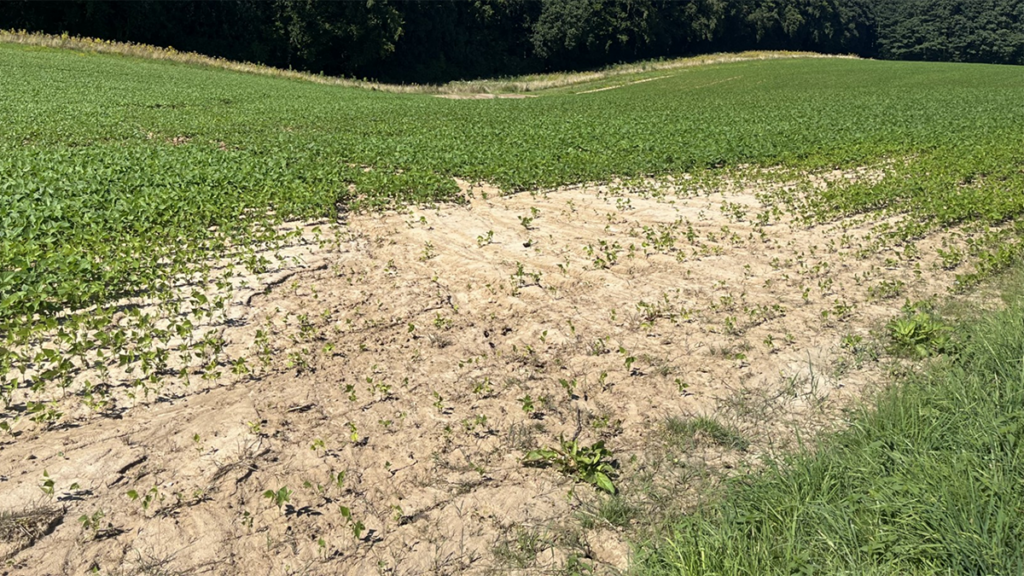
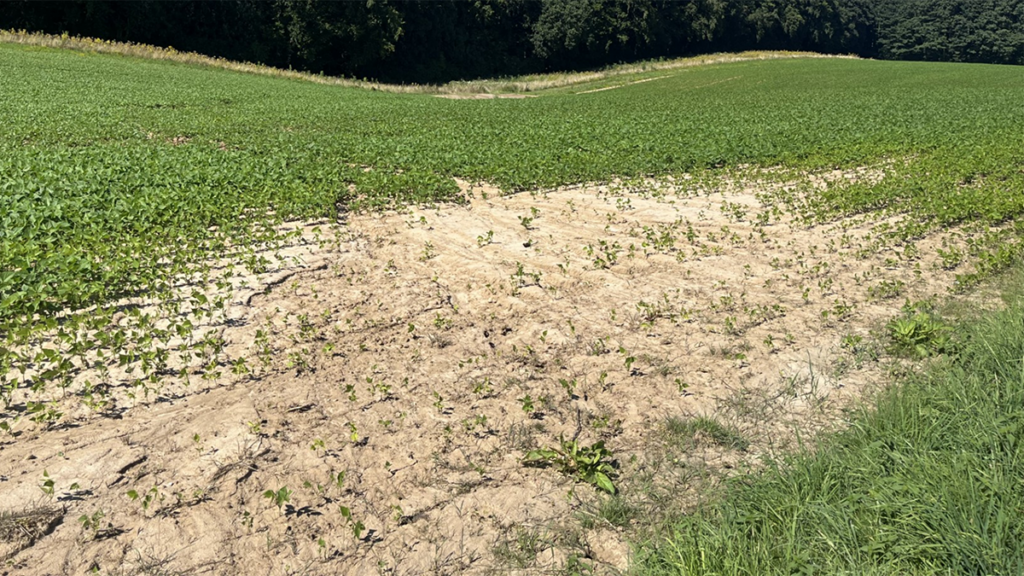
Soil degradation refers to the deterioration of soil quality resulting from unsustainable human activities most commonly associated with agricultural, pastoral, industrial, and urban land use. It involves a dynamic reduction in the physical, chemical, and biological properties of soil that diminishes its structural integrity, functional capacity, and overall resilience over time.
Studying soil degradation is important because it is a major global environmental challenge that threatens soil security, ecosystem services, agricultural productivity, and human well-being. It also makes land more susceptible to droughts, floods, landslides, and climate extremes. Soil degradation often develops gradually and may remain unnoticed until critical thresholds are reached, after which recovery can be extremely slow, costly, or even impossible. Understanding the causes, processes, and consequences of soil degradation is therefore essential for preventing long-term environmental and socio-economic damage and for supporting sustainable land management and ecosystem resilience.
What are the key processes that degrade soil?
The key processes of soil degradation can be grouped into physical, chemical, and biological degradation. Physical degradation includes the breakdown of soil structure, aggregate loss, compaction, reduced porosity and pore connectivity, and erosion caused by water, wind, tillage, or crop harvesting. These processes remove topsoil, nutrients, and organic matter while reducing the capacity of soil to retain water. Chemical degradation includes acidification, alkalization, nutrient depletion or excess nutrient accumulation, loss of soil organic matter and soil organic carbon, salinization, sodicity, and contamination by toxic chemicals or pollutants. Biological degradation involves declines in soil biodiversity, microbial activity, and overall biological functioning. These processes rarely occur independently; rather, they interact and reinforce each other thus increasing the susceptibility of soil to further degradation.
What are the major drivers of soil degradation and how do they differ from perturbations?
The major drivers of soil degradation are long-term natural or anthropogenic forces that initiate or accelerate the physical, chemical, and biological processes of soil degradation. These include deforestation, unsustainable agricultural practices, land-use change, industrial and mining activities, climate change, and overgrazing. These drivers place continuous pressure on the environment and gradually reduce soil functioning. In contrast, perturbations are typically short-term disturbances such as floods, droughts, extreme weather events, wildfires, or sudden land-use changes that temporarily disrupt soil ecosystems and their resilience. The distinction between drivers and perturbations lies primarily in their duration and persistence. When disturbances occur repeatedly or continue over long periods, they can become long-term drivers of degradation.
How do scientists measure soil degradation at different spatial scales?
Scientists quantify soil degradation using complementary approaches across multiple spatial scales. At local or field scales, direct surveys and monitoring quantify physical, chemical, and biological indicators of soil health and degradation. These measurements are supported by expert assessments and land-user knowledge gathered from interviews or questionnaires. Analytical frameworks then combine these indicators to evaluate soil functions and ecosystem services under different land management practices. While field observations provide detailed and localized evidence, they are difficult to scale, require repeated monitoring, and depend on context-specific indicator thresholds.
At regional, national, continental, and global scales, assessments combine bottom-up, top-down, and hybrid methods including expert mapping, soil sampling, modeling, and remote sensing. High-resolution satellite imagery and remote sensing technologies enable continuous, large-scale monitoring of land cover, vegetation dynamics, erosion, soil moisture, and other indicators associated with soil degradation. These assessments are increasingly supported by big data analytics, high-performance computing, and advanced machine learning models that integrate diverse datasets and improve the detection and prediction of degradation patterns.
At the microscopic scale, a wide range of experimental and modeling techniques can be employed to characterize the parameters and processes governing the physical, chemical, and biological properties of soils, thereby providing insights into the mechanisms that contribute to soil degradation.
What are some of the restoration efforts or practices being implemented to combat soil degradation?
Efforts to restore degraded soils range from large-scale policy initiatives to practical land management strategies. At the national level, restoration projects such as China’s rehabilitation program on the Loess Plateau have successfully restored millions of hectares of degraded land. In Europe, international agreements to reduce transboundary air pollution have decreased acid deposition and promoted the recovery of acidified soils.
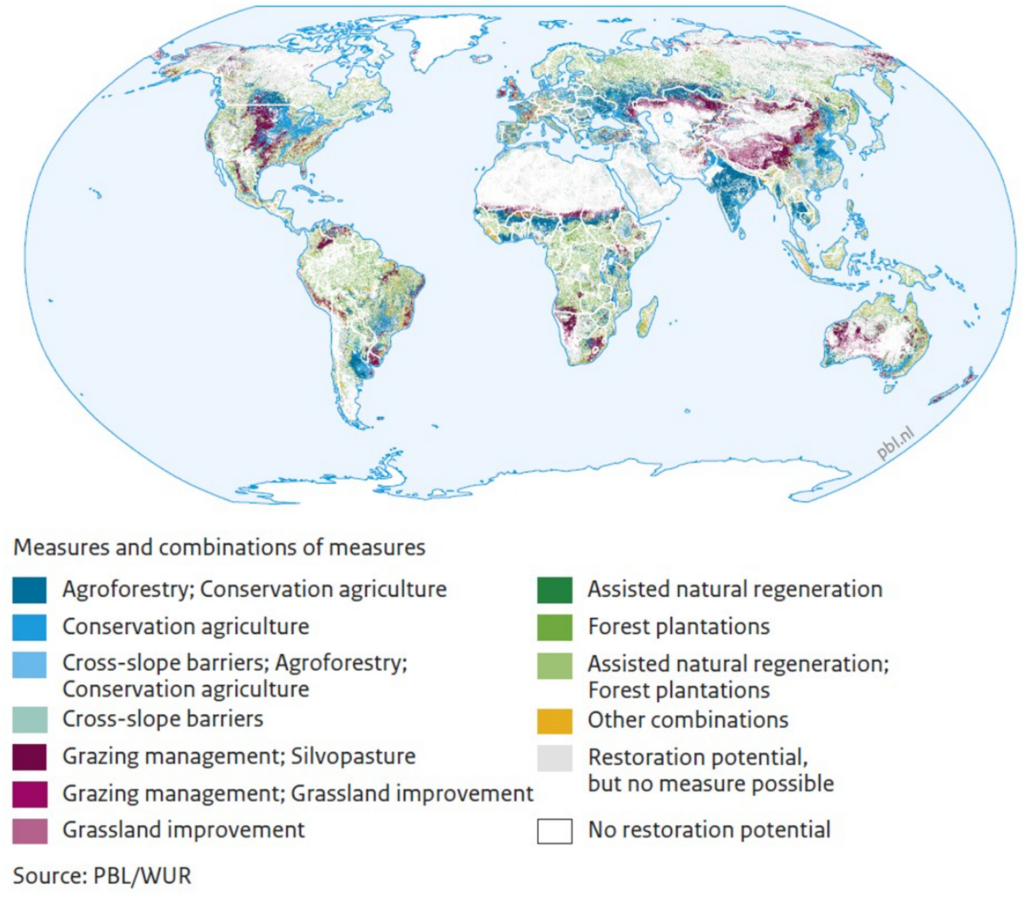
At the field scale, restoration focuses on minimizing further degradation while rebuilding soil health. Reducing vehicle traffic is encouraged to minimize soil disturbance and prevent compaction. Agricultural practices include reduced or no-tillage farming, crop rotation, agroforestry, cover crops, compost and manure application, integrated pest management, and efficient irrigation methods such as drip irrigation and rainwater harvesting. These practices improve soil structure, enhance soil fertility, reduce erosion, increase organic matter, and strengthen the long-term resilience of agricultural soils while supporting sustainable land management.
Why is combating soil degradation essential for achieving the United Nations Sustainable Development Goals?
Combating soil degradation is recognized as a fundamental prerequisite for achieving the United Nations Sustainable Development Goals (SDGs) due to the extensive socio-economic and ecological impacts of soil health. Healthy soils provide natural capital and ecosystem service delivery that directly support human well-being. Preventing soil degradation is essential for ensuring global food security, maintaining agricultural productivity, supporting livelihoods, and reducing hunger and poverty. Furthermore, maintaining soil functionality is strictly necessary for preserving water security, regulating the climate, and supporting overall ecosystem health. Consequently, sustainable soil management contributes directly to several SDGs, including SDG 2 (Zero Hunger), SDG 6 (Clean Water and Sanitation), SDG 13 (Climate Action), and SDG 15 (Life on Land). Failure to combat soil degradation can lead to severe socio-economic consequences such as health crises driven by desert dust storms and widespread human migration, which would completely undermine the environmental resilience demanded by the SDGs.
What are the remaining questions or knowledge gaps where additional research is needed?
Several important knowledge gaps remain in our understanding of soil degradation. One major challenge is the lack of a universally accepted definition of soil degradation. This inconsistency makes it difficult to compare studies and establish standardized indicators and assessment methods. In addition, many global and national assessments are fragmented, outdated, or lack long-term monitoring data.
Further research is needed to improve understanding of how multiple drivers interact, how quickly degradation develops, and whether soils can fully recover after pressures are removed. Scientists also need a better understanding of the links between climate, land use, and soil processes, as well as the socio-economic impacts on livelihoods, inequality, and migration. Improving monitoring methods, data sharing, and standardized protocols will help produce more reliable assessments and support more effective soil management and restoration strategies.
—Nima Shokri (nima.shokri@tuhh.de,  0000-0001-6799-4888), Institute of Geo-Hydroinformatics, Hamburg University of Technology, Germany; Mehdi Afshar (0000-0002-4411-3299), Institute of Geo-Hydroinformatics, Hamburg University of Technology, Germany; and Milad Aminzadeh (0000-0002-0074-3600), Institute of Geo-Hydroinformatics, Hamburg University of Technology, Germany

Citation: Shokri, N., M. Afshar, and M. Aminzadeh (2026), Why healthy soils matter more than ever, Eos, 107, https://doi.org/10.1029/2026EO265026. Published on 22 July 2026.
This article does not represent the opinion of AGU, Eos, or any of its affiliates. It is solely the opinion of the author(s).
Text © 2026. The authors. CC BY-NC-ND 3.0
Except where otherwise noted, images are subject to copyright. Any reuse without express permission from the copyright owner is prohibited.