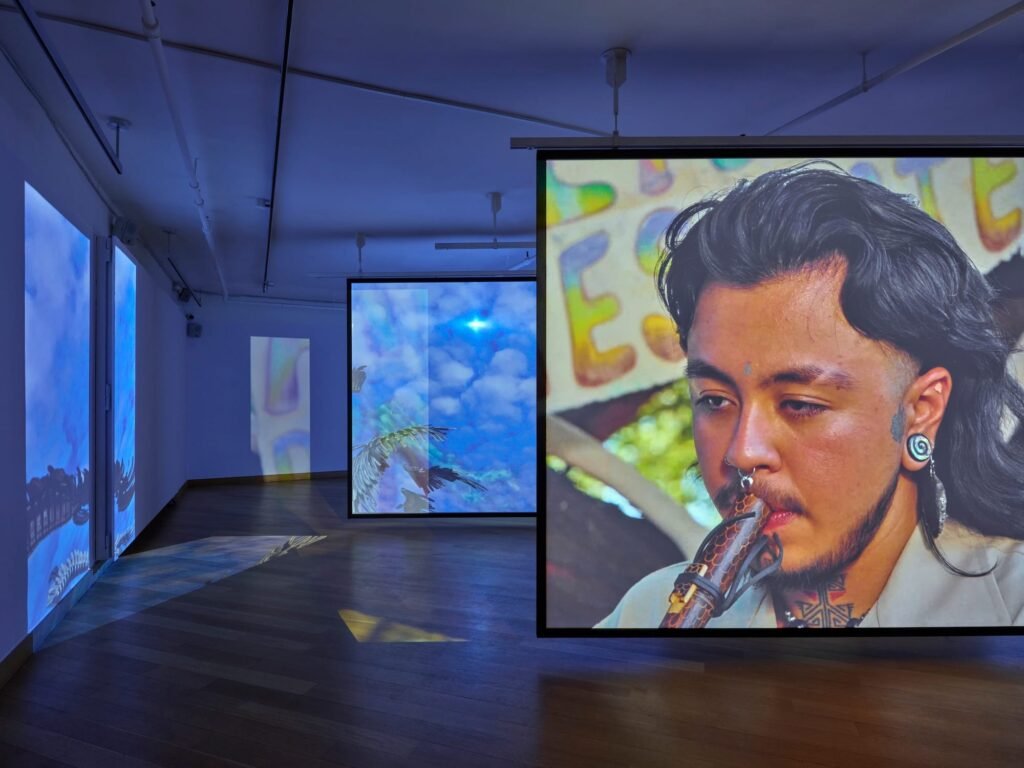
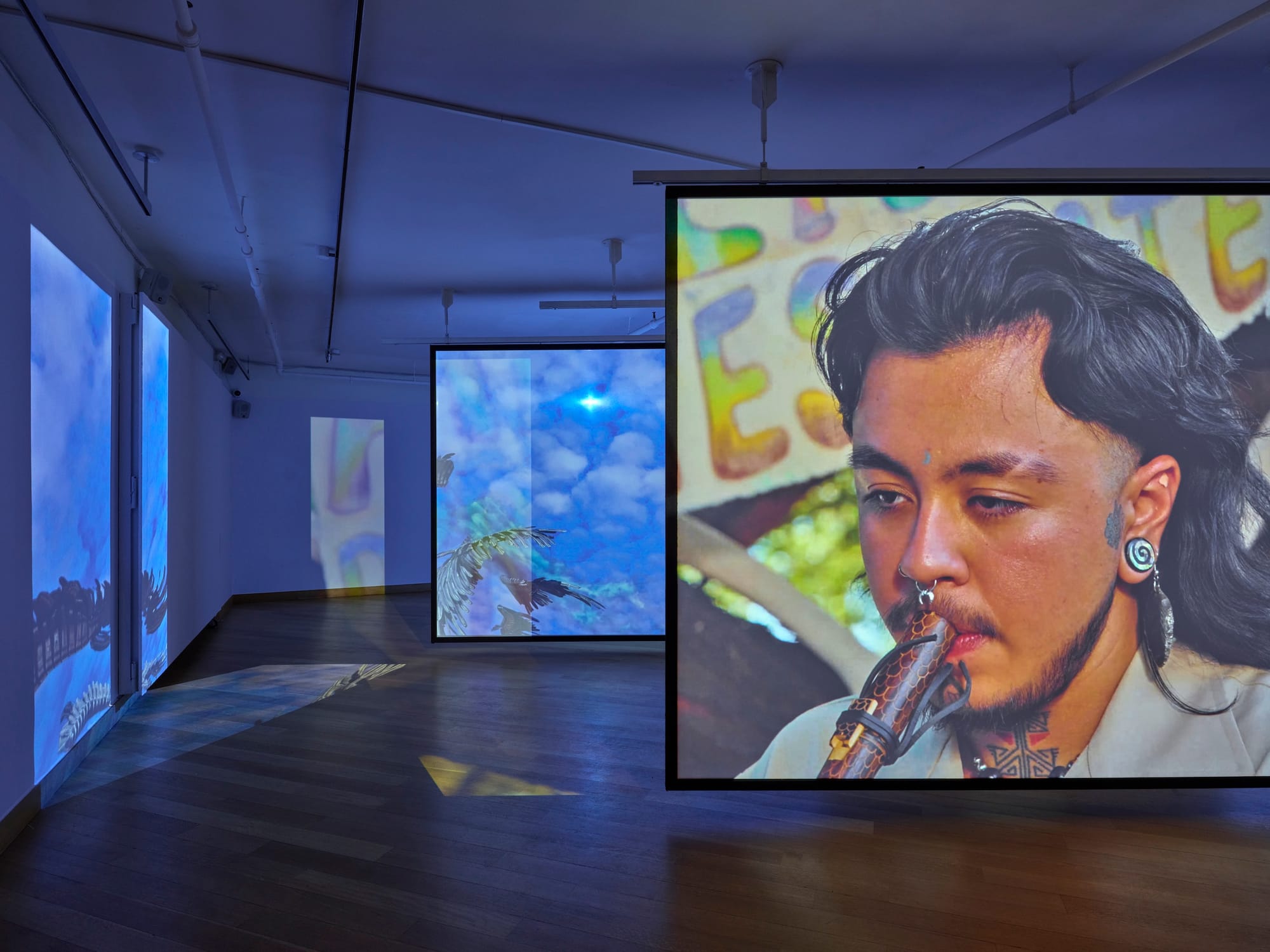
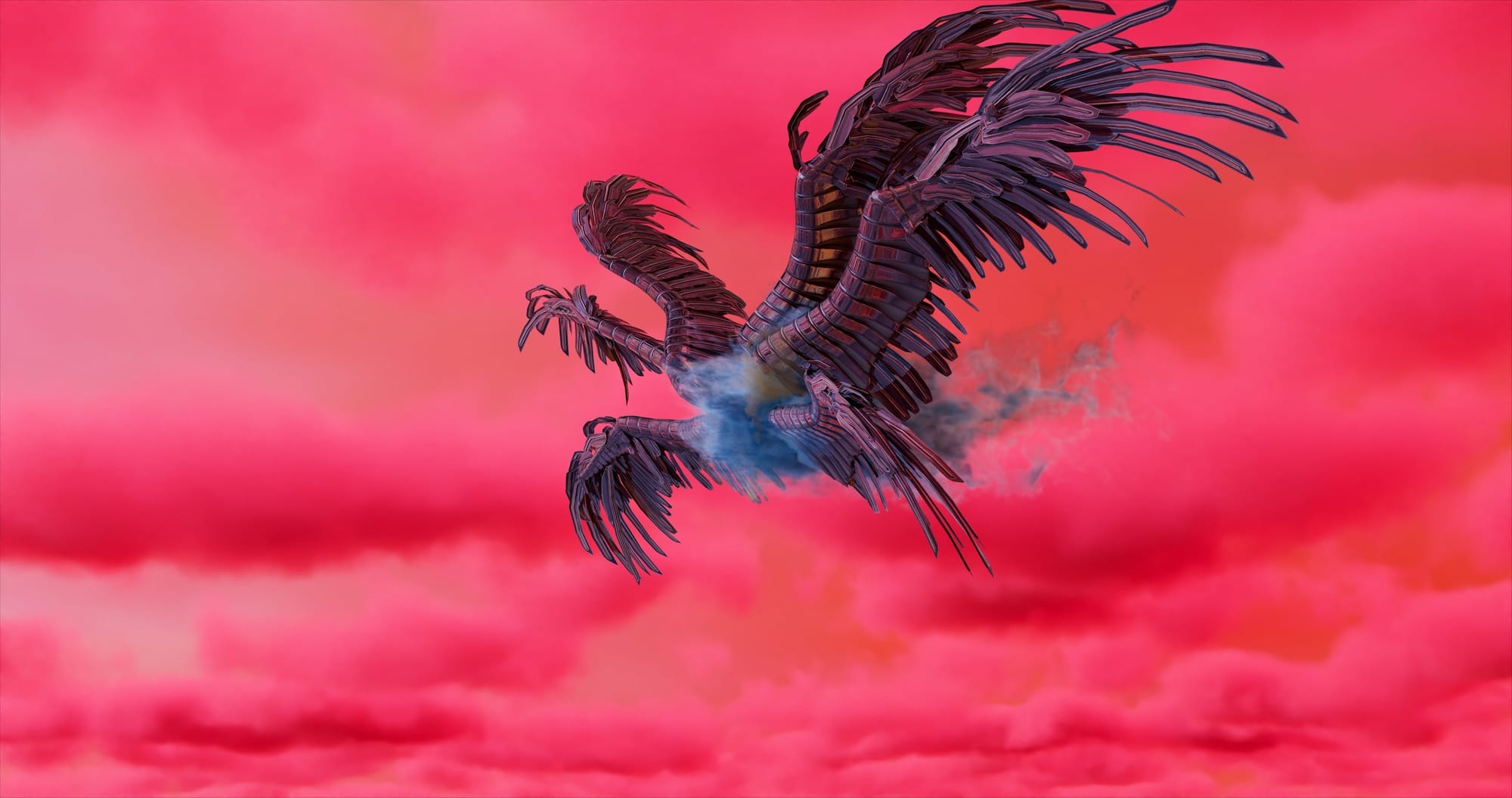
Upon entering the Leslie-Lohman Museum of Art in Soho, viewers are enveloped by projections of an animated Berlin apartment block. As the image loops around the room, a third-floor window swings open and smoke pours into the overcast sky, transforming into a six-winged seraphim that flaps its way into another portal.
Taiwanese-American artist and filmmaker Shu Lea Cheang’s commission LOVER LOVE, on view through January 3, 2027, excavates the experiences and dreams of transgender and gender-nonconforming people through the marriage of physical and virtual landscapes. In the museum’s largest commission to date, a 28-minute film featuring the performances of eight artists plays across four screens suspended on tracks throughout the gallery. The exhibition invites viewers to push and reposition the screens, creating overlapping, complementary, and juxtaposed compositions.
The show serves as a tribute to Cheang’s late friend and longtime collaborator Aérea Negrot, a Berlin-based Venezuelan musician and DJ. Negrot took her own life in 2023, and her tragic passing served as the impetus for LOVER LOVE.
“When I heard that Aérea killed herself, I didn’t believe it,” Cheang told Hyperallergic in a Zoom interview. “I really think she believed she could fly when she stepped out of the window.”
In Cheang’s animation, the seraph’s wings multiply and Negrot’s 2011 track “LOVER LOVE” — a meditation on broken promises that lends the exhibition its title and plays throughout the film — begins to play. In this way, Cheang continues her friend’s story. “It’s almost like she’s giving Aérea the wings to fly that she always wanted,” added Stamatina Gregory, the exhibition’s curator and the museum’s director of Exhibitions and Collections, during a private walkthrough.
Gregory said that they had long wanted to work with Cheang, whose radical, interdisciplinary practice challenges the parameters of the digital realm and provokes conversations around institutional oppression and sexual politics. A pioneer of new media art since the ’80s, Cheang’s work spans projects such as Color Schemes (1990), a video installation about ethnic stereotyping exhibited at the Whitney Museum of American Art; Fresh Kill (1994), a feature film envisioning a post-apocalyptic landscape as a critique of corporate pollution and commodity culture; and Brandon (1998–99), a year-long narrative project examining gender fusion in public and digital space, based on the rape and murder of 21-year-old trans man Brandon Teena in 1993. Gregory, who joined the museum in 2019, cited Cheang as one of their earliest curatorial ambitions.
“In my interview, they asked me what two years of programming I would propose,” Gregory recalled. “I said there is a really important artist who is not shown enough in the US, and who is one of the few artists grappling with the foundations of queer and trans identity through media.”
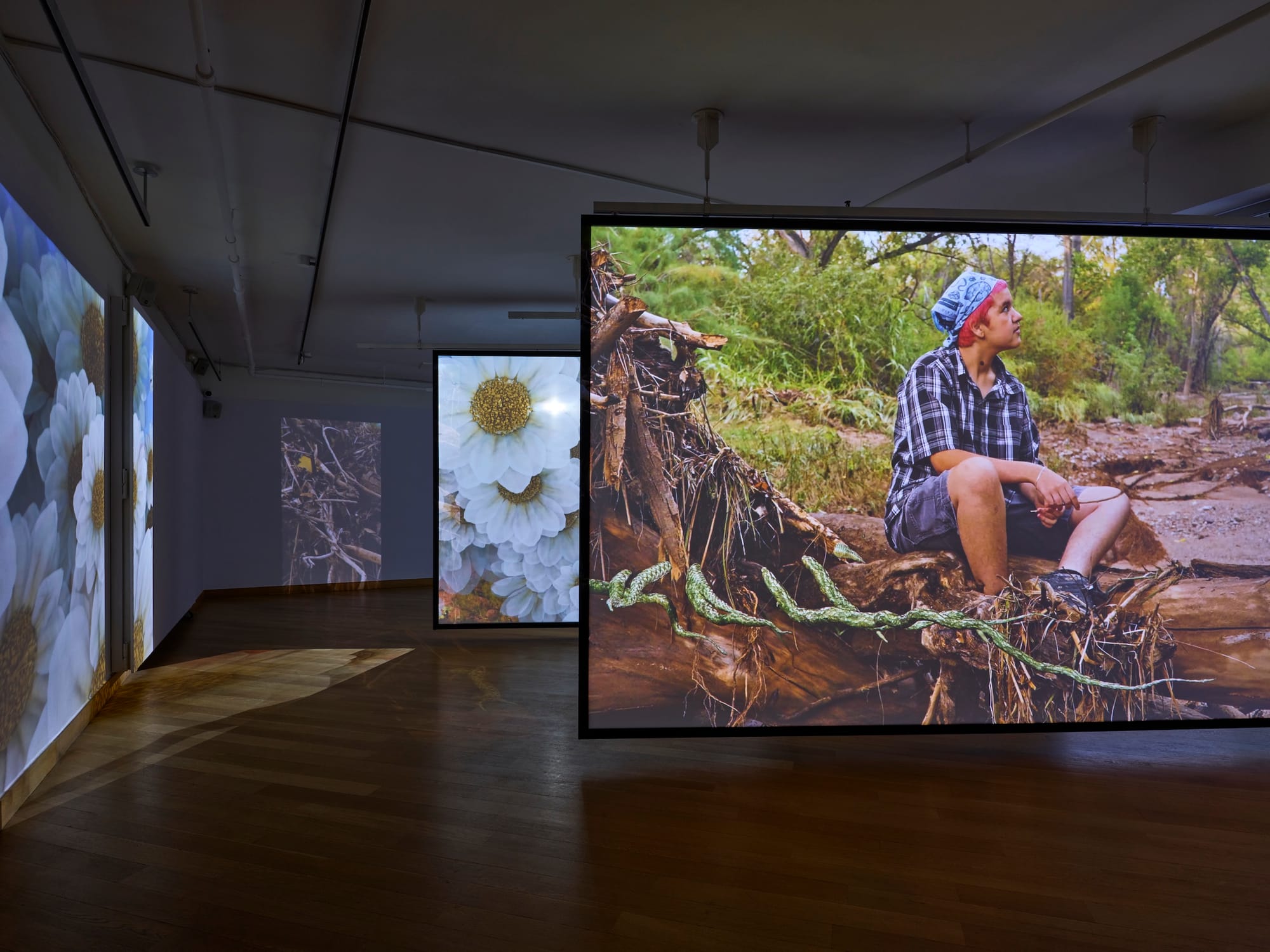
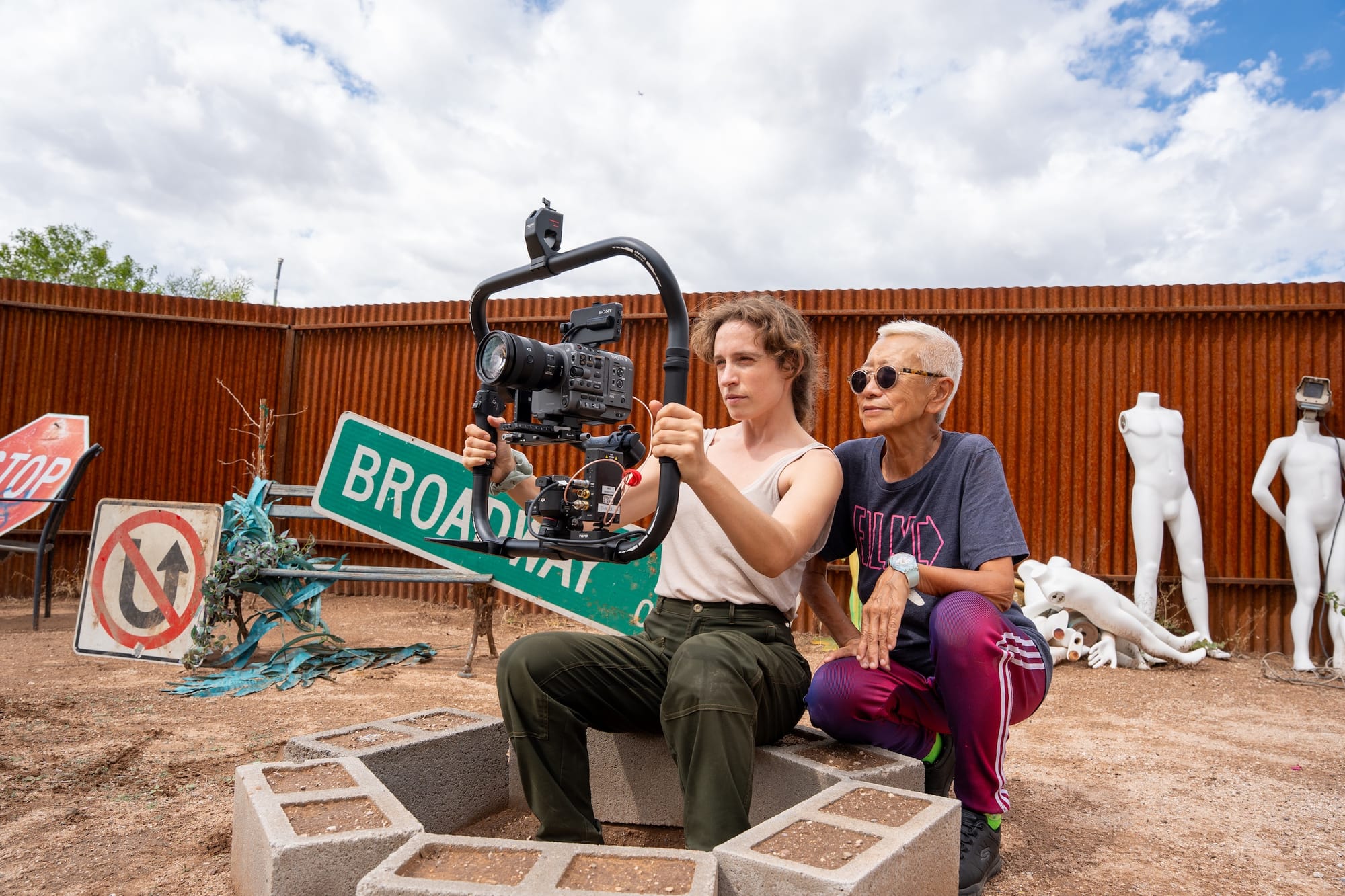
In the wake of federal-level initiatives to redefine gender as binary and more than 830 anti-trans bills currently under consideration across the United States, the exhibition became more critical than ever. Cheang cast eight intergenerational performers through an open call in Tucson, Arizona, while on her 2024 cross-country tour screening a restored 35mm print of Fresh Kill. “In the middle of America, in a red state, I found a small but very powerful community of young artists,” she said.
“For a lot of these artists, it’s really the first time they’ve had the opportunity to receive recognition for their work,” Gregory added. “And Shu Lea really gives them the autonomy to tell their own story.”
From a 17-year-old artist and activist Azrael Fayme reading their own poem to a consensual BDSM scene involving cactus needles that transforms bloodletting into blooming, the performances in LOVER LOVE span a wide range of forms. Performers traverse motel rooms, city streets, junkyards, and desert landscapes, where cacti become animated anthropomorphic appendages created by Cheang’s longtime VFX collaborator Roland Lauth. “There are dicks everywhere,” Gregory laughed.
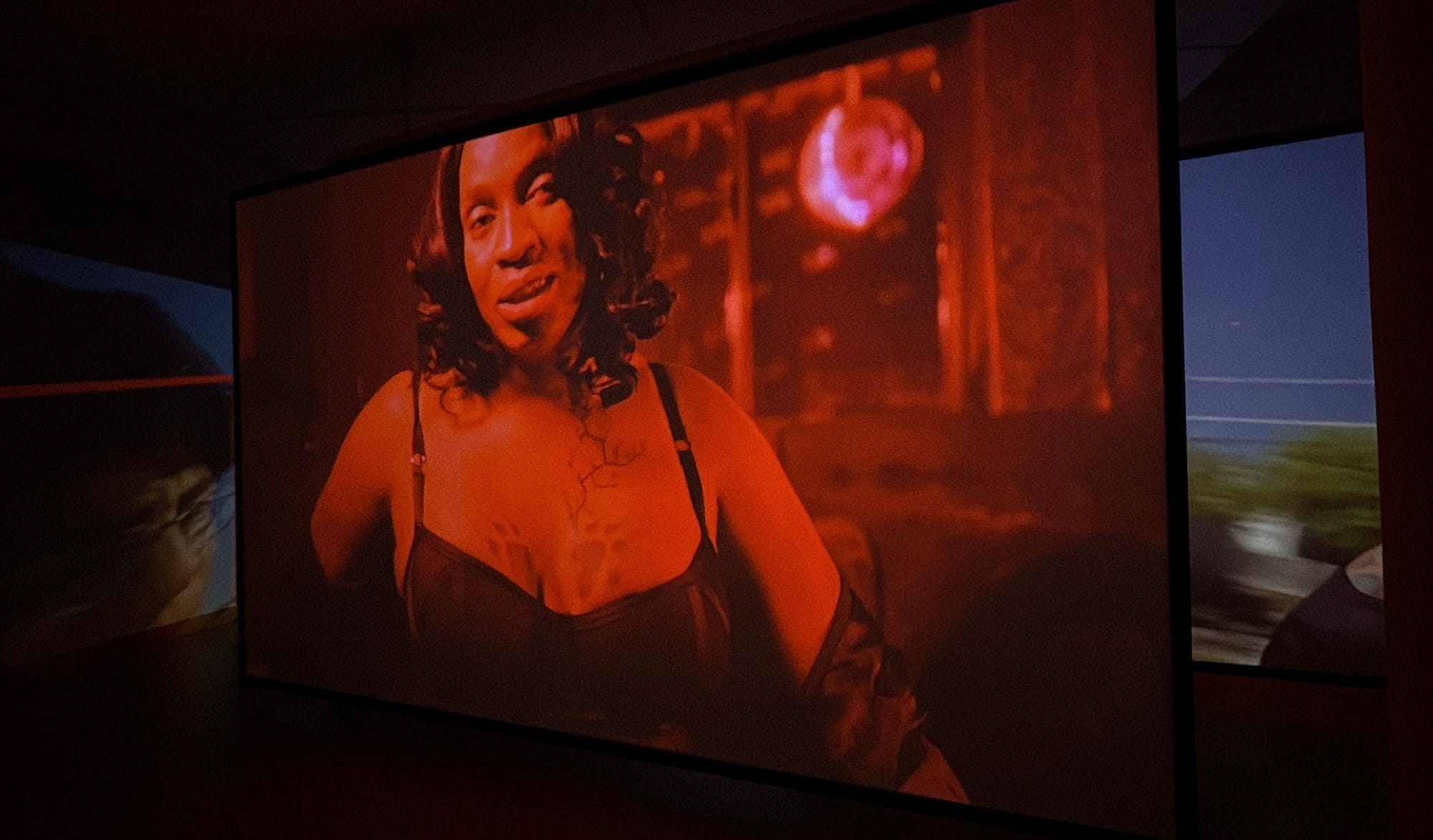
In one particularly emotive scene, activist Monica Jones plays a character named Vegas, reclaiming agency within sex work as she stands outside a diner advertising “quicky on the go” and “breakfast in bed,” choosing which clients to engage with as they drive by. In another, performers dodge an “X” projected onto a box-shaped camera, opening a vast breadth of interpretations around surveillance, identity, and erasure: Is the X a gun target? A demographic checkmark? An X on a passport? An attempt to bifurcate the gender spectrum?
Gregory noted that the installation required over a year of preparation with external consultants, including audio, video, and systems engineers, due to its complex structural demands. “The first technical supervisor thought I was going to create chaos in the gallery, so he passed,” Cheang laughed. “But when he came to the opening, he said, ‘Oh my god, you actually did it.’”
One of the most compelling aspects of LOVER LOVE is that there is no singular vantage point from which to experience it in full. This encourages viewers to revisit the film from multiple angles, subverting the conventions of exhibition film and traditional modes of viewer interaction.
“We are all taught not to touch the artwork,” Cheang said. “But when people start moving the screens, it creates completely different stories every time.”
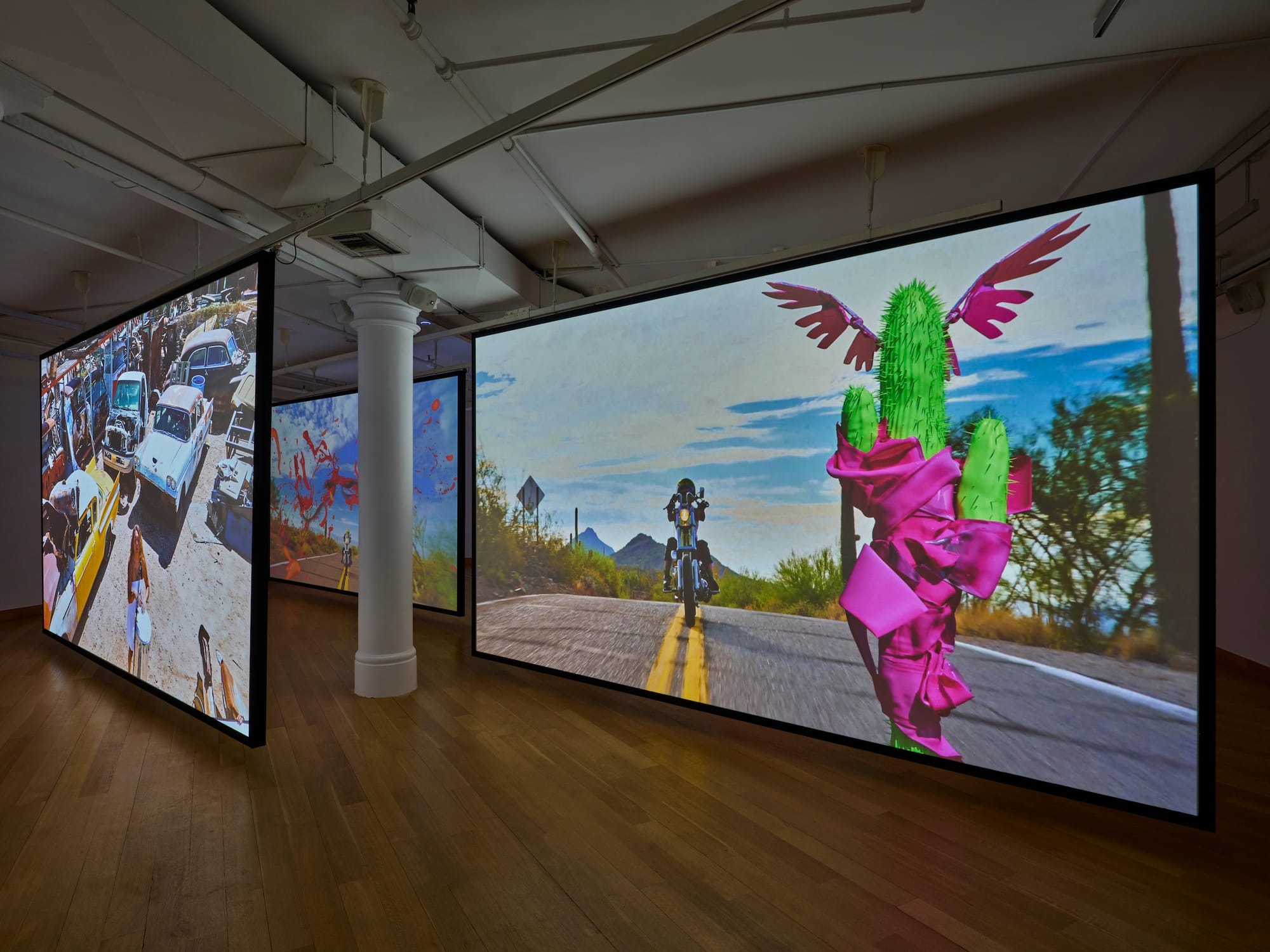
Gregory also connects the installation to the concept of “the slit,” pioneered by Italian-Argentinian artist Lucio Fontana, whose slashes into canvas pushed painting into spatial and metaphysical dimensions. “At the exhibit opening, two screens were moved so close together that you could only see between them from certain angles,” they recalled. “And people were making out inside the slit!”
Cheang hopes viewers will lean into the instability and impermanence of the projections, even as they produce a sense of loss. “You might realize that, as you move one screen, you’re missing another image,” she said. “But I don’t want people to be defeated. Because that displacement is really what the exhibit is about.”
As the film concludes, an animated UFO descends onto a road running through Tucson’s Sonoran Desert, echoing the extraterrestrial escape and divine intervention of the seraph at the beginning of the film. “It’s biblical and cosmic,” Gregory said. “It’s like souls are escaping inhuman oppression and taking flight.”