With their decidedly alien appearance and ability to change color, cephalopods like squid and octopuses have long captured our imagination. New analysis of cephalopod fossils reveals that squid alive during the Cretaceous roamed over a far wider swath of the world’s oceans than previously believed. This discovery, published in Geology, highlights that the ancient animals had adapted to a large range of habitats even before the Chicxulub impact upended marine ecosystems more than 66 million years ago.
Find the Beaks
Squid originated roughly 100 million years ago during the Cretaceous period. However, peering into their past is challenging because they aren’t well represented in the fossil record. That’s in large part because they lack bones and shells, structures that readily fossilize. “Such large, robust parts account for most fossils known,” said Shin Ikegami, a paleontologist at Hokkaido University in Japan. Squid also retain ammonia in their tissues to make them more buoyant, and the compound furthermore inhibits the fossilization process.
“Each squid has an upper and a lower beak as a primary feeding organ.”
The one component of a squid’s body that has a fighting chance of fossilizing is its beak. Similar to how we use our teeth to chew, a squid uses its stiff beak for eating, said Ikegami. “Each squid has an upper and a lower beak as a primary feeding organ used for biting.”
Ikegami and his collaborators recently analyzed a roughly basketball-sized concretion of sediments from South Dakota originally collected by Neil Landman of the American Museum of Natural History. The sediments date to roughly 67 million years ago. At that time, the area that is now South Dakota was squarely in the Western Interior Seaway, an ocean that bisected North America. Ammonites, which are also cephalopods, have been found in spades in the region, so the researchers were hopeful they might find squid beaks.
A Very Close Shave
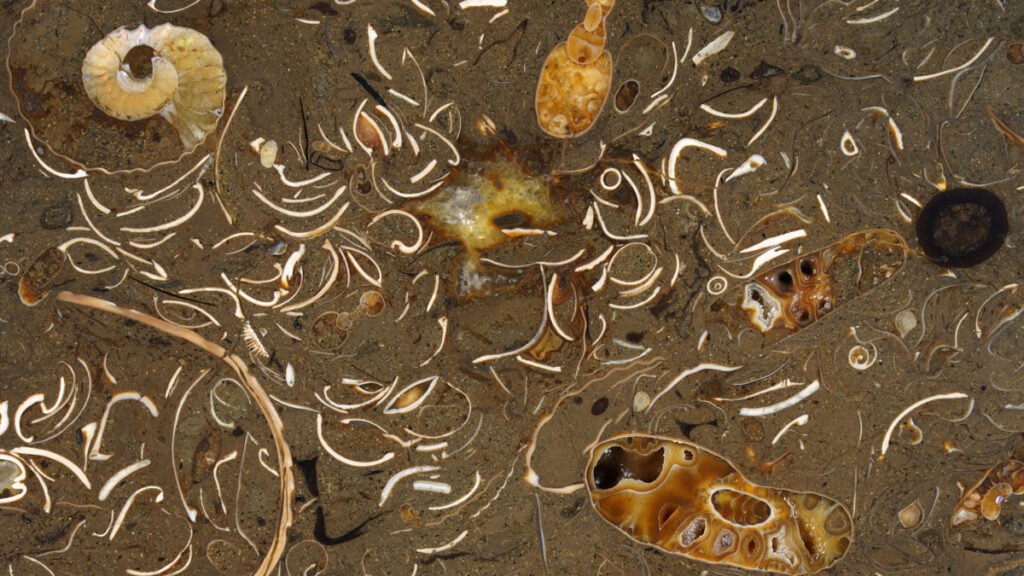
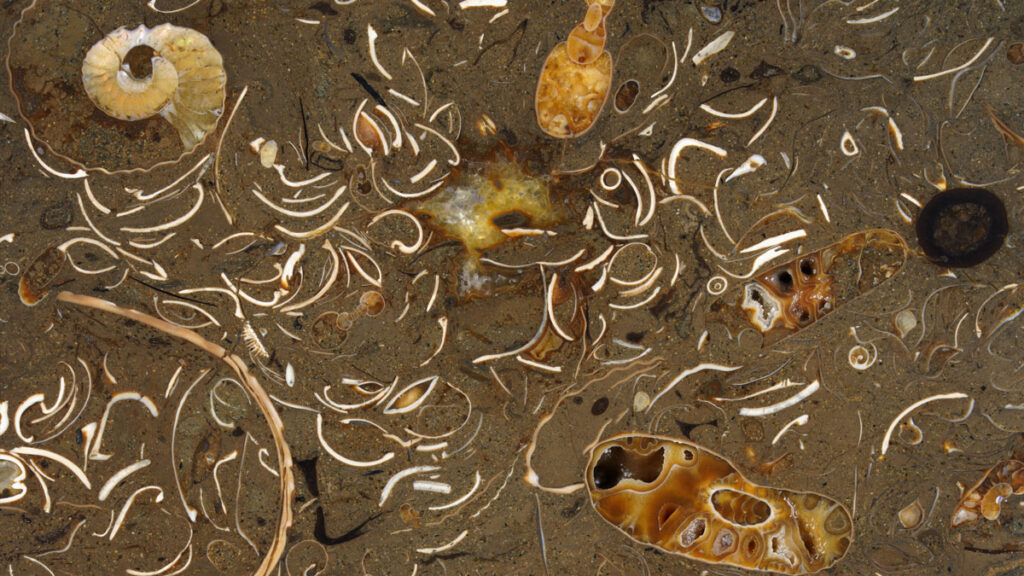
Ikegami and his colleagues used a technique they called digital fossil mining. The team sequentially ground down the concretion, shaving away just hundredths of millimeters at a time and taking more than 5,000 high-resolution pictures along the way. Those data allowed the team to digitally reconstruct and zoom through the concretion to search for embedded fossils.
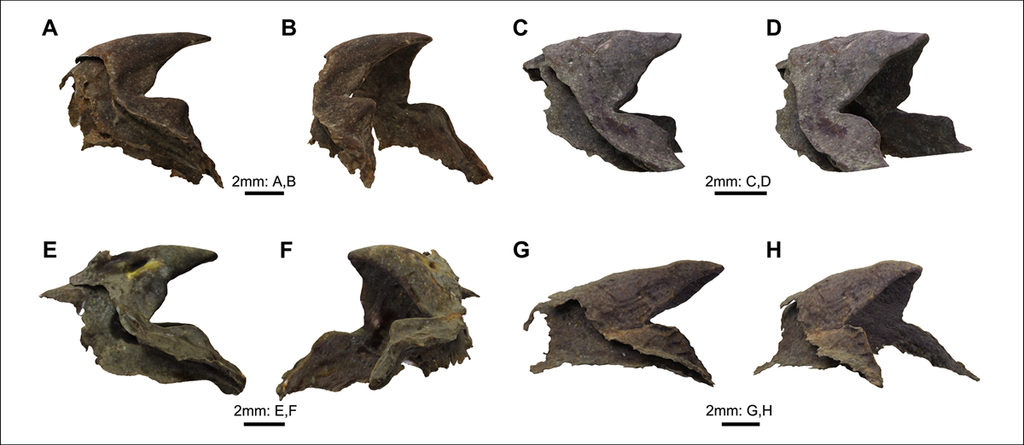
The researchers found four structures that they believe are fossilized lower squid beaks, each about 1 centimeter across. On the basis of the shapes of the beaks, Ikegami and his collaborators believe that they’ve identified two new species of squid. But the real surprise wasn’t pinpointing new species: It was finding any squid at all in these sediments, Ikegami said.
All of the other known remains of squid from the Cretaceous period have been found in what was then the northwestern Pacific Ocean, more than 10,000 kilometers away from the Western Interior Seaway. There was no evidence that squid existed beyond the Pacific Ocean, so finding them on what was literally the other side of the globe was wholly unexpected, said Ikegami.
Not Waiting for an Asteroid
“The restructuring of marine ecosystems had already started.”
Squid are distributed globally today, and their geographic radiation has long been believed to be attributable to a cosmic cataclysm: the asteroid impact that created the Chicxulub crater and spelled the demise of nonavian dinosaurs. But the sediments that Ikegami and his team analyzed predate that event by roughly 1 million years. “Our findings indicated that the rise of some modern-type animals occurred prior to the mass extinction,” said Ikegami. “The restructuring of marine ecosystems had already started.”
These findings shed new light on when squid started dispersing throughout the world’s oceans, said Thomas Clements, a paleobiologist at the University of Reading in the United Kingdom not involved in the research. But tracing the details and timing of that process will require analyzing more fossils from locations intermediate between the Pacific Ocean and the Western Interior Seaway, he added. “That will tell us how quickly these animals radiated.”
—Katherine Kornei (@KatherineKornei), Science Writer
Citation: Kornei, K. (2026), Squid were on the move before the Chicxulub impact, Eos, 107, https://doi.org/10.1029/2026EO260305. Published on 23 September 2026.
Text © 2026. The authors. CC BY-NC-ND 3.0
Except where otherwise noted, images are subject to copyright. Any reuse without express permission from the copyright owner is prohibited.