- Khan Academy hit a record $117.5 million in revenue in 2024-2025, roughly double the $59.3 million it raised in 2021.
- It runs almost entirely on donations: $90.4 million in contributions vs $22.2 million earned from services.
- It reaches 185 million+ registered learners, with about 8.5 million active monthly across 190+ countries.
Sal Khan, founder of Khan Academy, is probably the most well-known name in online education (and maybe education in general). In various interviews, I’ve heard the founders of Coursera, edX, and Udacity credit Sal Khan as the inspiration behind their companies.
And as I was looking through Khan Academy’s Tax Returns from 2008–2025, the data seemed to agree. 2011 was a breakthrough year for Khan Academy, with contributions rising from $1.8 million to $11.8 million and the number of employees growing from 3 to 30. In March 2011, Salman Khan published his Ted talk.
Later that year, three Stanford online courses went live, leading to the birth of the modern MOOC (or Massive Open Online Courses) movement. The following year, NYT called 2012 the Year of the MOOC. The timeline fits perfectly.
2020 was the “Second Year of the MOOC”. The same can be said about Khan Academy. We can clearly see the impact of the COVID-19 pandemic on Khan Academy’s finances. It received as much money in 2020 as it did in the previous two years combined. Like other companies, Khan Academy also experienced a post-pandemic slowdown in 2021, which is reflected in its revenues.
In 2025, Khan Academy switched its fiscal year from a calendar year (ending December 31) to one ending June 30. To make the switch, it filed one short tax return (from January to June 2024). This aligns its books with the July–June school year, when the product is actually used.

At the Class Central Report, our aim is to decipher the online education business. Previously, I analyzed the public filings of Coursera, Udemy, and Thinkific, and covered Coursera’s monetization journey as they went from zero to IPO. Recently, I wrote a 5,000+ word breakdown of the Coursera and Udemy merger, which was like my analysis of 2U’s acquisition by edX.
Since Khan Academy is a non-profit, its tax returns are publicly available. This is my first attempt at analyzing Khan Academy. If there’s an interest, we’ll analyze more reports in the future.
Khan Academy Revenues from 2020 – 2024
| 2020 | 2021 | 2022 | 2023 | 2024* | 2024-2025 | |
| Revenues | $79.3M | $59.3M | $53.2M | $98.3M | $28.1M | $117.5M |
| Contributions and Grants | $65.7M | $48.7M | $40.0M | $84.2M | $20.7M | $90.4M |
| Program Service Revenue | $12.6M | $9.4M | $12.9M | $12.1M | $5.3M | $22.2M |
| Expenses | $56.8M | $53.9M | $58.2M | $68.1M | $38.8M | $87.5M |
| Net | $22.6M | $5.4M | ($4.9M) | $30.1M | ($10.7M) | $30.0M |
| Employees | 197 | 229 | 258 | 237 | 0 | 337 |
| Volunteers | 1,400 | 1,400 | 650 | 600 | 600 | 600 |
| Registrations | 118M (27.3M new) | 140M | 147.6M | 162M | 168M | 185M+ |
In 2020, just six years ago, during the pandemic, Khan Academy had 27.3 million new registrations. The number decreased post-pandemic until 2022, when only ~8M students registered. After that, the number has been growing, of course, not at the pandemic rate.
In the school year 2024-2025, Khan Academy achieved a total of 185M+ million registrations (~21M new ones). It also had ~105M yearly active learners.
There were 8.5M learners active every month in more than 190 countries. ~53% of learners were outside the US. The platform had ~800 active courses.
Donations saw an inverse growth. They dipped in 2021 and 2022, then climbed to their highest levels after the pandemic rush was over, reaching $84.2M in 2023 and $90.4M in 2025. So Khan Academy’s best fundraising years came after user growth stabilized.
From 2020 to 2024-2025, here’s the breakdown of their revenue.
| Revenue Source | 2020 | 2021 | 2022 | 2023 | 2024- 2025 |
| Foundation and Individual Gifts | $52.6M | $24.6M | $21.1M | $64.2M | $70M |
| Corporate Gifts | $6.8M | $16.3M | $18.8M | $15.3M | $20M |
| Community Giving | $8.8M | $8.0M | $5.9M | $9M | $8M |
| Earned Income | $12.4M | $9.2 | $12.9 | $12M | $23M |
| Other Income | $1.6M | $1.1M | – | – | – |
The 2024 numbers weren’t reported due to half-year reporting
In 2021, there was a significant decline of more than 50% in Foundations and Individual Gifts. However, this was partially offset by a $10 million increase in Corporate Gifts.
In 2024-2025, the Corporate gifts increased, their best year and nearly three times the 2020 level. Community Giving slightly declined, but the earned income almost doubled. Foundation and Individual Gifts rose to $70M, the highest until now after falling as low as $21.1M in 2022. Earned Income grew the most, nearly doubling to $23M from $12M in 2023.
P.S. In the 2020 tax returns, I saw a mention of two separate donations of Google Shares worth $10.8M combined (the Google stock price had almost doubled since the stock was donated).
How Does Khan Academy Make Money?
Khan Academy has two major sources of revenue: Contributions and Grants (what it earns through donations) and Program Service Revenue (what it makes with its services). Here’s how these two revenue sources have grown over the years.

Contributions and Grants: $365M since 2008
Khan Academy began with almost no outside funding, raising only a few thousand dollars through 2009. 2010 and 2011 saw significant funding at $1.8M, then $11.8M. Contributions peaked at $42.8M in 2017 before falling to $27.6M by 2019.
After the 2020 peak, contributions fell for two straight years. By the end of 2021, Khan Academy had raised $365M since 2008, about a third of it in 2020 and 2021 alone. But in 2023, contributions more than doubled to $84.2M, bringing the total revenue to $98.3M. The 2024 figures cover only January to June, a fiscal-year transition period, so they aren’t comparable to surrounding years.
In 2024-2025, the first full year on the new fiscal calendar, contributions reached $90.4M and program service revenue hit $22.2M, both record highs. Total revenue of $117.5M is the most the organization has ever brought in.
Here’s the distribution of Khan Academy’s donors from 2020 – 2025.
| Tiers | 2020 | 2021 | 2022 | 2023 | 2024-2025 |
| $1,000,000 and above | 20 | 14 | 15 | 17 | 21 |
| $500,000 – $999,999 | 7 | 5 | 3 | 8 | 8 |
| $250,000 – $499,999 | 4 | 2 | 9 | 12 | 12 |
| $100,000 – $249,000 | 11 | 18 | 9 | 13 | 13 |
| $50,000 – $99,999 | 12 | 16 | 13 | 10 | 10 |
| $25,000 – $49,999 | 18 | 22 | 19 | 11 | 11 |
| $1,000 – $24,999 | ~1050 | ~775 | ~838 | ~799 | ~798 |
The 2024 report wasn’t available as it wasn’t calculated as a full year
Program Service Revenue: $131.5M since 2008
Program service revenue stayed under $5M until 2015. But it rose to a high of $17.2M in 2019, then dropped to $12.6M in 2020, even as donations surged.
We know how much money Khan Academy makes, but it’s unclear to me how it made $9.4M in 2021 and $12.6M in 2020. The tax returns aren’t very granular in this aspect, only breaking revenue down into vague categories.
The revenue stayed between $9M to (almost) $12M band for four years: $9.4M in 2021, $12.2M in 2022, $12.1M in 2023, and the $5.3M fall for the half-year 2024 (due to the six-month reporting). Growth stalled while contributions swung.
Program service revenue jumped to $22.2M, nearly double the 2023 level and the highest until now.
Khan Academy categorizes program services revenue into two major categories:
- Platform Development
- Content Creation and Curation
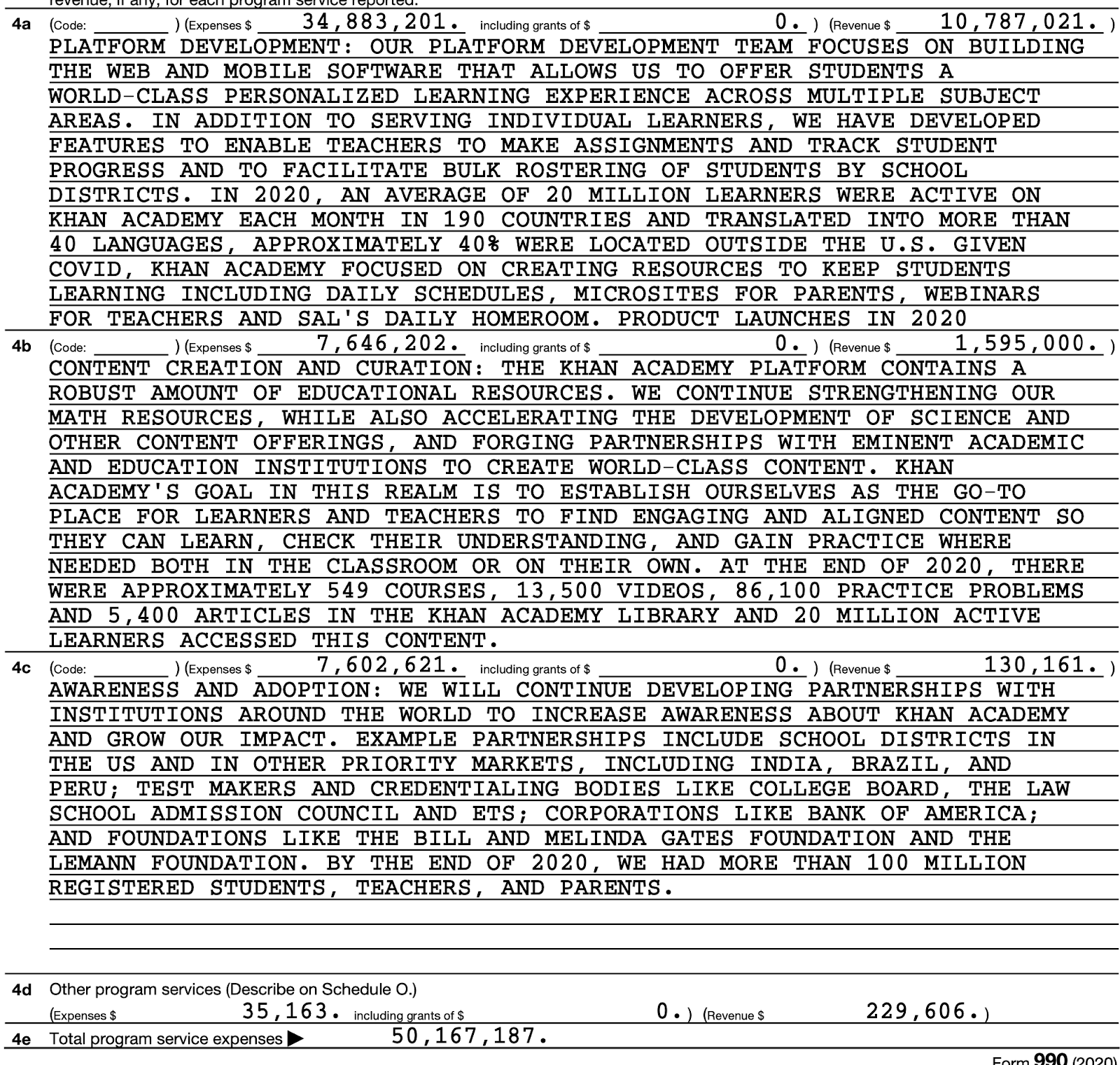
Deeper in the tax returns, fees are broken down into four categories: Development Fees, Maintenance Fees, Content Licensing Fees, and Speaking Fees.
Weirdly, Khan Academy hasn’t mentioned Content Licensing Fees since 2023. The fee has been falling since 2019 and may have reached its reporting threshold, below 100K.
A similar story appears in the Speaking Fees (the fee Khan Academy receives when its people, usually Sal Khan himself, give paid talks: keynotes, conference appearances, events, etc). From ~228K in 2013, it dropped to $409 in 2025.
But the Development Fees have soared in 2024-2025. It reached a whopping $21.3M from $8.2M in 2023.
| Year | Development Fees | Maintenance Fees | Content Licensing Fees | Speaking Fees |
| 2024-2025 | 21.3M | 884K | – | 409 |
| 2024* | 4.4M | 952K | – | – |
| 2023 | 8.2M | 3.6M | 120K | 60,000 |
| 2022 | 8.6M | 4.0M | 217K | 28,800 |
| 2021 | 4.3M | 3.6M | 1.3M | 124,040 |
| 2020 | 6.3M | 4.5M | 1.6M | 229,606 |
| 2019 | 9.0M | 4.1M | 3.7M | 380,125 |
| 2018 | 3.0M | 3.1M | 4.0M | 214,500 |
| 2017 | 2.0M | 3.0M | 4.0M | 383,987 |
| 2016 | 2.0M | 2.2M | 3.4M | 749,750 |
| 2015 | 120,548 | 2.8M | 669,600 | |
| 2014 | 3.6M | 214,831 | ||
| 2013 | 3.9M | 227,929 | ||
| 2012 | 106K |
If anybody has insights into who is paying Khan Academy and for what, please let me know in the comments or reach out to me at dhawal@classcentral.com.
Khan Academy Expenses
Expenses climbed steadily from near zero in 2009 to about $56M in 2020, with no down years. Net income was positive throughout, though it swung with donations: large surpluses in 2013 and 2016, then the first deficits appeared in 2018 and 2019.
Khan Academy was losing money on an annual basis due to an increase in expenses and a decrease in Contributions and Grants. But it did have tens of millions in assets and could have sustained this situation for a few years.

But in 2020, the donation surge restored a strong surplus. It got a big boost in Contributions and Grants, making it Khan Academy’s most profitable year since 2013. In 2021, it was back to losing money.
Expenses kept rising, from about $54M in 2021 to $68M in 2023. Net income stayed volatile: small deficits in 2021 and 2022 when contributions dipped, then a $30.1M rise in 2023.
In 2024-2025, expenses jumped to about $87.5M, the highest, and a dramatic step up from 2023. And the record contributions produced a roughly $30M surplus, matching 2023’s.
Khan Academy’s biggest expense is its people. In 2024-2025, salaries, compensation, and benefits reached $68.2M, about 78% of total expenses, up from roughly 73% in 2020. Since 2008, the organization has spent more than $400M on staff compensation.
| Fiscal Year | Salaries, other compensation, employee benefits | Part VII, Section A salaries | Total Employees |
| 2024-2025 | 68.2M | 5.8M | 337 |
| 2024* | 28.6M | 0 | 0 |
| 2023 | 51.6M | 5.6M | 237 |
| 2022 | 43.5M | 5.8M | 258 |
| 2021 | 39.4M | 5.0M | 229 |
| 2020 | 41.7M | 4.7M | 197 |
| 2019 | 38.6M | 4.5M | 251 |
| 2018 | 35.0M | 3.5M | 234 |
| 2017 | 27.3M | 3.3M | 219 |
| 2016 | 19.7M | 3.0M | 180 |
| 2015 | 16.0M | 3.9M | 147 |
| 2014 | 12.4M | 3.0M | 114 |
| 2013 | 8.1M | 2.3M | 90 |
| 2012 | 5.9M | 2.0M | 53 |
| 2011 | 2.2M | 1.3M | 30 |
| 2010 | 139K | 121K | 3 |
| 2009 | 1 | ||
| 2008 | 1 |
In 2020, employee count dropped from 251 to 197, yet compensation still rose from $38.6M to $41.7M. The likely cause is the shift to remote work and a reclassification of some staff as contractors.
Headcount has since grown sharply, from 197 in 2020 to a record 337 in 2024-2025, and compensation rose with it. “Part VII, Section A” salaries, covering officers and key staff, were $5.8M in 2024-2025, around 8% of total compensation, down from about 13% in 2021.
The highest-paid employee in 2021 was Sal Khan, at $856K. Even in 2024-2025, he remained the highest-paid employee, getting $871K compensation.
Khan Lab School Donation
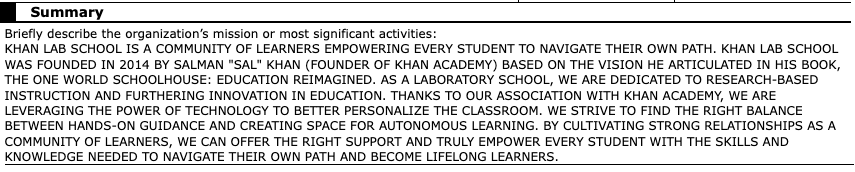
Khan Lab School is an actual school founded by Sal Khan in 2014, which now has two campuses in Silicon Valley (Mountain View and Palo Alto).
It cost around $29k – $33k per student per year in 2021 and had a total of 230 students. Now, it costs $33.7K to $37.7K per student and has 310 students.
It is a separate non-profit organization from Khan Academy, but over the years it has received $3.4 million in grants from Khan Academy.
We checked Khan Academy’s 2020, 2023, and 2024-2025 tax filings and found no grants to Khan Lab School reported in any of them. Grants under $5,000 don’t have to be reported, so small recent amounts could exist, but nothing above $5K.
| 2020 | NA |
| 2019 | 140K |
| 2018 | 215K |
| 2017 | 384K |
| 2016 | 1.2M |
| 2015 | 914K |
| 2014 | 530K |
I didn’t analyze Khan Lab School tax returns, but in 2021 it had a revenue of $7.7 million with a net income of $853k. In 2025, it reached $11.9 million with a net income of ~$1.6M.
The post The Business of Online Education: Khan Academy Tax Returns Analysis (2008–2025) appeared first on The Report by Class Central.