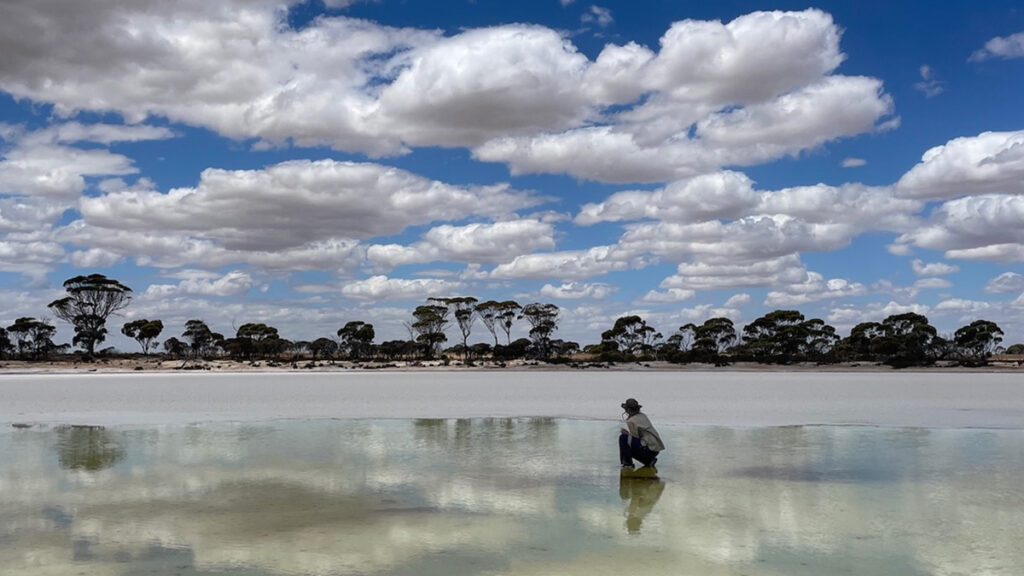
Every few years, Kathleen Benison flies across the world to look at a collection of strange lakes that are both salty and acidic.
Some of the most extreme lake brines are only 66% water, with the rest being made up of dissolved ions of elements like aluminum, iron, calcium, and copper. In comparison, seawater is about 96.5% water and 3.5% dissolved solids.
“At times, the acid salt lakes in Australia are 10 times saltier than seawater,” explained Benison, a geologist at West Virginia University.
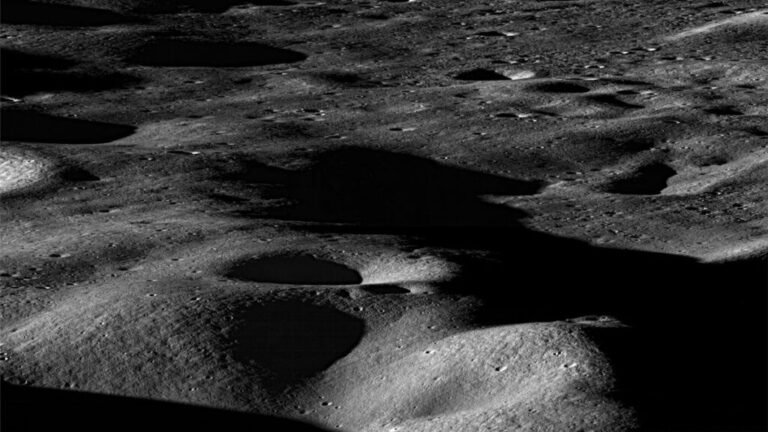
Studying acid salt lakes not only helps scientists learn about these extreme environments but can have applications in other fields, including astrobiology. For instance, the minerals in acid salt lakes are similar to minerals found on Mars, suggesting that Mars may have once had acid salt waters.
“Especially if we’re interested in things like, ‘Was there ever life on Mars?’ we look to extreme environments on Earth because they tell us the range of habitable environments,” Benison said.
Shiladitya DasSarma, a microbiologist at the University of Maryland School of Medicine, noted in an email to Eos that studying salt lakes can be valuable for many reasons. For instance, the study of halophile ion pumps has helped advance the field of neurobiology. He cited the 2026 Nobel Prize in Physiology or Medicine, which was awarded to scientists studying optogenetics—a method of using light to control nerve signals by influencing the flow of ions.
“Earth offers many examples of diverse extreme environments,” including ephemeral acid salt lakes “where novel geochemistry and microbiology may provide clues to life elsewhere,” he said. “Undoubtedly, there are many other potential benefits to such studies.”
We Have to Go Back!
In a 12 October presentation at GSA Connects, the annual meeting of the Geological Society of America, Benison spoke about the importance of studying these environments consistently over time.
One-time sampling might provide an accurate picture of the sedimentology, physical processes, or water chemistry of freshwater lakes, Benison said. But acid salt lakes are different, and understanding their sediments, weather, salt mineral formation, and microbiology can’t be done in one visit.
“Many salt lakes are ephemeral: They dry up and they flood and then they evapoconcentrate,” Benison said. “Every time I go back to the same old friend lakes, I see different things.”
Each lake also has different chemical characteristics based on the local geology. Because these lakes are based in the Yilgarn Craton, one of the oldest pieces of crust on Earth, some of the rocks are more than 3 billion years old. One lake even has a fault that runs underneath it, making it particularly heterogeneous: The researchers might find that one side of the lake is more enriched in aluminum than the other, for instance.
Changes over Time
Benison’s first trip to Australia was in July and August of 2001, which is wintertime in the Southern Hemisphere. Lake Aerodrome, the first lake she visited, didn’t look particularly unusual.
“It looked like a blue puddle,” she said. “But when we put a pH meter in it, the pH was 2.7,” about the acidity of grapefruit juice.
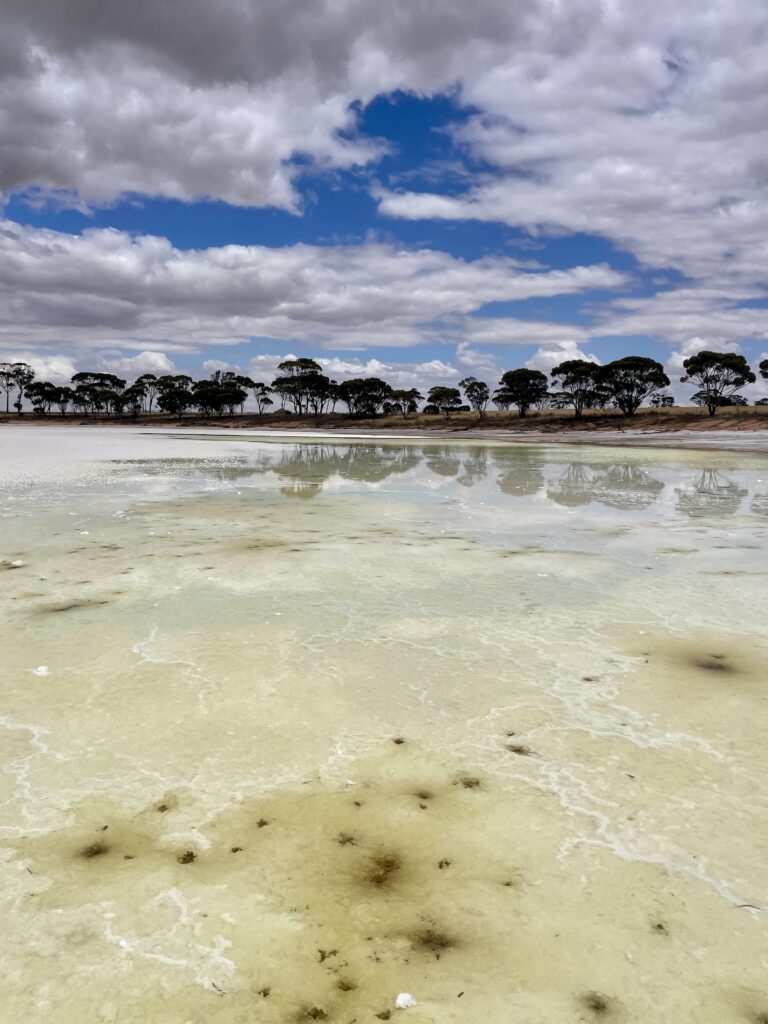
The lake was in its flooding stage. As an acid salt lake dries up, its water becomes even saltier and more acidic. Below, Lake Aerodrome is seen full of water in 2001, almost dry in 2011, and desiccated in January 2026.
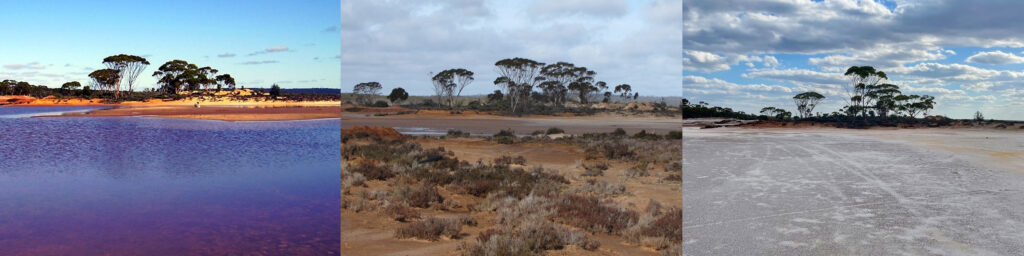
This cycle of flooding, evapoconcentration, and desiccation is not dependent on season, Benison has learned. She’s seen lakes in all three stages during the Southern Hemisphere summer and in both flooding and evapoconcentration states during the winter.
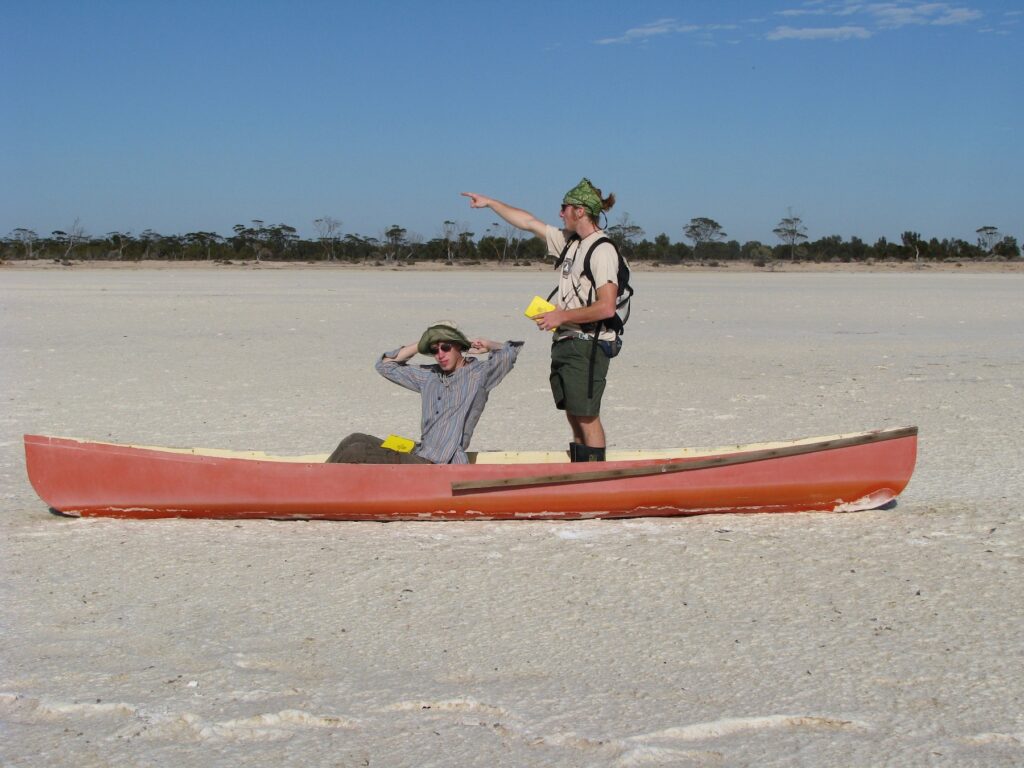
For instance, Lake Magic is seen here in a dry period during a summer visit in 2008.
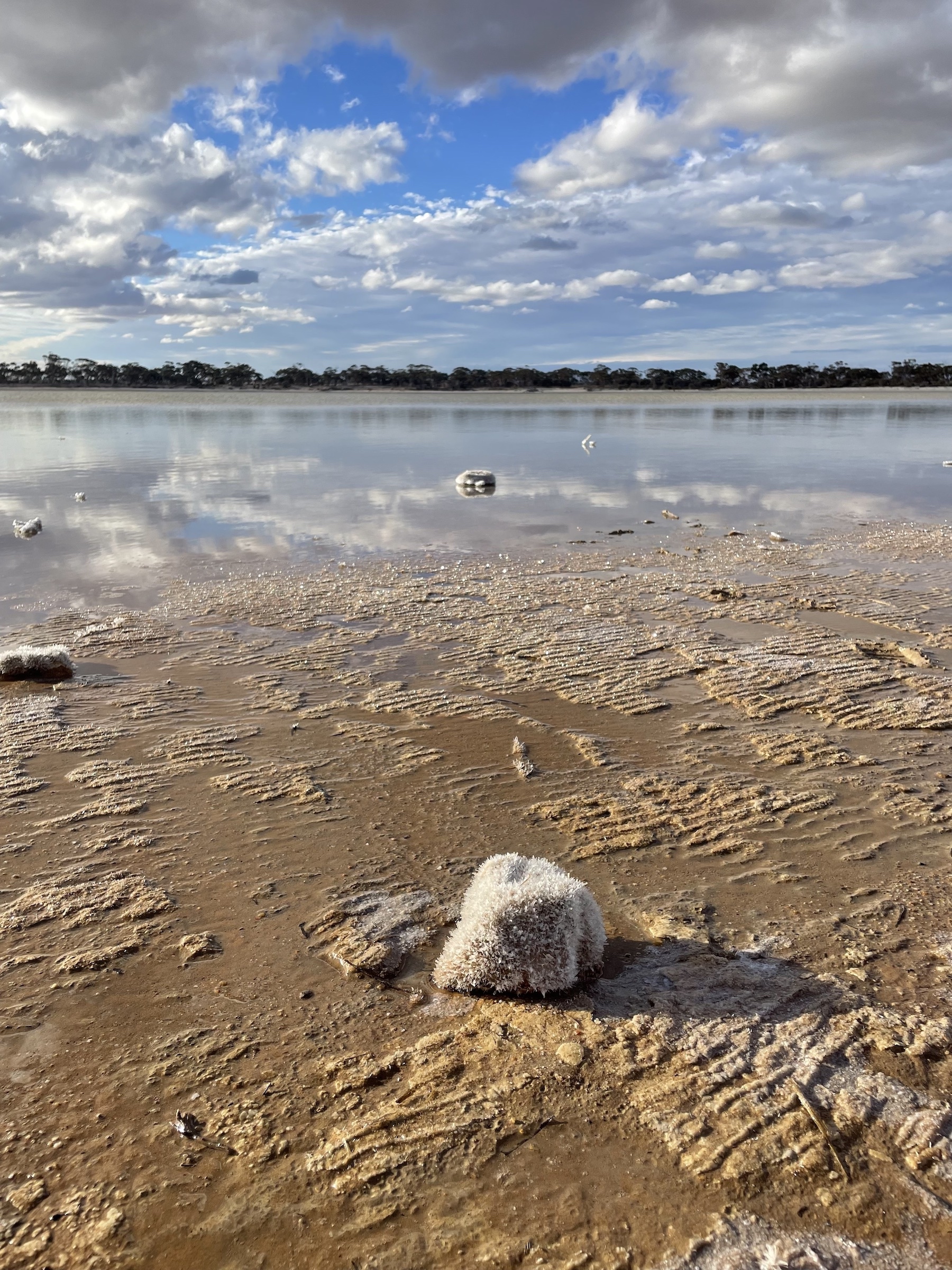
These lakes have multiple kinds of salt. Halite is known for its rapid rate of crystallization. But one question Benison has long wondered about is how long it took the gypsum crystals she sometimes saw on the bottom of these lakes to grow. Was it hundreds of years? Thousands? This year, she was able to visit Lake Aerodrome in late January and again in mid-March. In January, one area of the lake had no gypsum. By March, it had crystals a little over a centimeter high.
“Maybe gypsum grows as fast as halite in some of these environments,” she said in her GSA Connects session. “I think most of the time, gypsum is not forming in these lakes, but when it does, it’s forming very rapidly.”
Changes over Space
When Benison lands in Perth, Australia, she first heads to the hardware store to buy pails and a shovel.
The lakes she visits are anywhere from a half day’s to a full day’s drive from the city. She makes the journey out armed with her hardware supplies, along with notebooks, a camera, and containers for sampling water and salt. Also: pH meters, tape measures, thermometers, and salinity refractometers.
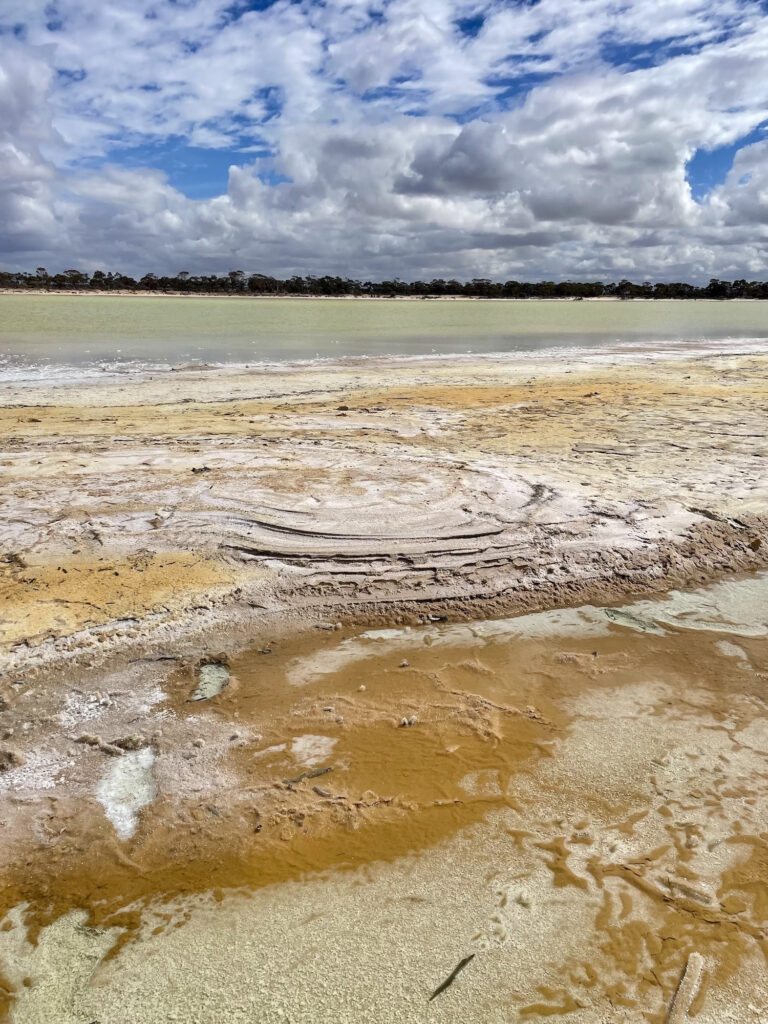
What she and her colleagues find when they arrive at the lake is “always a surprise,” she said. Keeping up with local weather doesn’t help much.
“The local weather is so local, you can have a thunderstorm that’s come through and has hit a lake and dissolves the salts in the lake, made the water get deeper and fresher and less salty,” she said. “And then you can go down the road just maybe a couple of miles and find a salt lake that’s totally dry because that thunderstorm didn’t hit that lake.”
Gathering all of this information—about sediment characteristics and about groundwater depth, pH, and salinity—at transects around and across the lake can sometimes take a full day. Other visits are shorter: Once, she and collaborator Brenda Bowen, a geologist at the University of Utah, spent 3 weeks driving around just to see how many lakes they could visit. They got to 61. Today, Benison regularly visits and tries to keep long-term records on 8 to 10 lakes.
Thinking back to when she first started reading studies on acid salt lakes, mostly by geochemists rather than sedimentologists, Benison can still recall all the questions that came to mind: What minerals were forming? Was there halite or gypsum present? What role did wind play in blowing sediment onto the lakes?
“I went out there kind of thinking maybe Western Australia wasn’t going to be that interesting, and then, in fact, it was far more interesting than I had imagined,” Benison said. “It is justifiable to go back to these places again and again because we do learn new things all the time.”
—Emily Gardner (@emfurd.bsky.social), Deputy Editor
Citation: Gardner, E. (2026), The secrets of acid salt lakes, Eos, 107, https://doi.org/10.1029/2026EO260333. Published on 23 October 2026.
Text © 2026. AGU. CC BY-NC-ND 3.0
Except where otherwise noted, images are subject to copyright. Any reuse without express permission from the copyright owner is prohibited.