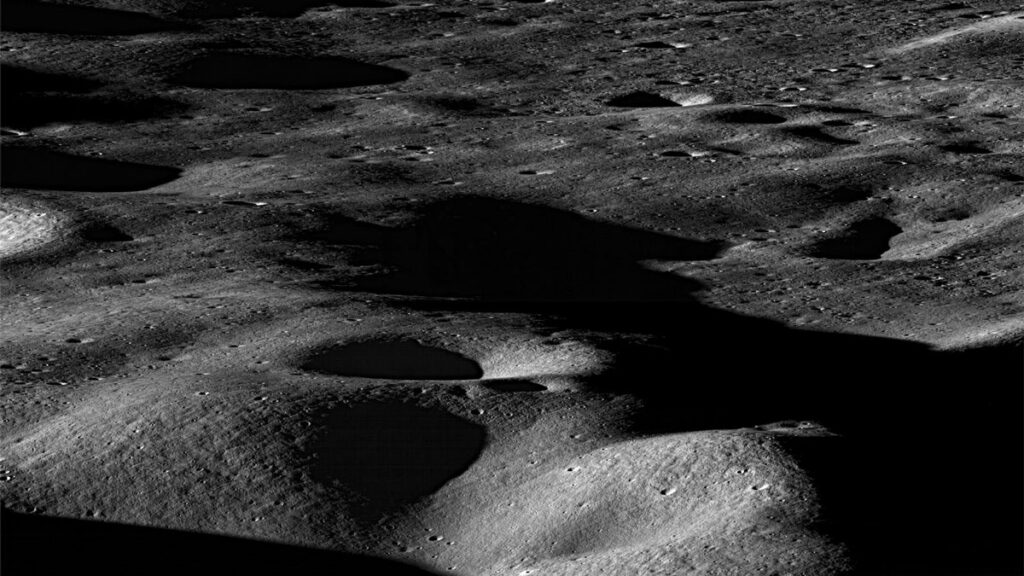
Very early in the history of the solar system, a Mars-sized planet known as Theia crashed into the newborn Earth. This impact destroyed Theia and split enough material off of both bodies to form the Moon. While Theia is long gone, its existence and fatal collision explain the strong geological resemblance our Moon bears to Earth, as well as the Moon’s large size.
Most planetary scientists agree on the general outlines of this story. Beyond that, however, researchers struggle to make the details of their theoretical models agree with the Earth-Moon system that exists. A paper published in Astrophysical Journal Letters contributes to the discourse by showing that if Theia is modeled with a solid crust, its collision could spin off a solid proto-Moon, rather than the debris disk most simulations produce.
“All of these [prior] explanations have relied on the assumption that we can treat the Earth and Theia as fluids when they collide,” said Adeene Denton, a planetary scientist at the Southwest Research Institute in Colorado who is the lead author of the study. Informed by her work on the formation of Pluto’s moon Charon, Denton wanted to see whether changing the material strength of Theia’s crust could make a difference in modeling outcomes.
Denton and her coauthors found that treating Theia as a solid body smashing into a fluid Earth could produce a range of possibilities, including the core of a new Moon.
Importantly, the researchers also demonstrated that when the Earth-Theia collision happened makes a difference as to whether the result was a proto-Moon or a proto–lunar debris disk. An earlier collision with a warm Theia (near but below the melting point) would result in a different outcome than a later collision with a colder, more solid Theia.
“We don’t actually know when the collision took place,” Denton said. “If Theia is cold, then it’s likely going to be stronger because the hotter you are, the weaker you are. So a cold, strong Theia that’s been around a long time isn’t going to deform as readily as a hot, squishy Theia.”
“Just knowing that [the debris disk stage] could be skipped entirely is a really interesting result.”
The new model doesn’t tell us which is correct, a proto-Moon forming sooner after the collision or a debris disk slowly evolving into the Moon we know.
“Making the Moon from a disk is even harder than trying to model giant impacts,” said Sarah Stewart, a planetary scientist at Arizona State University who was not involved with the study. The mystery of the Moon’s formation is “basically unsolved because everyone has to make some simplifying assumptions. But in this case, just knowing that [the debris disk stage] could be skipped entirely is a really interesting result.”
Lava Lamp or Crunchy Granola
Traditional computer simulations of the Earth-Theia impact can require days of runtime, discouraging researchers from further complicating their already-complex models by introducing issues like the material strength of the colliding planets. But improvements in computing power over the past decade have enabled planetary scientists to expand modeling scenarios, leading to the new study.
To enable direct comparisons with prior work, Denton and her collaborators used standard parameters for everything except the material strength of Theia. They started with a proto-Earth about 88% of the present Earth’s mass and a Theia of about 13% of present Earth’s mass. They also assumed surface temperatures close to but not quite at the melting point for surface rocks, also in agreement with the canonical collision model.
“None of that matters if you’re just approximating Theia as a fluid because it’s all just going to go bwah, like blobs in a lava lamp” when Theia hits Earth, Denton said.
“But if you implement material strength, you have a crunchy outer layer. That makes a huge difference because if a hot Theia collides with the Earth, it’s just cool enough on the outside and hot enough on the inside that it experiences global deformation.”
The result of the new model is Theia splitting into two pieces, one that merges with Earth to plump our early world and one that creates a proto-Moon.
However, if Theia was cool enough to have an even sturdier crust, the simulations show it’s too crunchy and breaks into little granola-like chunks rather than a lava lamp blob. That result aligns with the canonical model of a debris disk, but leads to the previously mentioned question of how the Moon eventually formed out of the debris.
Stewart pointed out that reconstructing historical planetary events like this one has intrinsic difficulties simply because the early solar system was complicated and the Earth-Theia collision was a random event.
“It is possible that we will not have one answer, and that’s okay.”
“We are computationally limited in the exploration of possible ways to make the Earth-Moon system,” she said. “It is possible that we will not have one answer, and that’s okay.”
In other words, Denton’s model doesn’t solve everything, but it could show a way forward. The next steps involve talking to geochemists to see how much those data could constrain more advanced material strength simulations. But in the meantime, showing that a proto-Moon could form from the collision offers one crunchy explanation for how our Moon came to be.
—Matthew R. Francis (@BowlerHatScience.org), Science Writer
Citation: Francis, M. R. (2026), Was the Moon-forming impact squishy or crunchy?, Eos, 107, https://doi.org/10.1029/2026EO260337. Published on 23 October 2026.
Text © 2026. The authors. CC BY-NC-ND 3.0
Except where otherwise noted, images are subject to copyright. Any reuse without express permission from the copyright owner is prohibited.