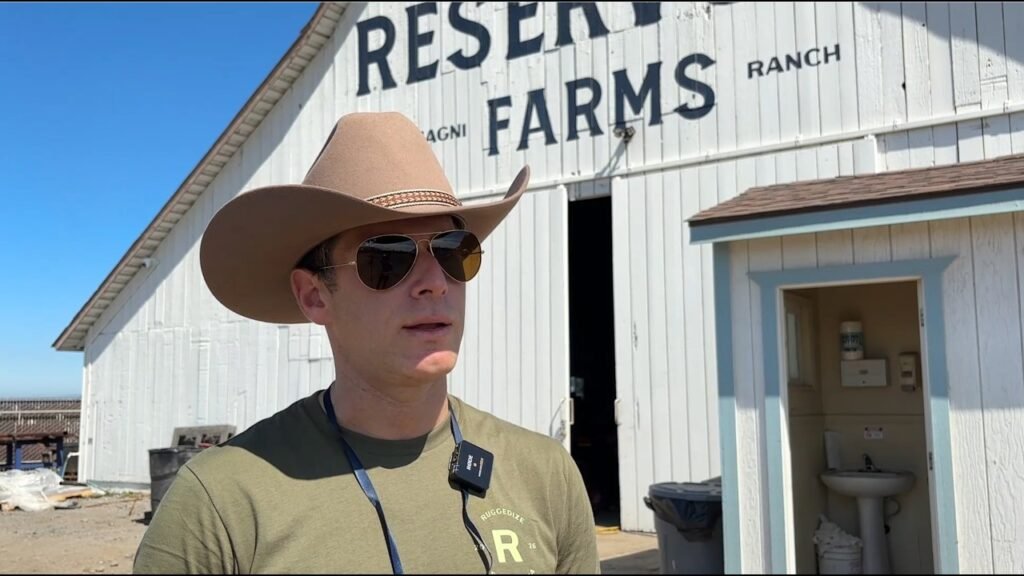
When growers are testing new ag robots, they will usually tell you one of two things, observed Ben Palone at Western Growers at the inaugural Ruggedize conference at Reservoir Farms in Salinas: “They’ll say it’s alright, which means its working great, or it’s a piece of sh*t.”
Growers, said Verdant Robotics* CCO Curtis Garner, expect your machine “to just work. Bombproof, reliable, and if something breaks, swap it.” And they will always “buy reliability before they buy innovation,” added John Deere business integration manager Sean Sundberg.
While high-profile setbacks in the space have made some investors wary, advances in perception technologies, edge computing, AI and robotics combined with a growing stack of off-the-shelf hardware and software are helping startups build more flexible machines more quickly, said successive speakers.
And that, claimed Reservoir founder Danny Bernstein, means “the whole system is now more investable,” pointing to machines that are now being “assembled, prototyped and tested in less than six months” on a surprisingly tight budget. “There are very few companies who are really building the entire stack now. It’s just not really logical.”
Machines, meanwhile, are becoming more flexible, added Bernstein: “They’re able to compound to multiple crops, multiple tasks, multiple machines, and multiple industries.”
But they still need a lot of support in the early stages, says Reservoir, which is on a mission to accelerate the space through a combination of venture investment and hands-on practical support. Its 40-acre site in Salinas gives startups access to farmland, workshop space and a community of growers, founders, OEMs and technology companies, while its new Reservoir VC arm is raising $50 million to back early stage players in the segment.
In the first in a series of videos from the Ruggedize event, AgFunderNews (AFN) caught up with Bernstein (DB) to discuss why ag robotics is becoming more attractive to investors and how Reservoir is trying to shorten the path from prototype to commercial deployment.
[Disclosure: AgFunderNews’ parent company is an investor in Verdant Robotics.]
AFN: You’ve said that ag robotics is more investable now… why? What’s changed?
DB: Ag robotics is more investable because the underlying technology has allowed for significantly more degrees of freedom. We mean this in a literal sense in that machines are more flexible; they have more joints, they have more points of freedom, but also that the machines are smarter: there’s more happening on the device.
Another piece of that is that the underlying technology is now much more available off the shelf. There are very few companies who are really building the entire stack now. It’s just not really logical. You have open-source solutions like the robotics operating system (ROS). You have proprietary solutions from Google, Nvidia, and others. Those are all clearly very intertwined.
It was the case even 15, 20 years ago where you had to have your own cloud, and of course now you can pull that from Amazon or Nvidia. So you can stitch all these things together now, so that makes a difference.
And what that unlocks basically are these total addressable markets that can compound. So if agtech 1.0 in robotics was one crop, one task, and you were highly limited, someone would say, “Well, no one can invest in a strawberry harvester because even the best case scenario is they’re just a strawberry harvester.” But now that same company with a lot of the same stack, can become a cross-berry harvester, can pick romaine and iceberg and brassicas, and even can start to think about orchards.
That sort of sort of compound potential didn’t exist five or seven years ago. And those same machines can also begin to think about land management, about forestry… They’re originating in agriculture, which is one of the better markets for complex outdoor industries, and now they’re able to compound to multiple crops, multiple tasks, multiple machines, and multiple industries.
AFN: How are investors thinking about ag robotics?
DB: We’re going to see a series of fundraising announcements. We saw one yesterday with TerraBlaster, for example, where Reservoir is an investor, and we should see a series of those now that I think will point to a really promising hot streak for agricultural robotics.
So, at a micro level, at a trend level, in the next six to 12 months, we’ll see some positive signals. But if we take a big step back and we think about why isn’t agricultural robotics at the first table of robotics, that’s a different question, and that fundamentally comes down to more systemic things.
If we compare it to defense, which we very often do, defense has two things. It has a buyer, which is of course the Department of War, which is a big buyer. It writes big checks and it writes big checks pretty early, and it also provides significant amounts of non-dilutive capital during the de-risking phase.
Agriculture doesn’t have either of those things right now. It doesn’t have the one big customer, the federal customer, nor does it have a federal de-risking mechanism, or even a state-level de-risking mechanism. And so, I would say for Reservoir, in terms of our agenda, building that system-level support around agriculture is one of the big unlocks that makes this sector more investable.
AFN: How deep is the pool of credible acquirers for some of these companies? And do firms need to have a broader addressable market that’s beyond ag to be of interest to these acquirers?
DB: We believe they do, and we invest across two segments. We invest in agricultural robotics, and those that we expect that those robotics companies can compound to other industries.
And that behavior exists, of course, in what we think of as traditional ag OEMs, where companies such as Deere and Kubota already operate across multiple outdoor industries. There are very few companies that are specific to ag OEMs.
The other area that we invest in and that we that we support is in the [tech] stack, what we call the rugged physical AI stack. This could be safety autonomy; this could be a navigation system; this could be various componentry. And that has a much broader aperture of potential acquirers that is dotted along Silicon Valley.
And so that’s where we think the space becomes more investable. We think about it not just as ag or agtech, but as rugged AI, rugged tech, and then the rugged AI stack, which can compound into Silicon Valley and beyond.
AFN: There is a lot of activity in precision spraying and weeding, but is harvesting proving a bigger challenge?
DB: Reservoir looks at three areas. We look at physics for chemical replacement. We look at AI and vision for chemical reduction or resource reduction using resources more precisely, and then a broad category, which is automation of the hardest to fill jobs, and that’s where harvest is very interesting.
Harvesting is a extraordinarily difficult engineering challenge. But we have a SAMI Robotics machine out there [near the entrance to Reservoir], which is arguably the most promising leafy greens harvester in the world right now.
The imperatives around harvest are more significant than ever before, and the relevancy around harvest automation is more significant than ever before.
AFN: You’ve argued that ag robotics companies need to be built around more realistic exit outcomes. But how much scope is there to lower burn rates and build more capital efficient models?
DB: So Reservoir has a company here called High Degree that is very capital efficient and raised just a little bit of venture capital. They built a full prototype here in about four months, and they’re already operating on commercial fields. So we do think that ag tech can be accelerated.
AFN: Give us the basics on Reservoir VC
DB: Reservoir VC is an early-stage deep tech fund for rugged AI, and we recently brought in a new general partner to run the fund. Her name’s Nicola Kerslake. Nicola was part of a management company called Contain. We acquired Contain. Nicola was the founder of Indoor Ag-Con, so she’s got this really deep background in the space.
AFN: How much money has Reservoir VC got to work with?
DB: We recently wound down a $3 million proof of concept fund anchored by Taylor Farms, which is very common for first time funds. We made several investments out of that, including Farm-ng, which was acquired by Bonsai, and Bonsai is now doing great. We also invested in the pre seed round of Terrablaster, and they just raised a seed round, where we invested again, so that proof of concept fund has been a positive outcome.
These companies are really notable in the ag robotics space, and so it’s given us confidence to now build out a new vehicle.
So we started working on that as of June once Nicola came in, and the initial signal we’re getting is extraordinarily positive. It’s a $50 million dollar target and we’re getting a lot of interest from mission-aligned family offices, from producers, and a segment of investor that’s beginning to tiptoe into agtech that wants to see the future-proofing of farming through robotics.
AFN: At what stage is Reservoir VC investing?
DB: Reservoir VC will invest pre-seed and seed primarily. We are lead follow agnostic, but we’re probably a very good follow alongside a very traditional deep pocketed deep tech fund. That’s something that we did for example with TerraBlaster’s seed round, where we followed Khosla Ventures, with us being a complement, the ag strategic. Plus, we have a proving ground [at Reservoir Farms where firms can test their tech on crops], so we have we have this capability to be able to really support these companies, to be able to deeply integrate them into rural regions of California and beyond.
AFN: Tell us about your LP base
DB: We have a very deep tech, even a bit geeky kind of LP base, so in some ways untraditional from I think a lot of what you see with agtech funds, where they’re very grower backed, or they’re very locally backed, or maybe you’ll have a lot of agribusiness that are crowding in.
But for us, what we’re seeing is that Reservoir is a diversification bet relative to their other physical AI bets, and they see that we’re basically at the early stage, at the cornerstone where ag and robotics are meeting, and that I think differentiates us. We’re also one hour from Silicon Valley. My background is Silicon Valley. So I think if you’re thinking about a fund that is really at the bleeding edge of applied physical AI in resiliency technology, that’s where folks are saying Reservoir.
The post ‘The whole system is now more investable’: Reservoir makes the case for ag robotics appeared first on AgFunderNews.