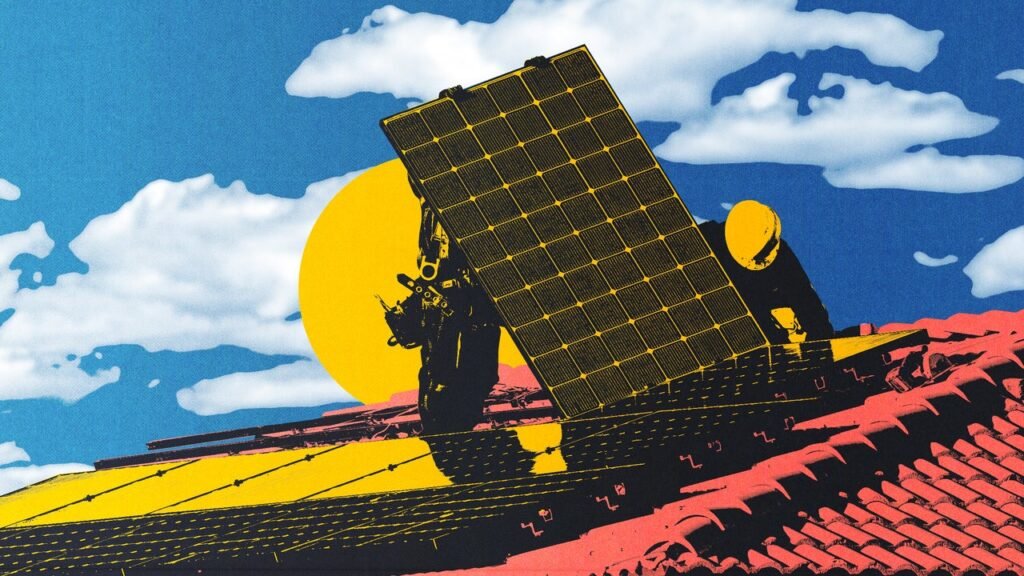
Building a large solar farm typically takes years, thanks to permitting and grid connection delays. But a startup called Resilience Energy is rolling out a faster way to add clean energy: It pays to install solar and batteries across a network of homes, then sells power back to the grid at peak moments.
Homeowners get free equipment, and their electric bills can drop by 60%-80% while they use it. At times when the grid is under the most strain, utilities can tap into the network and avoid using polluting gas “peaker” plants.
“We’re going through one of the largest energy infrastructure buildouts of our lifetime,” says Resilience Energy’s CEO, Ameet Konkar, who previously led sustainability at Airbnb. “And American homes should be part of that; the American family should benefit from that. That’s the core principle that we’ve built Resilience on.”
A new type of distributed utility
Virtual power plants, which tap into batteries and other energy tech at homes to help the grid, are gaining traction. Resilience is putting a new spin on the model. Rather than relying on homes that already have solar and batteries, it owns the equipment itself, allowing it to build out the network faster and reach many more homes. “One of the benefits of this model is that everyone qualifies, including low and moderate incomes,” Konkar says.
The company, which launched last year and is still in the pre-seed capital stage, has also started partnering with rental property owners who might not have invested in solar in the past because renters, not owners, see the financial benefits on electric bills.
As it builds lists of property owners who want to participate in an area—aggregating groups that range from 1,500 homes to 20,000 or more—the startup is negotiating contracts with utilities and customers, including tech companies, that are looking for the fastest ways to access more power.
Under a contract called a power purchase agreement, which tech companies have used for more than a decade to catalyze utility-scale solar, customers commit to buy the energy that a project produces over a certain number of years. Resilience can use the contracts to get financing for the equipment, and work with other partners to handle installation. The first contracts are in late-stage negotiation, Konkar says, and at least one is likely to be in place later this year. While interested property owners can sign up anywhere in the contiguous U.S. now, projects will roll out over time depending on where there are enough homes signed up and where power purchase agreements can be put in place.
A faster path to new power
For energy buyers, the approach isn’t designed to fully power a data center or other large project, but to cover capacity for the critical hours that the grid is under the most strain. For tech companies, there are advantages to getting power this way. First, it’s faster. Instead of waiting in line for years to get a new project connected to the grid, the model works with homes that are already on the grid. The interconnection process is simple. The cost of the power is competitive.
It’s also a way to build community support for new projects. “It’s not just, ‘Here’s $10 [million] or $20 million of a community benefit agreement,’ which is great, but if you look at the scale of the investment, really doesn’t compare,” says Konkar. “If we are doing 20,000 homes of solar and storage, that’s unlocking about $500 million of capital for those homes in that community. That’s not philanthropic, because philanthropic can’t scale to that level. It’s market priced.”
For a gigawatt-sized data center, the startup expects to provide 100-200 megawatts of capacity, which translates to 20,000 to 40,000 homes. Very quickly, it can add up to a massive deployment of solar and batteries. Tech companies aren’t the only buyers; the startup is in talks with manufacturers that have large electricity demand. Utilities will also be customers.
One of the challenges, Konkar says, is just convincing homeowners that the program isn’t too good to be true. An offer of free solar and storage, and a promise to cut energy bills, can sound hard to believe. The company is working closely with cities, counties, and community groups as it begins to recruit more homeowners. In some cases, utilities will also be the messenger. Interested homeowners can sign up on the company’s website now.