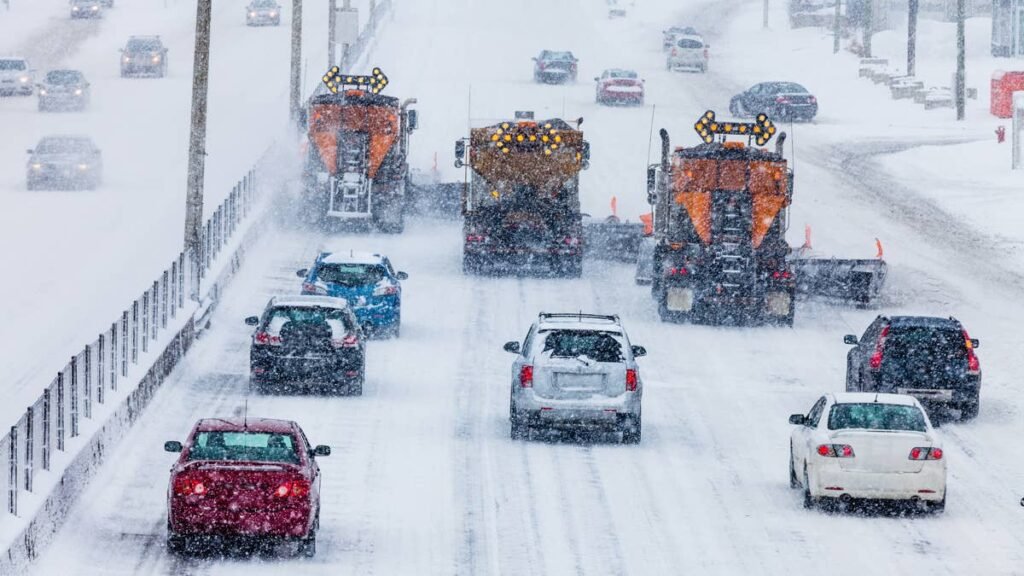
NWS Fairbanks has gusts of 70 mph forecast for the Richardson Highway on Friday and 65 on the Parks, peaking between 4 and 10 in the morning, and those are the two roads that carry traffic north out of Anchorage. Four hundred miles further north the same Bering Sea low does something different: Atigun Pass takes four to six inches of snow, a glaze of ice and temperatures in the upper 20s, under an advisory from the Fairbanks forecast office that runs to 4 p.m. AKDT Saturday and puts the whole of Saturday’s daylight driving inside it rather than after it. The snow is a narrow band with rain at both ends, so a driver running the Dalton end to end enters winter and comes out the far side in a few hours without ever changing roads.
The advisory was issued at 11:13 a.m. AKDT Thursday and covers the central Brooks Range, taking in Anaktuvuk Pass, Galbraith Lake, Atigun Pass, and the Dalton Highway from Mile Post 232 to Mile Post 322, with a trace to 0.05 inches of ice, gusts to 30 mph, and blowing snow cutting visibility to half a mile or less. The ice is the number that matters most of the three.
The Snow Band Is Narrow, And There Is Rain On Both Sides Of It
The advisory covers 90 miles of a 414-mile road, and the rest of the Dalton is not remotely wintry. At Coldfoot, Mile Post 175 and roughly 1,050 feet, the forecast is rain, a 100 percent chance of precipitation, and a high near 50 on Friday. At Deadhorse, Mile Post 414 at sea level, it is scattered showers with a high near 42 on Saturday, currently sitting in fog at 32 degrees.
Between them is Atigun Pass, Mile Post 244, which crosses the Continental Divide at 4,739 feet and is the highest year-round maintained pass in Alaska. NWS Fairbanks puts the worst conditions there, with temperatures holding in the upper 20s and 30s while the rest of the interior reaches the 40s and 50s.
A driver running the length of the Dalton on Friday leaves 50-degree rain, climbs into snow and ice, and drops back into 42-degree rain, all on the same road inside a few hours. Nothing about the pavement announces the transition. Wet asphalt at Coldfoot and wet asphalt at Chandalar Shelf look identical at 55 mph, and only one of them is about to freeze.
The Two NWS Products Do Not Agree On Where The Snow Line Sits
Snow levels start near 2,500 feet. The advisory has them rising to near 4,000 feet on Friday. The forecast discussion, issued three and a half hours later at 2:50 p.m., pushes that toward 5,000 by the afternoon, leaving solid snow only above 4,500 feet and, in the words of the forecasters on shift, “a mess of wintry mix that turns to rain in the afternoon and then back to wintry mix” everywhere between.
For a driver the disagreement resolves itself. Atigun tops out at 4,739 feet, which is above the advisory’s snow line and above the discussion’s mixed band, so the pass stays in snow under either version while the approaches on both sides cycle through rain. What does accumulate is wet and reluctant to blow, which means the surface that reads as merely damp during Friday daylight is the surface that refreezes into the advisory’s second night, and the advisory has a second night in it.
Road Crews Are Working Inside The Advisory Area
The advisory closes by telling drivers to check 511 for road conditions. Doing that turns up permanent repairs on the Dalton running from Mile Post 314.5 to 316, with single-lane traffic and 24-hour flagging operations, updated Thursday morning. That work sits inside the advisory zone, about 70 miles north of Atigun.
Single-lane means opposing traffic separated by a person holding a sign rather than by paint, on an unlit gravel highway, in blowing snow with visibility down to half a mile. As of Friday morning 511 Alaska listed no weather closures on the road, though Atigun Pass has closed for drifting snow on short notice in past seasons.
The corridor offers little to fall back on either way. The Dalton has fuel at three points across its length, no cell coverage over most of it, and no lighting anywhere.
This Is The Second Winter Product On The Road In A Week
NWS Fairbanks issued a special weather statement on August 25 covering Atigun Pass to Sagwon, forecasting one to two inches overnight Tuesday and a further one to two Wednesday night. Friday’s advisory follows three days behind it, and both follow snow events on the same stretch in June and late July.
Four Hundred Miles South, The Same Low Is A Wind Problem
The low makes landfall Friday morning near the eastern Norton Sound coast and tracks northeast, and its southern edge lands on a different mountain range entirely. NWS Fairbanks has a high wind warning for the eastern Alaska Range, covering Black Rapids, Donnelly Dome, and the Richardson Highway from Mile Post 224 to Mile Post 259, with south winds of 30 to 40 mph gusting to 70 from 1 a.m. to 10 p.m. AKDT Friday and peaking between 4 and 10 in the morning. A wind advisory covers the Parks Highway from Mile Post 237 to Mile Post 288 through Windy Pass and the Denali National Park entrance, with gusts to 65. Both products carry the same line: “Winds this strong can make driving difficult, especially for high profile vehicles.”
The Alaska Range sits roughly 400 miles south of Atigun, so none of this touches the Dalton. It does complicate any trip that starts in Anchorage and ends on the Dalton, because the Parks and the Richardson are the two roads that get you there.
The forecast discussion puts the peak gust outside the warning boundary. It has “Wind gusts up to 70 mph near Isabel Pass,” which sits at Richardson Mile Post 197.7, roughly 26 miles south of where the warning starts. Drivers treating Mile Post 224 as the edge of the problem are reading the map rather than the forecast. The timing on the Parks also moved: NWS Fairbanks cancelled the wind advisory it had already issued for Saturday and replaced it with one covering Friday, shifting the event forward by a day.
Studded Tires Are Illegal For Another 19 Days
Alaska statute prohibits studded tires on paved roads north of the 60th parallel from May 1 through September 15 inclusive, which makes September 16 the first legal day to fit them on the Dalton. Tire chains carry no such date. State regulation permits them whenever conditions warrant, which means chains are the only device that is both legal on Friday and effective at Atigun.
Everyone driving north this weekend is otherwise on all-season or winter compound rubber, and only the winter compound stays pliable at the upper 20s forecast for the pass. All-wheel drive does not substitute for either. It helps a vehicle accelerate on a slick surface and contributes nothing to braking or cornering on the refrozen film the Dalton produces overnight. Tread depth and pressure carry that load, and cold air costs roughly 1 to 2 psi for every 10 degrees the temperature drops, so a set checked in July is running low this week with nothing visibly wrong.
The rain-on-snow cycle at Atigun may also be an early look at a broader winter pattern. NOAA’s Climate Prediction Center puts a 69 percent chance on an El Niño strong enough to exceed every event on record since 1950, while noting that impacts consistent with El Niño become more likely at that magnitude without being guaranteed. That setup could increase the chances of the same rain-and-refreeze cycle on mountain passes farther south this winter.